What Is Credit Score Debugging?
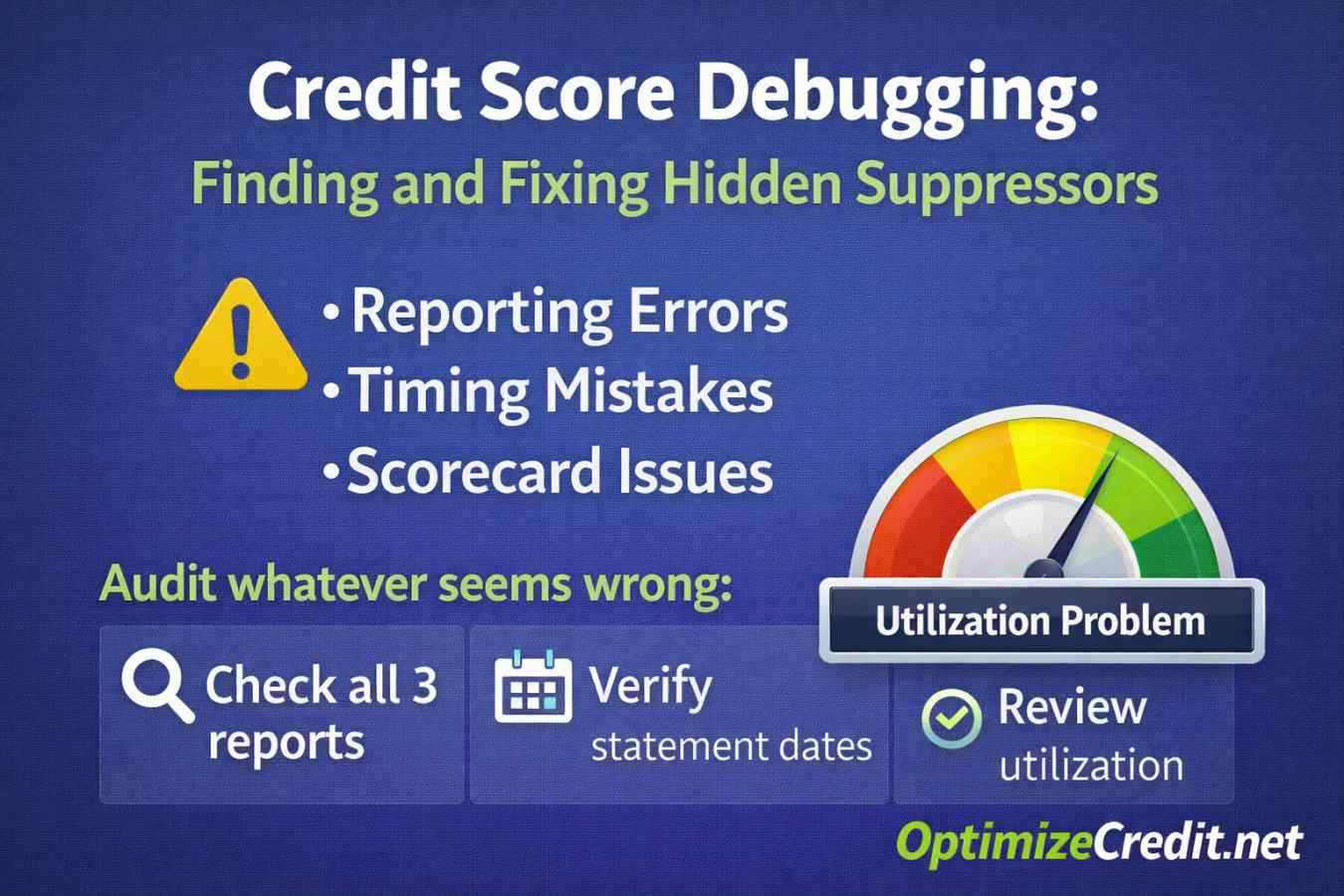
If your credit score is stuck despite "doing everything right," you likely have a hidden suppressor: a reporting glitch, a timing error, or a scorecard boundary problem. Credit score debugging is the process of auditing your three-bureau reports to find specific bottlenecks like duplicate collection entries, mid-cycle balance spikes, mixed-file errors, or thin-file weaknesses. When you treat your file like a system rather than a mystery, you can usually identify what is actually holding you back.
Credit score debugging means moving from general advice to targeted diagnosis.
Most people get told the same things:
- Pay on time
- Lower balances
- Do not apply too often
That advice is not wrong. It is just too broad. If your score is unexpectedly low, the useful question is not "how do I improve credit?" The useful question is "what specific suppressor is keeping my score from behaving the way I expect?"
That requires an audit. The optimizer automates much of this zone-by-zone analysis, but understanding the framework yourself is what separates real progress from guesswork.
Start with the Reason Codes, Not Your Feelings
Every real credit score comes with reason codes or adverse-action factors. These are the closest thing the scoring system gives you to debugging output.
If your score report or lender disclosure says:
- Balances too high relative to limits
- Proportion of balances to credit limits too high
- Too few accounts currently paid as agreed
- Length of time accounts have been established is too short
Those are not random labels. They are clues.
A lot of consumers skip this step and jump straight into action. That is how they treat the wrong problem. If the reason code says utilization is the issue, disputing an old address will not help. If the issue is a mixed file or a duplicate derogatory, paying cards down may not solve the main bottleneck.
Zone 1: Audit All Three Bureau Reports Side by Side
Pull all three reports from AnnualCreditReport.com, the federally authorized source for free bureau reports. Read them side by side.
You are looking for:
- Duplicate negatives
- Stale balances
- Missing tradelines
- Wrong personal information
- Unauthorized inquiries
- Mixed-file signs such as names, addresses, or accounts that do not belong to you
This matters because credit files are not identical across bureaus. One bureau may have the account you need. Another may be missing it. One may still show a high balance that was already paid down. One may contain a collection entry that is not being reported correctly.
If you are preparing for a major loan, bureau inconsistency can be the difference between a usable middle score and a disappointing one.
How to Dispute Errors Effectively
When you find inaccurate data, do not send a vague "this is wrong" letter. Precision matters:
- Identify exactly which data field is incorrect (balance, account status, date, ownership).
- Reference the account by number and the bureau where the error appears.
- Attach supporting documentation: payment receipts, account statements, or identity documents for mixed-file issues.
- Use the bureau's formal dispute process (online, mail, or phone) and keep a record of your submission date and confirmation.
- Follow up within 30 days. Bureaus are required to investigate within that window under the FCRA.
- If the dispute is denied and you believe the data is still wrong, escalate to the furnisher directly or file a complaint with the CFPB.
For serious issues like mixed files, paper disputes with supporting identity documents are often more effective than quick online submissions.
Why Metro 2 Matters
Most consumers never hear the phrase "Metro 2," but it is part of the real plumbing. Metro 2 is the standardized language furnishers use when they send account data to the credit bureaus. If the furnishing is wrong, incomplete, or internally inconsistent, the bureau report can be wrong in ways that a consumer might never catch at a glance.
You do not need to become a Metro 2 technician. But you should think like one. The standard mindset is:
- Is the data accurate?
- Is it complete?
- Is it verifiable?
- Is it being reported consistently across bureaus?
That framing is more useful than "my score seems unfair."
Mixed Files Are a Real Problem, Not a Minor Annoyance
A mixed file is what happens when your data and someone else's data get blended because of similar names, addresses, or identifying details. This can create some of the ugliest debugging cases because the file can look "mostly right" while still containing damaging noise.
Mixed files often are not solved by casual online clicking. Serious mixed-file problems can require paper disputes, identification documents, and a cleaner, more formal audit trail. If the issue is substantial, do not assume a fast online dispute is the full solution.
That is one reason side-by-side report review matters so much. Small inconsistencies can point to a bigger structural problem.
Zone 2: Diagnose Utilization and Balance Timing
A lot of score frustration comes from utilization, but not in the way people think.
Many borrowers believe: "I paid the card, so the score should already reflect it." That is often false because scoring reacts to what was reported, not what you remember paying yesterday. If a high balance was already captured on the statement date, the score can stay suppressed until the next reporting cycle.
That is why statement timing matters. Understanding the gap between your payment date and the bureau reporting date is critical to diagnosing utilization-based suppressors.
What Should You Check?
Check both:
- Overall revolving utilization
- Individual-card utilization
A single card at very high utilization can suppress the score even when the overall number looks decent. That is one of the most common hidden suppressors because borrowers focus on the total and miss the hot card.
What Is AZEO, and Why Does It Matter?
AZEO means "All Zero Except One."
In plain English:
- All revolving cards report zero
- One card reports a small balance
For many FICO situations, this produces a cleaner optimization pattern than having every card report a balance, and often cleaner than having every card report zero.
The key detail is that the "one" reporting card should usually show a very small balance relative to its limit, often under 1% to 9%, depending on the file. The point is not to carry debt. The point is to control the reported snapshot.
Before and After AZEO Example
| Scenario | Card A ($10K limit) | Card B ($5K limit) | Card C ($8K limit) | Overall Utilization | Typical Score Effect |
|---|---|---|---|---|---|
| Before (scattered balances) | $2,500 (25%) | $1,800 (36%) | $400 (5%) | 20.4% | Moderate suppression from Card B |
| After AZEO | $0 (0%) | $0 (0%) | $50 (0.6%) | 0.2% | Cleaner optimization pattern |
In this example, the borrower did not pay off more total debt. They restructured when and where balances reported. Card B at 36% was the hidden suppressor even though the aggregate looked moderate.
For a deeper look at how individual-card utilization creates traps, see The Utilization Trap.
AZEO is not a magic formula for every borrower forever. It is a debugging tactic, especially useful when someone is trying to identify whether utilization structure is suppressing the score.
Zone 3: Diagnose Structural Weaknesses
Sometimes the score is not stuck because of an error. It is stuck because the file structure itself is weak.
Examples:
- Thin revolving depth
- Very short average age
- Too many new accounts
- Too many recent inquiries
- Not enough strong primary tradelines
That is where people make costly mistakes. They apply for a new card, ask for a hard-pull limit increase, or add multiple new accounts at once without asking whether the cure will worsen the score in the short run.
If you are already debugging because the score is weak, a hard-pull credit limit increase request may backfire. Some issuers use soft pulls for limit increases, but some do not. If the issuer uses a hard inquiry, you can take the inquiry hit and still get denied.
That is why "request a CLI" is not universal advice. First determine whether the issuer is known for soft-pull increases. Then decide whether the potential utilization benefit is worth the risk.
Zone 4: Understand Scorecards and Why Small Changes Can Create Big Moves
A lot of consumers think a score is one giant sliding scale. In practice, score behavior often feels lumpy because files are being compared within different profile buckets.
You do not need the exact proprietary architecture to use the concept. The practical takeaway is enough: a clean thin file is not judged like a mature clean file, and a derogatory file is not judged like a non-derogatory file.
That is why one change can produce a surprising jump. It is not always because the action was huge. Sometimes it is because the action moved the file into a more favorable scoring neighborhood.
This is also why debugging is more powerful than random point-chasing. A borrower near a boundary can gain more from fixing the right suppressor than from doing three generic "good credit" actions that do not touch the real bottleneck.
Zone 5: Know When Inquiries Are Part of the Problem
Inquiries are often treated as minor. Sometimes they are. But on thin files or inquiry-sensitive profiles, they can matter more than people expect.
This is especially true when:
- The file is young
- There are already multiple recent inquiries
- The borrower is close to a lending threshold
- A lender is known to be sensitive to recent credit-seeking behavior
The mistake is not just "too many inquiries." The deeper mistake is using new applications as a debugging strategy when the file already shows inquiry stress.
Zone 6: Use the Right Fix for the Right Suppressor
Here is the simplest debugging map:
| If the Issue Is | Then Do This |
|---|---|
| Inaccurate reporting | Dispute with precision. Preserve documentation. Use formal processes when the issue is serious. |
| Utilization timing | Lower reported balances before statement close. Use AZEO if appropriate. Watch individual-card utilization, not just the total. |
| Thin-file structure | Build primary tradelines carefully. Consider whether an authorized user account helps. Do not add multiple new accounts blindly. |
| Version mismatch | Stop relying only on app scores. Identify which score family your target lender uses. |
| Threshold strategy | Aim for the specific score movement that changes your lending outcome. Do not assume every point is equally valuable. |
When Debugging Helps Most
Debugging helps most when:
- Your score seems too low for your behavior
- You are preparing for a mortgage, auto loan, or major approval
- You were denied despite an apparently decent score
- Your file has bureau inconsistencies
- You suspect utilization timing, mixed files, or score-version mismatch
When Debugging Is Not the Main Answer
Debugging is less useful when the file's core problem is obvious and severe:
- Active major derogatories
- Ongoing delinquencies
- Unresolved charge-offs
- Debt load problems that are bigger than scoring mechanics
In those cases, there may still be debugging value, but the file probably also needs a longer recovery timeline.
Get Your Personalized Credit Roadmap
Upload your credit report and our Credit Analyzer identifies exactly what is holding your score back and gives you a step-by-step 90-day plan to reach 740+.
Trusted by 500+ successful placements and excellent reviews on TrustPilot ★★★★★
Analyze My Credit Free →