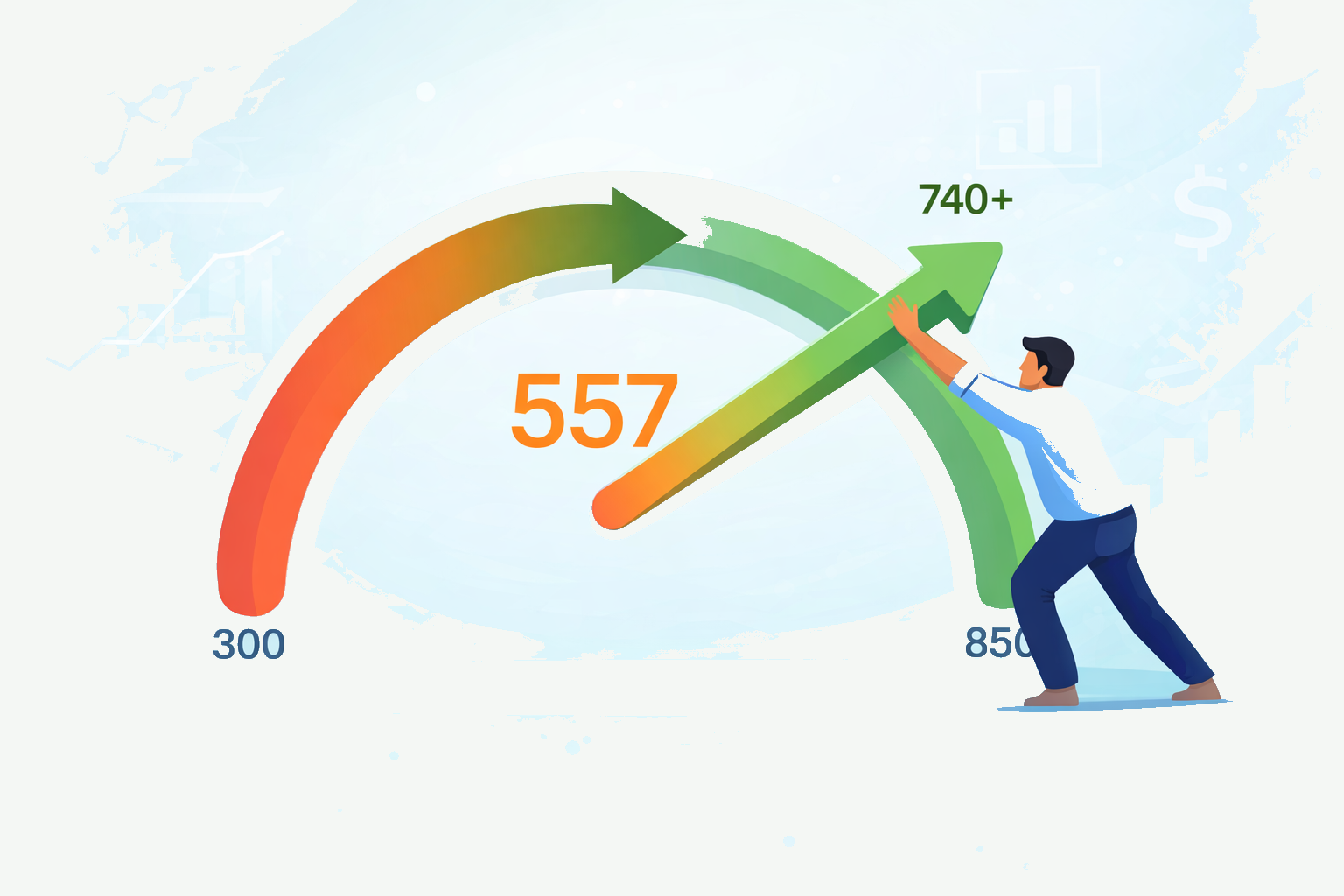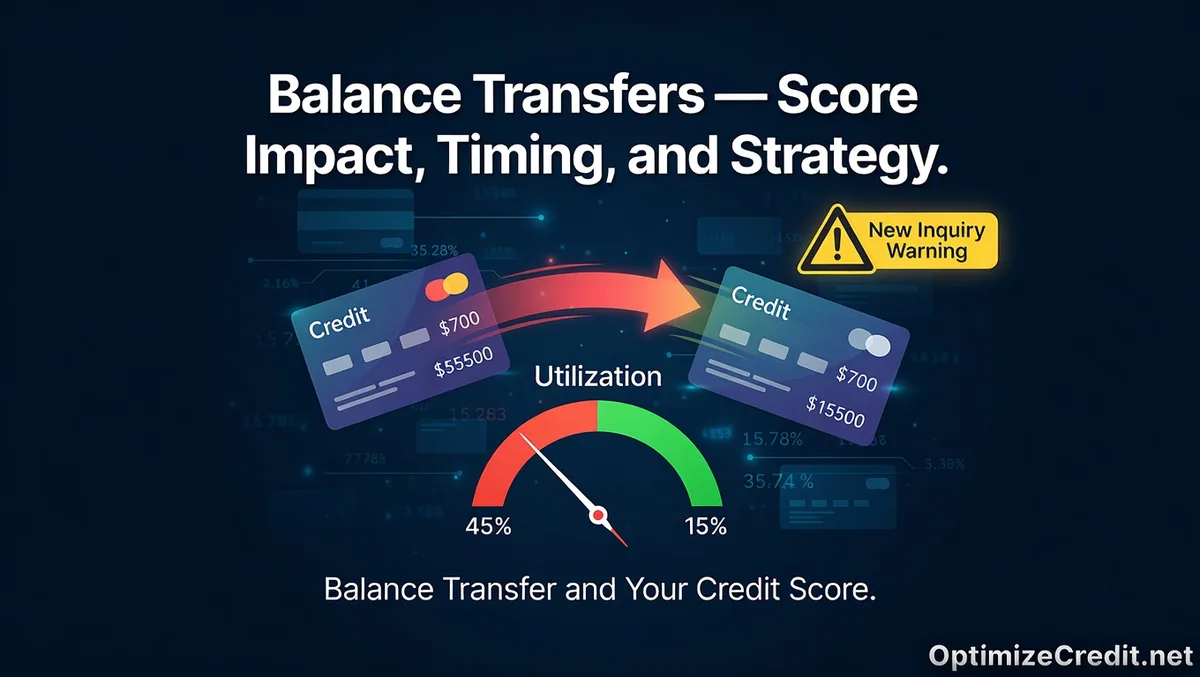
If you move $5,000 from a maxed-out card to a shiny new 0% APR offer, you may save a lot on interest and still see your score dip first. That is not a contradiction. It is how credit scoring works.
A balance transfer can be financially smart and still create a short-term scoring problem. The move may lower interest and improve utilization over time, but it can also add a hard inquiry, lower your average account age, and create a brand-new card that reports with a high balance.
The key question is not whether balance transfers are "good" or "bad." The key question is whether the transfer improves your utilization math enough to outweigh the new-credit costs.
What a balance transfer actually is
A balance transfer is a move from one credit card to another credit card, often with a promotional APR and a transfer fee. CFPB defines it that way directly. The promotional rate usually lasts for a limited time, and the issuer can still charge a fee even when the transfer APR is 0%.
That definition matters because a balance transfer is not the same as paying off cards with a personal loan.
- Balance transfer: revolving debt moved to another revolving account.
- Debt consolidation loan: revolving debt paid off with an installment loan.
Those two strategies can overlap in purpose, but not in scoring behavior. Paying off credit cards with a personal loan can reduce utilization and help your score, but installment loans are scored differently, and paying off installment debt can create a different pattern, including a temporary dip in some profiles.
Why balance transfers can help your score
The main reason is utilization.
FICO says "amounts owed" is about 30% of the score, and revolving utilization is one of the biggest moving parts in that category. myFICO explains that utilization is measured both per card and across all cards, and that lower is generally better.
Here is the basic example:
- Old card: $5,000 balance on a $5,000 limit = 100% utilization
- New card: $12,000 limit
- Transfer amount: $5,000
- Transfer fee: 3% = $150
- New card balance after transfer: $5,150
- New card utilization: about 42.9%
That is still not ideal, but it is much better than 100% on the original card. If the old card remains open at $0, your total available revolving credit also increases, which can improve aggregate utilization.
A balance transfer can also help when it consolidates multiple high-utilization cards into one much larger line. Experian gives a simple version of this math: when a new transfer card adds a meaningful amount of available credit and the old cards report low or zero balances, overall utilization can fall sharply.
There is another practical benefit: lower interest can make payoff faster. CFPB notes that balance transfers are often marketed with low or 0% promotional APRs, and that introductory rates must remain in effect for at least six months unless you are more than 60 days late. If more of your payment goes to principal instead of interest, the balance may shrink faster, and lower balances often help scores once they report.
Why balance transfers can hurt your score
A balance transfer can also create three immediate headwinds.
1. Hard inquiry
If you apply for a new card, the issuer usually makes a hard credit check. myFICO says one additional hard inquiry will usually lower FICO Scores by fewer than five points, though the effect can be larger if you stack multiple inquiries.
2. Lower average age of accounts
Opening a new card drops your average age of accounts. myFICO says this affects the length-of-credit-history category, which is about 15% of a FICO Score. On a mature file, that hit may be modest. On a thin or younger file, it can matter more.
3. A new card that may report highly utilized
The score does not care that the APR is 0%. It cares that a revolving account now reports a balance. If the new card reports near-maxed or heavily utilized, the transfer can hurt before it helps. Experian and myFICO both warn that the transfer can improve utilization only if the resulting math is actually better.
The classic trap: $5,000 transferred to a $6,000 limit
This is the most common failure case.
If you transfer $5,000 to a card with a $6,000 limit and pay a 3% fee, the starting balance becomes about $5,150. That puts the new card at roughly 85.8% utilization.
You saved on interest, but you did not create a healthy utilization profile.
That is why many borrowers are confused after a transfer. Financially, the move may still be smart. Scoring-wise, it may look like you simply moved a maxed-out problem from one tradeline to another while also adding a new account and inquiry.
There is no official published FICO cutoff that says 29.9% is fine and 30.1% is not. The safer rule is the one myFICO gives: lower is better, and very high utilization tends to hurt.
The spend-on-the-old-card trap
This is the second major failure case.
After the transfer, the old card may show a $0 balance and feel "free" again. If you start spending on that card while the new transfer card still carries the old debt, you have not solved the utilization problem. You have spread it across two cards.
Experian specifically advises people not to add to debt after a transfer and to create a budget so the new card does not become an excuse for more borrowing.
The old-card-closing trap
Many people want to close the old card for discipline. That can be understandable behaviorally, but it is often bad for scores.
Experian says closing the old card can increase utilization because you lose the credit limit from your available revolving credit. That is usually the biggest immediate scoring risk. However, closing the card does not usually erase its positive history overnight. Closed positive accounts can remain on your report and continue helping for up to 10 years, so the more precise rule is this:
- closing hurts capacity immediately
- closed positive history may still help for years
- thin files and older cards are where closure tends to sting more
That is more accurate than saying "closing instantly kills age."
Temporary reporting overlap: real risk, but not guaranteed
One reason people panic after a transfer is timing.
Lenders generally report monthly, not in real time. That means the new card may show the transferred balance before the old card updates to zero. During that window, your reports can temporarily look worse or at least confusing. Experian notes that revolving balances typically update after the billing cycle ends, which is why score changes often show up in one to two months rather than instantly.
The right way to write this risk is: temporary overlap can happen and can create underwriting noise. The wrong way is to say it will automatically wreck DTI or cause rejection. Underwriters may ask questions about new credit activity close to application, but the outcome depends on the file, the lender, and the timing.
When balance transfers usually help
| Scenario | Likely score effect | Why |
|---|---|---|
| One maxed-out card moved to a much larger-limit card | Often positive after reporting settles | Per-card and total utilization improve |
| Several high-util cards consolidated onto one large enough card | Often positive | Fewer stressed revolving accounts and better aggregate utilization |
| Transfer made well before a major loan application | More manageable | Time allows the new account to age and reporting to settle |
| Old cards stay open at $0 and are not reused | More favorable | Available credit stays high |
When balance transfers usually hurt
| Scenario | Likely score effect | Why |
|---|---|---|
| New card opens with very high utilization | Often negative at first | The new tradeline still looks stressed |
| Thin or young credit file | More fragile | Inquiry and average-age effects matter more |
| Old card gets closed | Often negative | You lose revolving capacity and utilization rises |
| Transfer happens right before mortgage, auto, or rental underwriting | Risky | New credit activity and unsettled reporting can create extra review |
A note on pre-mortgage timing
If you are close to mortgage preapproval, stability usually matters more than clever optimization.
Experian explicitly says that if you are applying for a mortgage soon or otherwise want your credit to be as strong as possible, avoid applying for new credit accounts. That applies to balance transfer cards too. A transfer might eventually help, but "eventually" is not the same thing as "before the lender pulls your file."
The practical rule
Before doing a balance transfer, answer these four questions:
- After the fee posts, what will the new card utilization be?
- What happens to your total utilization if the old cards stay open?
- Are you disciplined enough to leave the old cards at zero or near zero?
- Are you at least a few billing cycles away from any major underwriting event?
If the transfer meaningfully lowers utilization, avoids re-spending, and gives the file time to stabilize, it can help. If it simply relocates debt onto another stressed revolving account, it may save interest while still hurting the score.
For a deeper breakdown of the math behind this failure pattern, the most relevant companion is The Utilization Trap. For guidance on where your utilization should land, see the utilization sweet spot guide. You can also browse all troubleshooting guides for related topics.
You can verify what each bureau is actually showing by pulling your reports from AnnualCreditReport.com.
Get Your Personalized Credit Roadmap
Upload your credit report and our Credit Analyzer identifies what may be holding your score back and provides a step-by-step report-based improvement plan.
Analyze My Credit Free →