Troubleshooting June 26, 2026  ·  12 min read

Medical Debt and Your Credit Score — What Changed and What It Means for You

Medical debt rules changed in 2022-2023 but unpaid collections over $500 can still hurt. Learn what is removed, what remains, and how to protect your file.

Medical Debt and Your Credit Score — What Changed and What It Means for You
TLDR
Medical debt is much less damaging than it used to be, but it is not universally invisible. The three major credit bureaus now remove paid medical collections, exclude collections under $500, and enforce a one-year waiting period before unpaid medical collections can appear. However, unpaid medical collections over $500 that survive the waiting period can still show up and affect scores, especially under older models like FICO 8. VantageScore 3.0 and 4.0 ignore medical collections entirely, and FICO 9 and 10 are more forgiving than older versions. The CFPB finalized a broader ban in January 2025, but it was vacated by a federal court in July 2025. The current system rewards active file management: verify bills before paying, use the one-year window for disputes and hardship applications, and do not assume every medical collection is valid or automatically harmless. For a personalized action plan, upload your credit report to OptimizeCredit.net’s free AI analyzer.

Medical debt is one of the weirdest things in the credit system because it behaves like a collections problem without starting as a normal credit decision.

You did not swipe a card for a vacation. You went to the ER, got lab work, had a surgery, or ended up in an out-of-network billing mess. For years, the credit-reporting system often treated that unpaid bill almost like a defaulted credit card. That is no longer fully true. But it is also not true that medical debt has disappeared from credit reporting altogether.

That is the key update for 2026: medical debt is much less damaging than it used to be, but it is not universally invisible.

The biggest nationwide changes came from the three credit bureaus' 2022–2023 policy shifts:

  • paid medical collections are removed
  • medical collections under $500 are not reported
  • unpaid medical collections get a one-year waiting period before they can appear

If you want the cleanest official overview of those changes, start here: CFPB: Have medical debt? Anything already paid or under $500 should no longer be on your credit report

The three big reporting changes that matter most

Between 2022 and 2023, the nationwide credit bureaus changed how medical collections are reported. Those changes still define the practical baseline today.

ChangeWhat it means now
Paid medical collections removedOnce the collection is updated as paid or settled to a zero balance, it should no longer remain on the credit report as a medical collection tradeline
Medical collections under $500 not reportedSmall-dollar medical collections should not appear on Equifax, Experian, or TransUnion reports
One-year waiting periodNew unpaid medical collections generally should not appear until they are at least 365 days old

That changed the real consumer experience in a major way. Before those shifts, a medical bill could move into the credit-report ecosystem much faster and could continue hurting the file even after payment. Now the system gives you more time to resolve insurance errors, request financial assistance, or pay before reporting kicks in.

But those protections apply to medical collections, not every form of debt connected to healthcare. If you put a hospital bill on a normal credit card and then fall behind on the card, that is no longer being treated as protected medical debt. It is just ordinary revolving debt.

What still can appear on your report

This is the part people get wrong.

Medical debt is not "gone." What is gone are:

  • paid medical collections
  • medical collections under $500
  • medical collections younger than one year

What can still show up is an unpaid medical collection over $500 that remains unresolved after the waiting period.

That means if a valid $1,200 hospital bill is sent to collections, remains unpaid, and survives the current reporting delay, it can still show up and affect your credit.

The right mental model is:

Medical debt is now filtered more aggressively before it reaches your report. But if it clears the filter, it can still matter.

The one-year grace period is your most valuable protection

The one-year delay is not just a technical change. It is the most useful practical protection in the entire medical-debt system.

Why? Because medical billing is messy:

  • insurance claims get reprocessed
  • providers send corrected bills
  • EOBs arrive late
  • charity-care applications take time
  • balances are often disputed before they are truly final

That one-year gap gives you time to fix the bill before it becomes a credit-report problem.

The best way to use that year is not to ignore the bill. It is to create a paper trail:

  • explanation of benefits (EOB)
  • itemized statement
  • insurance correspondence
  • payment receipts
  • names and dates from every billing call
  • charity-care or hardship applications

That is how you turn the grace period into protection instead of wasted time.

The FCRA reporting period: how long can medical collections stay?

This is where a lot of articles get sloppy.

A reportable medical collection does not get to stay forever. The general Fair Credit Reporting Act limit for collections is seven years from the original delinquency date, and the statute is technically structured as seven years measured from the delinquency that led to the collection activity, with a 180-day rule built into the formal calculation.

The practical consumer version is:

A reportable medical collection can usually remain on your credit report for about seven years from the original delinquency that led to collections.

Two important clarifications:

  1. The seven-year limit is not reset just because the account is sold to a new collector.
  2. The one-year medical grace period before reporting does not erase the longer FCRA timeline if the debt eventually becomes a reportable collection.

So the one-year delay helps prevent early damage, but if the debt becomes a valid reportable collection and stays unpaid, the longer FCRA clock still matters.

How different scoring models treat medical debt

The credit report rule is only half the story. The scoring model matters too.

FICO 8

FICO 8 is stricter than newer models.

It does not have FICO 9's broader forgiveness for paid collections, and if a reportable unpaid medical collection over $500 appears, FICO 8 can still react meaningfully. myFICO says FICO 8 disregards collections with an original amount under $100, but it does not provide the same medical-debt leniency that newer FICO versions do.

That is why medical debt can still feel very real if the lender is using an older FICO model.

FICO 9 and FICO 10

FICO 9 and the FICO 10 suite are more forgiving.

myFICO says:

  • paid collections are disregarded in FICO 9 and FICO 10
  • unpaid medical collections over $500 are still considered
  • but those unpaid medical collections have less impact in FICO 9 and FICO 10 than in older FICO versions

So if the same unpaid medical collection appears in both FICO 8 and FICO 9, the FICO 9 damage may be materially smaller.

VantageScore 3.0 and 4.0

VantageScore went even further.

VantageScore has said its 3.0 and 4.0 models exclude medical collection data from the score calculation entirely. Experian also states that VantageScore 3.0 and 4.0 ignore medical collection accounts, paid or unpaid.

That is why a borrower can see a clean-looking consumer score while a lender using an older FICO model still sees risk.

If you want a fuller explanation of why the exact score model matters, understanding how to debug your credit score can help clarify which model is driving the number you see.

Recovery curves: how much does removal actually help?

This is the area where the loudest blog posts tend to overpromise.

There are two true things that have to be held together at the same time:

1. Removal can matter a lot on the right file

CFPB's research found that people experienced an average 25-point increase in credit score in the first quarter after their last medical collection was removed from the credit report. CFPB also found:

  • 21 points average increase for those with sub-$500 medical collections removed
  • 32 points average increase for those with over-$500 medical collections removed

That is a real and meaningful recovery pattern.

2. The average consumer does not always get a dramatic score jump

FICO's own 2022 analysis found that the July 2022 medical-collection changes would affect only about 3% of FICO-scorable consumers, and that less than 1% of the total scorable population would see a FICO Score 8 change greater than 20 points from those July 2022 changes alone.

That sounds contradictory, but it is not.

The clean interpretation is:

  • if the medical collection being removed is the last major derogatory item, the score effect can be substantial
  • if the file already has multiple other negatives, the removal may help less
  • if you look at the whole U.S. scored population, most people were not dramatically affected because most did not have the relevant medical tradelines in the first place

So the safe rule is:

Medical-debt removal can produce meaningful recovery, but the curve depends heavily on whether the collection was the main suppressor or just one problem among many.

If medical debt appears on your report, do not assume it is valid

A medical collection is not automatically accurate.

Before you pay it, verify it.

Start with these questions:

  • Is the balance correct?
  • Did insurance already pay part or all of it?
  • Is the account older than one year?
  • Is the original balance over $500?
  • Is it a duplicate bill?
  • Was it already paid?
  • Is it actually your account?

Medical billing error rates are not trivial, and collections can reflect:

  • bad coding
  • wrong patient responsibility
  • insurer delays
  • duplicate billing
  • stale balances after insurance adjustments

That is why the first move is verification, not surrender.

What to do if it shows up

Use this sequence.

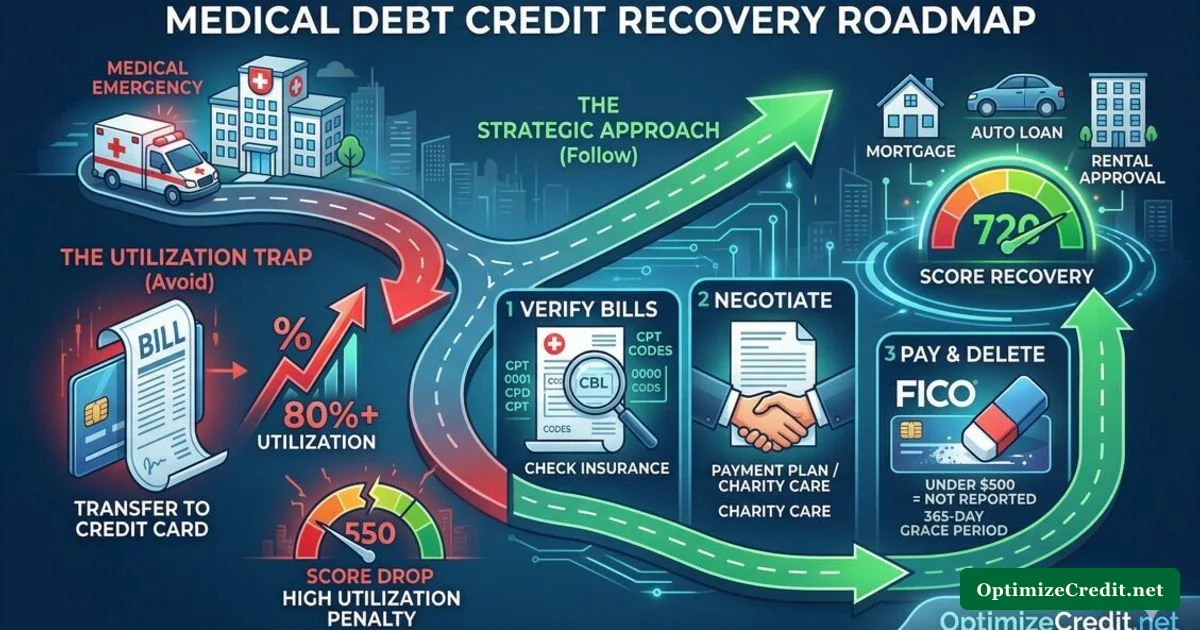
Step 1: Get the documents

Ask for:

  • an itemized bill
  • your explanation of benefits (EOB)
  • any insurance denial or adjustment notices
  • proof of payment if you already paid
  • any charity-care or hardship documents

Step 2: Check whether it is reportable under current rules

If the item is:

  • paid
  • under $500
  • younger than one year
  • inaccurately reported

then it may not belong on the report in the first place.

Step 3: Dispute inaccuracies

AnnualCreditReport explains that disputes are free. If the item is wrong, dispute it with the bureau and, when appropriate, with the furnisher. For a walkthrough of the full dispute process, see the credit dispute guide.

You are not disputing because the debt is inconvenient. You are disputing because the data is inaccurate or not reportable under current standards.

Step 4: If valid, negotiate before more damage happens

If the debt is valid, then the best move is often to resolve it before it sits and ages.

Negotiating medical debt: payment plans, charity care, hardship

Not every medical bill is wrong. Sometimes the bill is real, but the payment terms are the real problem.

This is where consumers should ask, directly and early, about:

  • payment plans
  • charity care
  • financial assistance
  • hardship discounts
  • retroactive review of income-based assistance

Many nonprofit hospitals and larger providers have formal financial-assistance policies, but they are not always obvious unless you ask for them.

A clean negotiation sequence looks like this:

  1. Request an itemized bill
  2. Confirm insurance responsibility
  3. Ask for the provider's charity-care or hardship policy
  4. If the balance is valid, ask for a payment plan
  5. Get the agreement in writing

That is often a much better move than moving the balance onto a credit card. Once you transfer medical debt onto a credit card, you lose the special medical-debt treatment and replace it with ordinary revolving debt, utilization pressure, and interest.

CFPB's ongoing efforts — and what changed legally

CFPB has treated medical debt as an active policy issue for years. In January 2025 it finalized a rule that would have broadly removed medical debt from credit reports used by lenders and blocked creditors from using medical debt in credit decisions.

But that rule does not control the current national landscape.

CFPB now states on its own site that the rule was vacated by a federal court on July 11, 2025. That means the broader 2025 federal medical-debt ban is not currently in force.

So the current real-world protections are still the bureau-side changes:

  • paid medical collections removed
  • under-$500 collections removed
  • one-year delay before unpaid medical collections can appear

That distinction matters because many consumers heard "medical debt is banned from credit reports now" and stopped checking whether an over-$500 unpaid collection was still reportable under the older framework.

What this means for you in practice

The current system is much better than it was, but it still rewards active file management. For more troubleshooting guides on fixing credit-report issues, start with the hub.

The right practical rules are:

  • do not assume medical debt is automatically harmless
  • do not assume every medical collection is valid
  • do not assume a paid or sub-$500 item should still be there
  • do assume the score impact depends heavily on the scoring model
  • do use the one-year window aggressively for insurance review, disputes, hardship, and payment planning

That is what the 2022–2023 changes actually mean in practice. They did not make medical debt disappear. They made the system more survivable for people who act early and document everything.

Free Tool

Get Your Personalized Credit Roadmap

Upload your credit report and our Credit Analyzer identifies exactly what is holding your score back and gives you a step-by-step 90-day plan to reach 740+.

Trusted by 500+ successful placements and excellent reviews on TrustPilot ★★★★★

Analyze My Credit Free →
Credit score gauge showing improvement from 557 to 740+
Frequently Asked Questions
Yes, sometimes. Unpaid medical collections over $500 that survive the one-year waiting period can still appear and affect scores, especially under stricter models like FICO 8.
Yes. Under the current bureau policies, paid medical collections should be removed from your credit reports instead of remaining as paid collection tradelines.
No. VantageScore 3.0 and 4.0 ignore medical collections, and FICO 9 and 10 are more forgiving than older FICO versions. But a reportable unpaid medical collection can still matter under older FICO models.
Generally about seven years from the original delinquency that led to the collection, subject to the FCRA timing rules. The account does not get a fresh seven years just because it is sold to a new collector.
Verify it before paying it. Check the amount, insurance responsibility, age of the account, and whether it is even reportable under the current under-$500 and one-year rules.
It finalized a rule in January 2025 that would have done that broadly, but CFPB now states that the rule was vacated by a federal court in July 2025.