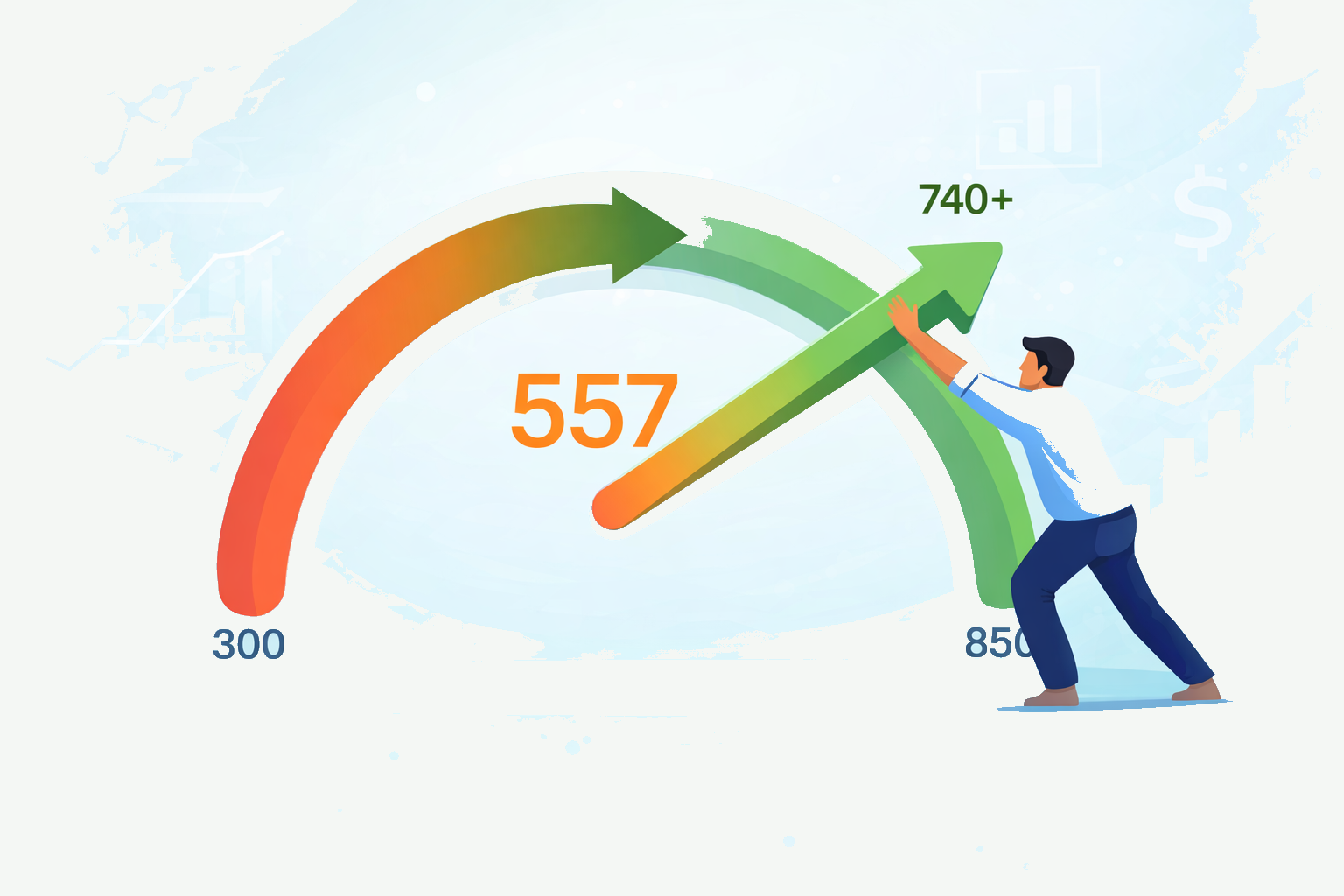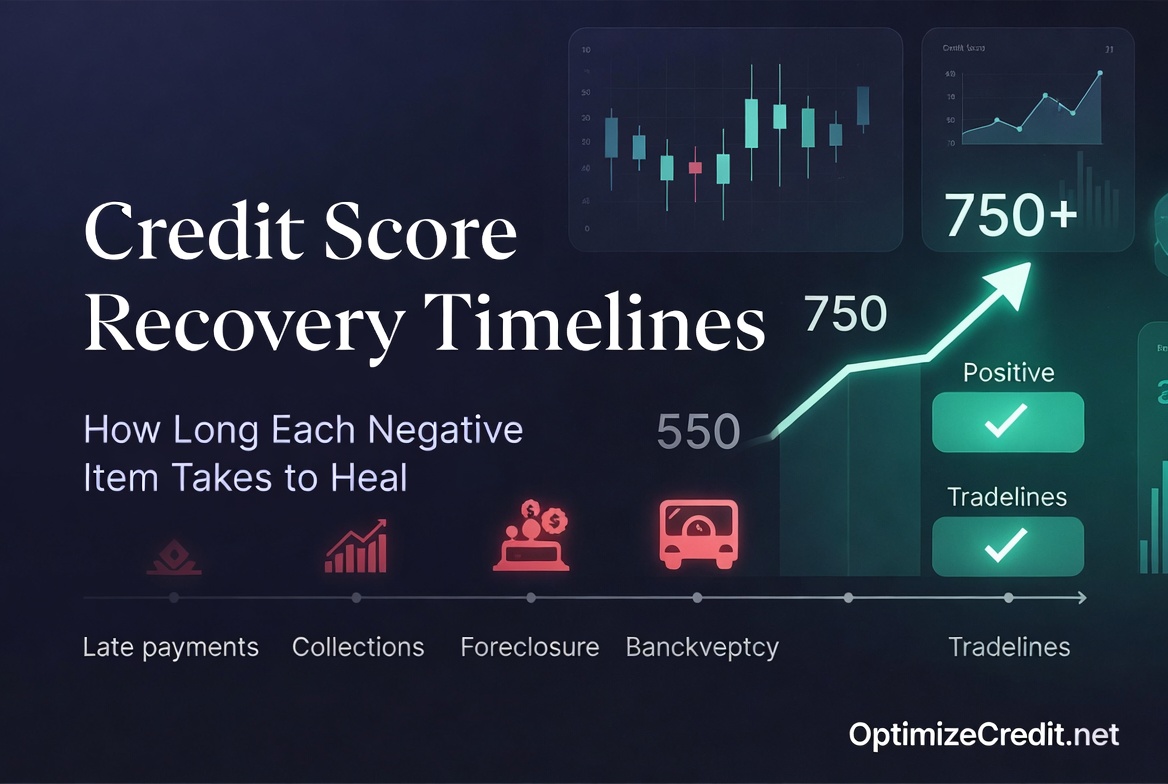
When your credit gets hit, the worst advice is also the most common: "Just wait." Time does matter. But if you are sitting at a 580 trying to get mortgage-ready, qualify for an auto loan, or stop rental denials, "wait" is not a strategy. What actually matters is understanding two separate clocks:
- How long a negative item can stay on your credit report
- How long it tends to meaningfully hurt your score
Those are not the same thing.
Most negative items stay on a credit report for about seven years. Hard inquiries usually stop affecting FICO scores after 12 months even though they remain visible for two years. Chapter 7 bankruptcy can stay for 10 years. But scoring impact is more front-loaded than reporting life. In plain English: a fresh negative usually hurts much more than an old one.
That is why recovery is not just about letting bad data age. It is about stacking positive data while the negative ages. The consumers who recover fastest are usually the ones who stop new damage, build clean payment history, keep revolving utilization low, and let the math re-weight their files month by month.
For a tactical rebuild sequence after reading this master timeline, see Credit Score Optimization: The 90-Day Plan. For an external authority summary of how long major negatives generally remain, CFPB's credit-rebuild guide is the cleanest consumer reference: How to rebuild your credit.
The master timeline table
| Negative item | Typical report life | What recovery usually feels like |
|---|---|---|
| 30/60/90-day late payment | 7 years | Usually heaviest in the first 12–18 months, then softens if everything else stays clean |
| Collection account | Usually 7 years | Stronger early, less dominant as it gets older and new positives stack |
| Charge-off | 7 years from the delinquency that led to it | Severe at first, then gradually less influential if no new negatives appear |
| Foreclosure | 7 years | One of the heavier mortgage-related negatives, especially in the early years |
| Chapter 13 bankruptcy | Commonly summarized as 7 years in consumer guidance | Long rebuild arc, but many files improve meaningfully well before the item ages off |
| Chapter 7 bankruptcy | Up to 10 years | Longest common reporting tail; rebuild still starts long before year 10 |
| Hard inquiry | 2 years visible, usually 12 months of FICO impact | Usually short-lived unless you stack many in a short window |
The table above combines CFPB's consumer reporting windows with myFICO's inquiry guidance. The "what recovery usually feels like" column is a practical rebuild pattern, not a formal scoring schedule.
First principle: report life and score life are different
This is the mistake most people make.
A late payment can stay on your report for seven years. That does not mean it hurts equally for all seven years. Credit scoring models care about recency. CFPB says recent negative information generally has more effect on your credit score than older information. That one line explains most real-world recovery behavior.
A fresh 60-day late, a fresh collection, and a five-year-old version of the same item are not treated the same way in practice, even if both are still visible on the report. The older item is still negative, but it is less predictive than a newer one. That is why score recovery usually starts long before the item drops off completely.
Late payments: common, painful, but usually the fastest to visibly fade
Late payments are the most common negative item and often the one consumers notice first. They matter because payment history is the largest part of a FICO score.
A single 30-day late can hurt sharply if the rest of the file was clean. A deeper delinquency—60 or 90 days late—usually hurts more because it signals a more serious breakdown in payment behavior. But the big practical point is this: the damage is usually most intense while the late is fresh.
Late payments can remain on your report for seven years. If you missed several payments in a row and never brought the account current, the recovery clock ties back to the original delinquency sequence, not to the day the account finally charged off or went to collections.
From a recovery standpoint, late payments often create the clearest "I can actually see progress" pattern. If the account is now current and everything else stays clean, many consumers start to feel meaningful relief in roughly the 12- to 18-month window. That is not a formal bureau milestone. It is a practical pattern that shows up because the late is no longer brand new and new clean payment history has had time to accumulate.
Collections: still serious, but less dominant as they age
Collection accounts often feel permanent because they are emotionally loud. They look bad on a report and they tend to trigger panic. But collections are still on a clock.
A collection account is generally tied to the original delinquency date of the underlying debt, and collection reporting typically remains for about seven years from that original delinquency timeline. Paying a collection may matter for underwriting optics, lender requirements, or settlement goals, but it does not usually make the reporting timeline disappear on command.
Where collections become easier to manage is the same place all negatives do: recency. A one-year-old collection on a thin file can dominate the story. A six-year-old collection on a file with two years of perfect payments, low card utilization, and no fresh negatives is usually much less powerful.
That is why passive waiting is usually weak. The better strategy is to keep the collection aging while the rest of the file becomes cleaner and more predictable.
Charge-offs: severe because they bundle delinquency plus loss
Charge-offs are heavier than ordinary lates because they usually come after a serious delinquency sequence and signal that the creditor wrote the account off as a loss. For a deeper breakdown of how charge-offs work and what options exist, see charge-offs explained.
The reporting timeline is generally seven years from the delinquency that led to the charge-off, not seven years from the day you later settled it. That distinction matters. Consumers often assume paying the balance restarts the clock or wipes the item faster. In general, it does not.
Charge-offs are a good example of why "waiting" can be technically correct but strategically weak. A charge-off that just happened can drag hard. A charge-off that is four years old on a file with low utilization, perfect current accounts, and no new applications is still negative, but it no longer defines the whole file the same way.
Foreclosure: long tail, front-loaded pain
Foreclosure information generally remains on a credit report for seven years. It is one of the heavier mortgage-related negatives because it signals default on a major installment obligation tied to housing.
Like charge-offs and collections, foreclosure pain tends to be front-loaded. The earlier years usually feel much worse because the event is both severe and recent. As time passes, the foreclosure remains part of the history, but the score impact typically weakens if the borrower keeps the rest of the file clean.
This is where many rebuilds fail emotionally. A borrower sees "7 years" and assumes no meaningful progress is possible before year seven. In reality, the scoring question is usually: what has happened since the foreclosure? If the answer is two years of clean payments, low utilization, and no new negatives, the file often behaves very differently than the raw reporting period suggests.
Bankruptcy: the reporting tail is long, but rebuild starts early
Bankruptcy is where consumer guidance gets messy because people confuse maximum reporting period with practical rebuild timeline.
Consumer credit-rebuild guides commonly summarize:
- Chapter 13 as 7 years
- Chapter 7 as 10 years
That is useful shorthand and aligns with current CFPB rebuild guidance. But the larger point is that bankruptcy does not freeze your score until the final year. Many borrowers start rebuilding immediately after discharge by adding new clean payment history and keeping balances controlled.
Chapter 7 tends to feel slower because it carries the longest common reporting tail. Chapter 13 is often described as shorter in consumer guidance and may look somewhat better to some lenders because it involved a repayment plan. But the practical scoring lesson is the same: even a bankruptcy-heavy file can improve materially in the first 12 to 24 months if the post-bankruptcy behavior is clean.
The mistake is thinking the legal reporting period is the recovery period. It is not. For a fuller walkthrough of post-bankruptcy rebuilding, see bankruptcy recovery.
Hard inquiries: the shortest problem on this list
Hard inquiries are the easiest negative item to overrate.
They remain visible on a credit report for two years, but FICO generally only counts them for 12 months. That makes them one of the shortest-lived scoring issues in a rebuild.
If you have too many recent applications, especially on a thin file, inquiry drag is real. But it is also relatively temporary compared with late payments, collections, charge-offs, or bankruptcy. This is one reason some rebuilds start to feel noticeably easier after the one-year mark. The inquiries may still be visible, but they are no longer part of the FICO scoring math.
That said, inquiries are still a signal of credit-seeking behavior to human underwriters and lenders. So even after the score penalty fades, a messy application pattern can still create manual friction.
The recovery curve: why the first 24 months usually matter most
Here is the cleanest version of the "recovery curve" idea:
- The first months after a major negative usually feel the worst.
- The next 12 to 24 months are where many rebuilds become visibly winnable.
- After that, the negative is often still present, but it is not dominating the file the same way.
The official part of this is simple: recent negative information usually matters more than older negative information. The unofficial part is where a lot of blog content goes wrong. There is no public FICO chart saying "60–70% of the damage disappears by month 24" or "you gain exactly X points in month 19." Those claims sound scientific, but they are usually not sourced.
The safer and more accurate way to explain recovery curves is this: they are front-loaded but not linear. A recent negative typically hurts much more than an older one, and the relief usually comes gradually rather than by a single magical cliff date.
Why waiting is not the best strategy
Waiting helps. It is just rarely enough on its own.
The strongest recoveries usually come from positive stacking while the negative ages. That means improving the factors you still control:
- On-time payments: every month of clean history helps dilute the old problem.
- Low revolving utilization: this is one of the fastest levers because it can change on the next reporting cycle.
- Healthy mix: if you already have both revolving and installment accounts, keeping them stable helps round out the file.
- Fewer unnecessary inquiries: stop creating fresh drag while older drag is fading.
This is where many consumers miss the math. A four-year-old charge-off by itself is one problem. A four-year-old charge-off plus 80% card utilization plus three new hard inquiries plus one recent late is a totally different problem. The goal is not just to let the old item age. The goal is to stop feeding the file fresh signs of risk.
The tipping point: when positives start to outweigh the old damage
Consumers often describe a point—usually somewhere around month 18 to 24 after a major negative—when the file finally starts behaving more like a "recovering" profile than a "damaged" one.
That is a useful idea, but it needs careful wording. It is not a formal bureau milestone. It is a practical tipping point that often happens when three things come together:
- The negative is no longer fresh
- Hard inquiries from the rebuild phase may already be outside the 12-month FICO window
- You now have a year or two of clean recent history and lower utilization on top of the old event
That is why month 18 to 24 is a helpful reference range, not a promise. Some files turn earlier. Some take longer. A thin file with one old collection may recover faster than a thick file with a bankruptcy plus maxed-out cards. But as a rebuild pattern, the 18- to 24-month range is where many files start to feel materially less pinned down.
How to read your own recovery clock correctly
If you are rebuilding, do not track only the score. Track the report.
You want to know:
- what the negative item actually is,
- how it is dated,
- whether it is being reported accurately,
- whether there are multiple negatives stacking together,
- and whether your new positive behavior is actually showing up.
Use your reports to separate "still visible" from "still hurting heavily." For inquiries, those are two different clocks. For late payments, charge-offs, and collections, the original delinquency date matters more than the date you paid something later. For bankruptcy and foreclosure, the reporting tail may be long, but the score can still improve well before the item ages off.
That is how rebuilds become predictable instead of emotional. For more recovery and repair walkthroughs, browse the full troubleshooting hub.
Bottom line
Credit score recovery is not magic and it is not purely patience. It is time plus clean new data.
Most negatives remain visible for years. But their scoring power usually fades as they get older, especially if you stop adding new damage and start stacking positives. That is why the best recovery strategy is not to stare at the old negative and hope. It is to make the rest of the file increasingly boring, current, and low-risk while the clock runs.
Get Your Personalized Credit Roadmap
Upload your credit report and our Credit Analyzer identifies what may be affecting your score and provides a step-by-step, report-based action plan.
Analyze My Credit Free →