If you are 90 days away from a mortgage application, an auto loan, or a competitive apartment screening, you still have time to improve the file. Not enough time to erase every serious derogatory. But enough time to fix reporting errors, lower revolving utilization, verify what the bureaus are actually showing, and stop the self-inflicted mistakes that wreck approvals at the finish line.
That is the point of a 90-day plan. It is not a "hack your score" plan. It is a sequencing plan.
The file you bring into underwriting is a moving target. Credit card balances report on statement cycles, disputes run on statutory clocks, and new tradelines or authorized-user accounts do not help the second you think about them. A 90-day window gives you enough room for one diagnostic pass, one action cycle, and one verification cycle before the real lender, dealer, or property manager pulls the report.
For the exact timing difference between when you pay and when the bureaus actually see the change, see Statement Date vs Bureau Update.
Why 90 days is enough for meaningful change
Ninety days is long enough for the fastest score levers to move:
- incorrect items can be disputed and investigated
- high credit card utilization can be paid down and re-reported
- a soft-pull credit limit increase may reduce utilization further
- a thin file can sometimes be strengthened with a correctly chosen authorized-user tradeline
- the final 30 days can stay quiet so no new inquiry or account blows up the work
It is also short enough that you should not waste it on low-probability tactics or vanity moves. If your real problem is a recent bankruptcy, a fresh 60-day late, or a valid charge-off, a 90-day plan is mainly about damage control and presentation. If your problem is 76% utilization, stale balances, a duplicate collection, or a file that is just too thin, 90 days can matter a lot.
The critical idea is that lenders do not score your intentions. They score what is on the report when they pull.
Before you start: optimize for the purchase, not the app score
The first mistake people make is optimizing for a dashboard number instead of the actual transaction.
A mortgage file usually needs the most discipline. Timing, middle score, dispute status, and inquiry behavior all matter. An auto loan file is often more tolerant if income and prior auto history are solid, but recent credit-seeking and high utilization still hurt pricing. Apartment screening is often simpler, but recent collections, unstable identity information, or a noisy file can still cause a denial.
That means your 90-day plan should be built around the purchase type:
| Goal | First things that matter |
|---|---|
| Mortgage | Utilization, dispute status, inquiry discipline, lowest/middle score readiness |
| Auto loan | Utilization, recent inquiries, recent lates, stable trade lines |
| Apartment | Collections, identity consistency, recent negatives, overall file cleanliness |
This is not because the scoring models are identical. It is because the decision criteria are not identical.
Days 1-7: pull all three reports and diagnose the file
The first week is not for "fixing." It is for getting the file out of guesswork.
Pull all three reports from AnnualCreditReport.com and compare them line by line. Do not rely on one consumer app, one bureau, or one score monitoring dashboard. Your plan is only as good as the raw data you are looking at.
During this first week, run four diagnostics.
1. Measure aggregate and per-card utilization
This is usually the highest-leverage short-term variable.
Write down:
- total revolving balances
- total revolving limits
- utilization on each individual card
- number of cards reporting balances
One maxed-out card can hurt even if total utilization looks acceptable. Likewise, a file with every card carrying a balance can underperform a file with the same total balance spread more cleanly.
2. Separate real errors from real negatives
Not everything ugly on a report is wrong. Some of it is just bad but accurate.
Look for:
- duplicate collections
- wrong balances
- wrong account status
- obsolete addresses or identity mismatches
- accounts that are not yours
- inquiries you did not authorize
If an item is accurate, do not build the next 80 days around fantasy disputes. If it is inaccurate, document it immediately.
3. Identify thin-file gaps
If the file has very few open accounts, limited age, or almost no installment history, the problem may be depth rather than damage. Thin files require different tactics than overutilized files.
4. Count recent hard inquiries and recent openings
This tells you how noisy the file already is. If you already have several recent inquiries or a very young new account, the last thing you need is another "helpful" credit move.
At the end of week one, put the file into one of these buckets:
- utilization problem
- reporting error problem
- thin-file problem
- derogatory problem
- mixed problem
That classification determines everything that follows.
Days 7-30: dispute real errors, pay down high cards, and ask for soft-pull limit increases
This is the highest-velocity phase of the plan.
Dispute only what is actually wrong
If you found real errors in week one, dispute them now. Do it early enough that the investigation has time to finish before your final pull.
That means:
- identify the exact item
- explain what is inaccurate
- provide supporting documents
- track each dispute carefully
Do not turn the file into a dispute carnival. A clean dispute strategy is narrow and evidence-based.
Pay down the worst utilization first
If cash is limited, do not spread it evenly across every card. Hit the worst cards first — especially those at or near maxed-out territory.
A good operating sequence is:
- bring the ugliest card down first
- reduce the number of cards reporting significant balances
- lower aggregate utilization after the worst individual cards are fixed
This is where most short-term score movement is usually created.
Request a credit limit increase only if it is a soft pull
A CLI can help because utilization is balances divided by limits. But it is only worth it if the issuer does not hard-pull your credit.
Ask first. If the issuer says it requires a hard inquiry, skip it in most pre-purchase windows.
Lock in operational discipline
This is boring but critical:
- turn on autopay for at least the minimum
- stop carrying cards for "just one big purchase"
- stop moving balances around randomly
- stop letting due dates and statement dates surprise you
A 90-day plan gets ruined by sloppy operations more often than by complicated credit law.
Days 30-60: verify reporting, add an AU only if it actually fits, and re-check dispute outcomes
By this point, the first changes should be reaching the reports.
This is the month where you stop assuming and start verifying.
Verify that the utilization actually updated
Did the lower balances really show up? Did every bureau update? Did one card miss the reporting cycle because you paid too late relative to the statement close?
The answer matters because a plan that looked smart on paper may still be one cycle behind in practice.
Review dispute results carefully
If a real error was corrected, great. If not, look at the result and decide whether a second-round dispute makes sense. Not every unresolved dispute should be chased inside a 90-day purchase window. Focus on the items that are both wrong and material.
Add an authorized user only if the file is truly thin or under-aged
This is where AU can make sense — but only conditionally.
A good AU candidate usually has:
- long account age
- perfect payment history
- low utilization
- issuer that actually reports AUs
- a file that needs age or depth support
A bad AU candidate is:
- a card with high utilization
- a card with late history
- a file already full of primary trade lines
- a last-minute attempt to overpower a dirty file with one borrowed account
An AU tradeline can help, especially on a thin or young file, but it is support, not magic.
Days 60-90: fine-tune the balances, verify the file, and go quiet
The final 30 days are the quiet zone.
This is where a lot of people sabotage themselves by getting impatient.
Fine-tune the utilization
The goal is not necessarily "everything at zero." The goal is a clean, stable, low-utilization file that looks controlled when pulled.
If one card needs to report a small balance for utilization optimization, this is the window to control that. But the main idea is simpler: keep utilization low, keep the file stable, and do not let balances creep back up.
Verify every bureau again
By now you should know:
- whether dispute changes landed
- whether AU reporting landed, if used
- whether the card balances are showing as intended
- whether any surprise inquiry or update appeared
If the reports still do not match the intended plan by day 75 or 80, you are not ready just because the calendar says you are.
Go dark on new credit activity
No new accounts. No co-signing. No store cards. No "just checking" financing. No casual personal-loan shopping. No mobile-carrier hard pull if it can wait.
The final 30 days should be about preservation, not experimentation.
What not to do during the 90-day plan
These are the most common self-inflicted mistakes.
Do not open new accounts
New accounts can reduce average age, add inquiry noise, and make the file less stable before a major purchase.
Do not close existing cards
Closing a card can reduce available revolving credit and make utilization worse right when you are trying to improve it.
Do not co-sign for anyone
Even if they pay perfectly, the debt is now connected to your profile and can complicate underwriting.
Do not assume a paid balance changed your score immediately
The score usually changes when the new balance reports, not when the payment leaves your bank account.
Do not mistake an app score for purchase readiness
Mortgage, auto, and rental screening do not all use the same score version or the same logic.
How to customize the plan for the purchase type
Mortgage
Mortgage optimization is the strictest version of this plan.
Priorities:
- keep disputes targeted and clean
- keep utilization very low
- avoid all new applications
- watch the lowest and middle bureau profile carefully
- avoid any move that changes the file structurally late in the process
Mortgage files punish noise.
Auto loan
Auto lenders care heavily about recent payment behavior, utilization, and whether the file looks desperate for credit.
Priorities:
- pay down revolving balances
- avoid stacking inquiries from unrelated products
- keep the file stable
- make sure previous auto history, if any, is clean
Apartment
Rental screening is often less precision-based than mortgage underwriting, but it still hates recent collections, identity inconsistencies, and chaotic recent credit behavior.
Priorities:
- clean up obvious report errors
- lower utilization if high
- address recent collections if truly inaccurate or duplicative
- avoid unnecessary new applications
A simple 90-day execution table
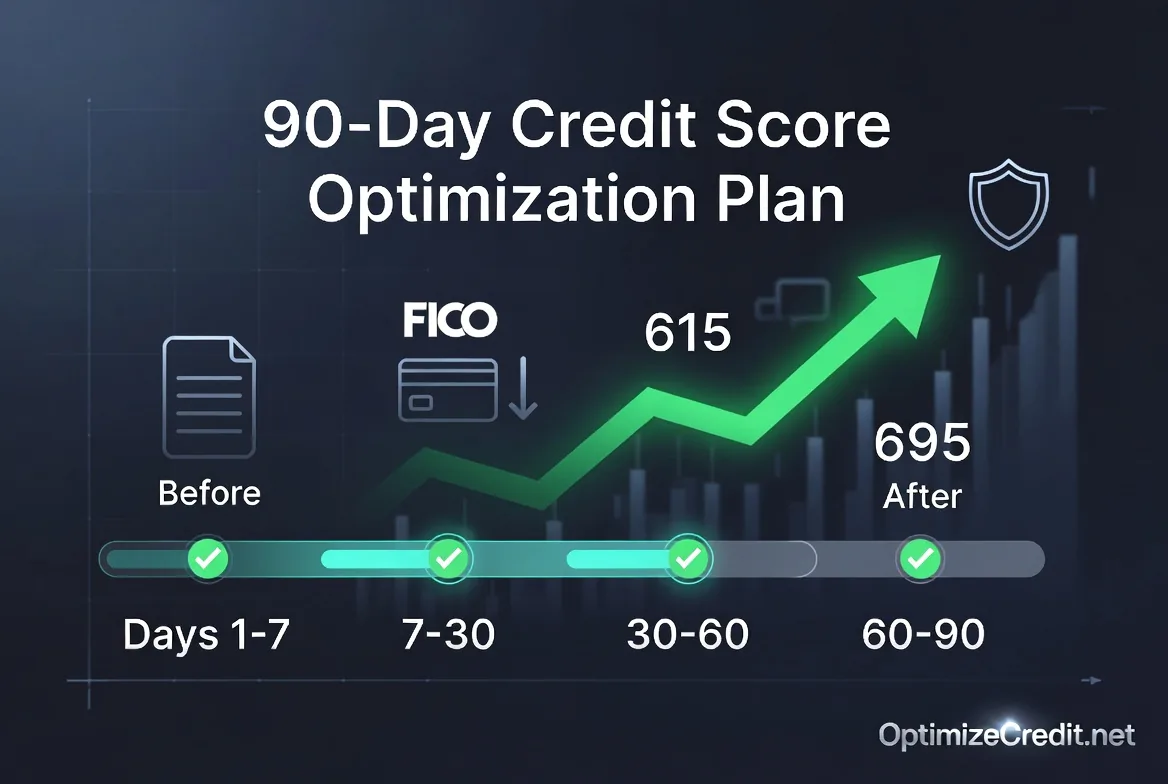
| Time window | Main actions | What you are trying to accomplish |
|---|---|---|
| Days 1-7 | Pull all 3 reports, diagnose utilization, identify errors, count inquiries, classify the file | Stop guessing |
| Days 7-30 | Dispute real errors, pay down highest-util cards, request soft-pull CLI if appropriate | Create the biggest early score movement |
| Days 30-60 | Verify reporting, review disputes, add AU only if the file truly needs age/depth support | Stabilize the changes |
| Days 60-90 | Fine-tune utilization, verify every bureau, avoid new credit activity | Arrive with a clean, quiet pull-ready file |
The real goal: optimization sequencing, not credit theatrics
The biggest strength of a 90-day plan is not that it gives you time to do "more." It gives you time to do things in the right order.
That order matters:
- Diagnose the actual file
- Fix what is wrong
- Lower what is high
- Verify what reported
- Stop touching the file
That is why 90 days works better than frantic last-minute credit moves. It respects the reporting cycle, the dispute cycle, and the way lenders actually pull and evaluate a file.
Bottom line
A 90-day pre-purchase plan works because it aligns with the real mechanics of credit reporting.
It gives you enough time to:
- find errors
- lower utilization
- verify reporting
- support a thin file if needed
- avoid a last-minute self-inflicted inquiry or new account
It does not guarantee a specific point gain. It does put you in a much better position to walk into a mortgage, auto, or apartment application with a cleaner, quieter, and more lender-ready file.
Back to the Troubleshooting hub for more file-level fixes, or see Credit Score Debugging, The Utilization Trap, and The Last-Mile Problem for related deep dives.
Get Your Personalized Credit Roadmap
Upload your credit report and our Credit Analyzer identifies what may be holding your score back and provides a step-by-step report-based improvement plan.
Analyze My Credit Free →