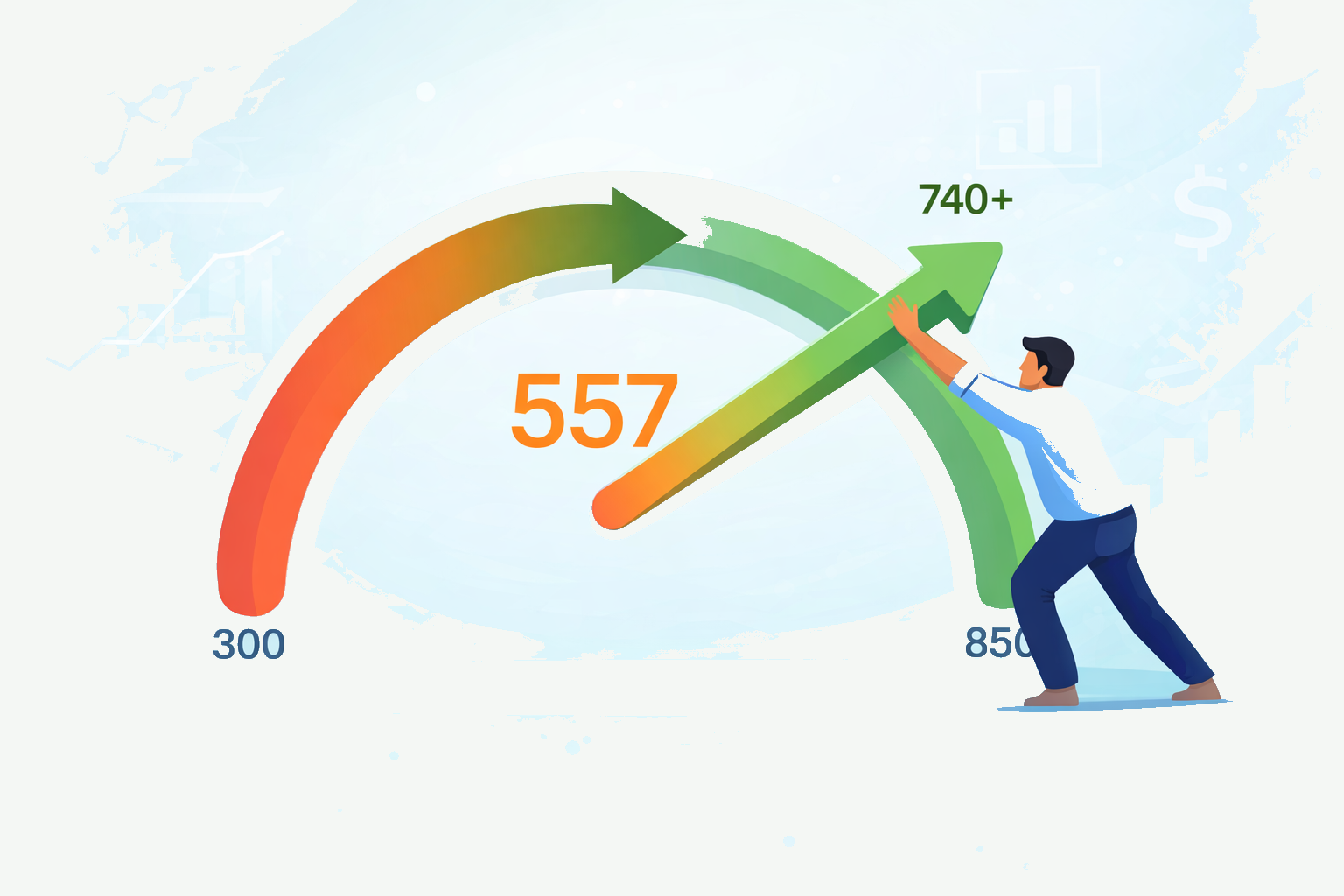
For loan officers, mortgage brokers, and finance managers, a bad credit pull is not just a minor annoyance. It can cost the client points, trigger the wrong expectations, and push a borderline file into a longer and more expensive path than necessary. The operational goal of pre-screening is simple: do not spend a hard pull until you know whether the file is application-ready now, or whether it needs 30, 60, or 90+ days of work first.
A strong pre-screen is not a full underwrite. It is a focused diagnostic. You are checking whether the borrower's actual credit structure matches the target program, whether any hidden derogatory or dispute issues will break AUS logic, and whether the score is being suppressed by fast-moving variables like utilization rather than slow-moving variables like recent serious derogatory events.
The payoff is real. Better pre-screening saves time, reduces wasted hard pulls, improves lock discipline, and keeps borrowers from applying too early with the wrong score model, the wrong bureau assumptions, or unresolved red flags.
Why pre-screening matters before the application
Borrowers often arrive with the wrong score in mind. They may be looking at a consumer score from a bank app or a monitoring platform, while mortgage lending still typically relies on the classic mortgage FICO versions used in tri-merge reporting. For conforming mortgage credit reports, Fannie Mae still requires lenders to obtain classic mortgage FICO scores from all three repositories when ordering a three-file merged report. That alone is enough reason to pre-screen carefully before moving into full application mode.
Pre-screening also protects the borrower from unnecessary inquiry damage. A single inquiry usually has little impact, and mortgage or auto rate-shopping inquiries are generally treated as a single inquiry if they occur within the scoring model's shopping window. But a file that is pulled too early can still suffer avoidable stress if the borrower ends up applying repeatedly across channels before the real credit issues are diagnosed.
Operationally, the best pre-screen answers three questions:
- Is the borrower in the right product lane?
- Is the score being dragged down by something that can move in one cycle?
- Are there hidden deal-killers that will surface after AUS or manual review?
The 5-point pre-screen framework
1) Confirm the actual score environment
Start with the score model that matters for the loan type.
For mortgage files, that usually means the classic mortgage FICO versions used in the tri-merge report:
- Equifax Beacon 5.0 / FICO 5
- Experian Fair Isaac Risk Model v2 / FICO 2
- TransUnion FICO Risk Score Classic 04 / FICO 4
The borrower's consumer-facing score may be directionally useful, but it is not enough for program screening. A clean pre-screen records all three repository scores, identifies the representative or median mortgage score for the borrower, and flags any bureau that is materially weaker than the others.
A large spread between bureaus is a diagnostic clue. It often points to bureau-specific collections, stale utilization, an active dispute, or a reporting error that has to be addressed before the file is truly ready.
2) Run a derogatory scan before you talk product fit
Do not start with rate or payment talk. Start with derogatories.
A fast derogatory scan should review:
- recent 30/60/90-day late payments
- collections and whether they are recent, medical, or non-medical
- charge-offs
- bankruptcy, foreclosure, deed-in-lieu, short sale, or modification timing
- active disputes on derogatory tradelines
- federal debt issues where program rules care
Recency matters as much as severity. A four-year-old isolated late is very different from a 30-day late from two months ago. Fresh major derogatory events are not 30-day optimization files; they are seasoning files.
Disputes matter too. On FHA, disputed derogatory accounts with an aggregate balance of $1,000 or more can trigger a manual downgrade, subject to HUD's exclusions such as many medical disputes and certain identity-theft situations. On Fannie DU files, if the approval depends on excluding disputed tradelines, the lender must investigate those disputes, and a file can lose DU deliverability if the borrower is responsible for accurate disputed debt.
3) Measure utilization with real math
For most borderline files, utilization is the fastest scoring lever.
A professional pre-screen should calculate:
- aggregate revolving utilization
- per-card utilization
- number of cards reporting balances
- whether one card is maxed out even if total utilization looks acceptable
- whether the borrower can pay before the next statement cut
This is where a lot of deals are rescued. A borrower with clean history and 75% utilization is very different from a borrower with clean history and 12% utilization. The first may be a 30-day file if cash is available to pay balances down before reporting. The second may already be ready.
Example:
- Card A: $5,000 limit, $4,000 balance = 80%
- Card B: $7,000 limit, $5,600 balance = 80%
- Card C: $8,000 limit, $6,400 balance = 80%
Total limits = $20,000
Total balances = $16,000
Aggregate utilization = 80%
If the borrower pays balances down to $2,000 total before the cards report, aggregate utilization falls to 10%. That kind of change can materially improve mortgage scores once the updated balances hit the bureaus. The timing matters: most lenders report after the statement cycle closes, so the pre-screen should always note statement dates, not just payment dates.
4) Check tradeline depth, not just the top-line score
A 660 built on seasoned primary accounts is not the same as a 660 built on a thin file or heavy authorized-user dependence.
Your pre-screen should evaluate:
- number of open and closed tradelines
- age of oldest account
- average age of accounts
- whether the borrower has primary revolving and installment history
- whether the file is thick enough for the target channel
- whether AU accounts are doing too much of the score-building work
This matters even more on lower-score files and on manual or overlay-heavy lanes. USDA guidance is especially explicit here: when the credit score is below 640, or when there is one or no usable score, USDA reviews the file for indicators of unacceptable credit rather than treating the score alone as sufficient. Thin files often become documentation-heavy files.
Authorized-user accounts deserve their own scrutiny. Fannie Mae says DU takes authorized-user tradelines into account, but the lender must review them to make sure they are an accurate reflection of the borrower's credit history. For manually underwritten loans, authorized-user tradelines generally cannot be relied on unless they fall within specific exceptions, such as spouse or co-borrower accounts or documented sole-payment history by the borrower.
5) Review inquiries and new-credit velocity
Inquiry count by itself is not the whole story. The real question is what those inquiries produced.
A clean pre-screen checks:
- hard inquiries in the last 12 months
- whether those inquiries were mortgage/auto rate-shopping or unrelated credit-seeking
- any recently opened debt not yet fully reflected in liabilities
- undisclosed debt that may raise DTI or change AUS findings
This is where many files break late. The credit report may look acceptable at first glance, but the borrower has a brand-new personal loan, store card, or auto note that has not yet fully settled into the underwriting picture. USDA guidance explicitly warns lenders to manually enter new obligations and re-evaluate the file if debt changes after submission.
Threshold mapping: sort the file into the likely lane
The table below is a practical pre-screening map, not a substitute for lender overlays.
| Program | Practical screening view | Key caution before application |
|---|---|---|
| FHA | 580+ is the cleanest starting point because maximum financing still centers on 580 for 3.5% down, while 500-579 typically requires 10% down and stronger manual treatment. | Check disputed derogatories, recent major lates, collections handling, and lender overlays. |
| Conventional conforming | Do not rely on the old "620 always" shortcut. Fannie DU no longer requires a minimum third-party score, but manual underwrites still publish minimum score rules, and overlays remain common. | Confirm AUS path, MI overlay, reserves, disputed tradelines, and pricing impact. |
| VA | VA itself does not set a minimum credit score, but most lenders do. In practice, many shops still screen in the high-500s to low-600s depending on channel. | Overlay, residual income, recent lates, and total risk picture matter more than a single folklore cutoff. |
| USDA | USDA does not use one universal minimum credit score, but 640 remains an important operational benchmark because below 640 the file receives a deeper unacceptable-credit review. | Verify GUS findings, score validity, federal debt status, and manual-underwrite complexity. |
| Jumbo | Treat jumbo as investor-specific from the start. There is no single national minimum. | Score threshold, reserves, liquidity, inquiry activity, and AU dependence are all under heavier scrutiny. |
This is where many blog drafts get sloppy. "Conventional minimum 620" is still common shorthand, but it is no longer precise enough for professional use because Fannie's DU rules changed. The safer and more useful operational approach is to treat 620 as a common screen in many lender channels, not as a universal agency truth.
Red flags that justify stopping the file
Recent collections or charge-offs
Collections are not one-size-fits-all. Program treatment differs, and newer medical-debt reporting changes have reduced the impact of some medical collections. But fresh non-medical collections, recent charge-offs, or unresolved repayment issues remain major screening events.
Active disputes
Disputes are one of the most mismanaged parts of pre-qualification. They can suppress or distort the score picture, especially on derogatory accounts. FHA and Fannie both have dispute-related rules that can change eligibility, downgrade the file, or require investigation.
Questionable authorized-user accounts
If AU tradelines are carrying too much of the file, especially where there is little primary credit depth, the loan may look stronger in the raw score than it really is in underwriting review.
Thin-file weakness
A borrower may have an acceptable score yet still lack the depth needed for a clean approval path. Thin files often require more documentation, more seasoning, or a different product lane.
Timeline estimation: 30 / 60 / 90+ days
A useful pre-screen ends with a timeline, not just a diagnosis.
30-day files
Usually these are utilization or reporting-cycle files:
- high revolving utilization
- stale reported balances
- small balance corrections already capable of documentation
- otherwise clean payment history
These are the classic "pay down before statement cut, re-check after update" files.
60-day files
Usually these involve moderate complexity:
- disputes that need to be resolved correctly
- small collection treatment issues
- recent new-credit activity that needs to stabilize
- files where AU reliance or thin depth needs deeper review
These often need a full reporting cycle plus documentation cleanup.
90+ day files
These are not quick-score files. They usually involve:
- fresh serious derogatory events
- repeated recent late payments
- thin primary depth with no fast fix
- bankruptcy / foreclosure seasoning issues
- manual-underwrite complexity
- unstable recent borrowing behavior
The most expensive mistake a professional can make is treating a 90-day file like a 30-day file just to keep the borrower emotionally engaged.
Rapid rescore: what it is, when to use it, and what documentation matters
Rapid rescore is not credit repair. It is an expedited process a lender may use to update credit report information more quickly than the normal reporting cycle after a verifiable positive change or a documented correction.
Equifax says rapid rescoring typically takes three to five business days, and TransUnion says lenders may use it when a borrower is close to a credit requirement and recently made a positive credit move that has not yet updated through normal reporting. That makes rapid rescore most appropriate when:
- the borrower is already in an active mortgage process
- the score is close to an approval or pricing threshold
- balances have already been paid down or an error has already been corrected
- the issue is timing, not deep credit weakness
Typical documentation includes:
- updated account statements
- payoff letters
- proof of payment
- creditor letters reflecting the new balance or corrected status
The key rule is discipline: use rapid rescore to accelerate a real update, not to gamble on a speculative improvement. It does not remove accurate late payments just because the file needs help. For a deeper workflow discussion, see The Broker's Guide to Rapid Rescoring.
Putting the checklist into workflow
- Gather soft-pull or borrower-supplied preliminary credit data.
- Run the five-point screen.
- Sort the file into ready now, 30 days, 60 days, or 90+ days.
- Identify whether the limiting factor is utilization, derogatory timing, tradeline depth, disputes, or new debt.
- Only then decide whether the borrower is ready for the official application pull.
That is the operational difference between a file that glides through underwriting and one that keeps boomeranging back with preventable conditions.
For more professional credit strategy resources, explore our full guide library.
External authority reference: AnnualCreditReport.com
Get Your Personalized Credit Roadmap
Upload your credit report and our Credit Analyzer identifies what may be holding your score back and provides a step-by-step report-based improvement plan.
Analyze My Credit Free →