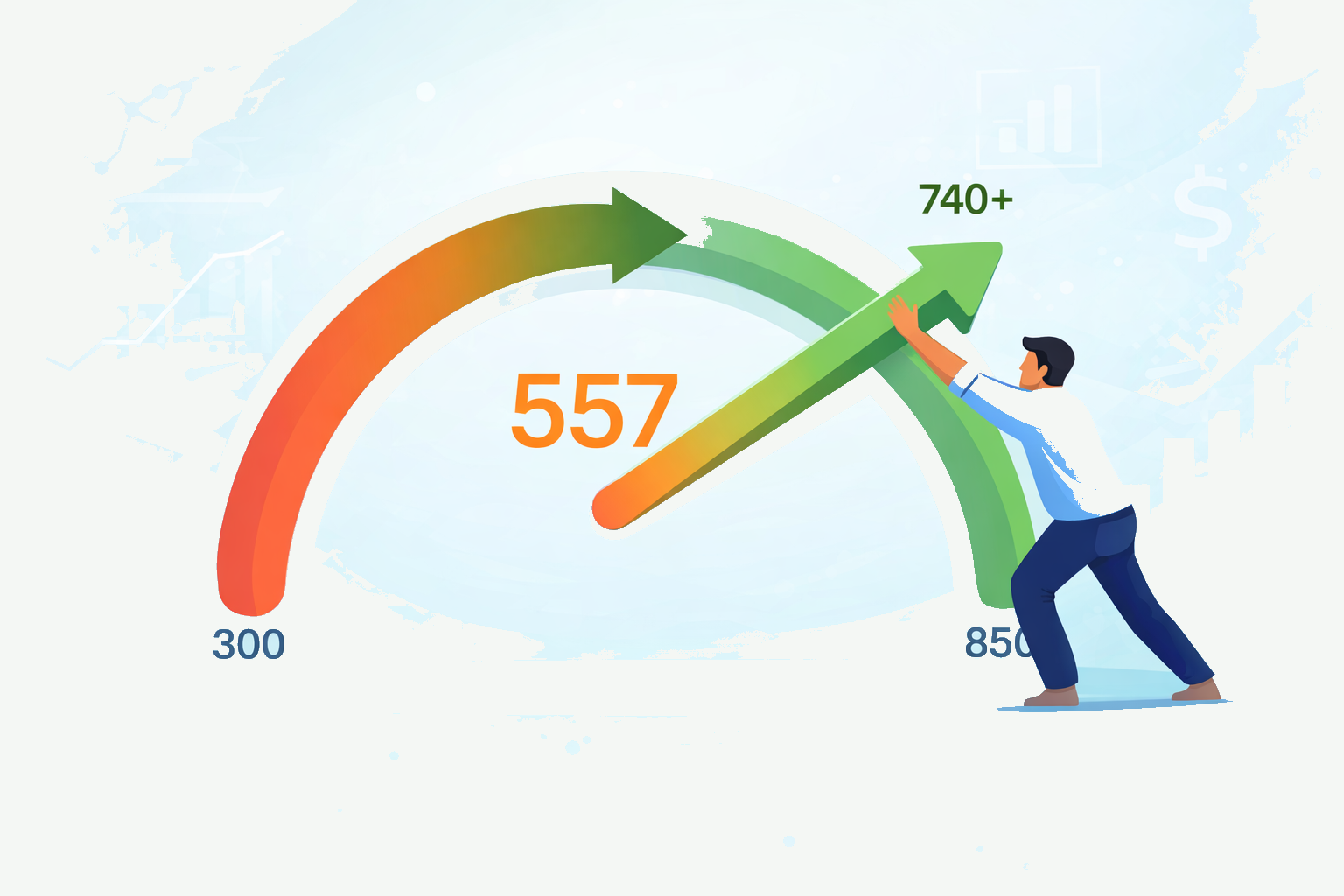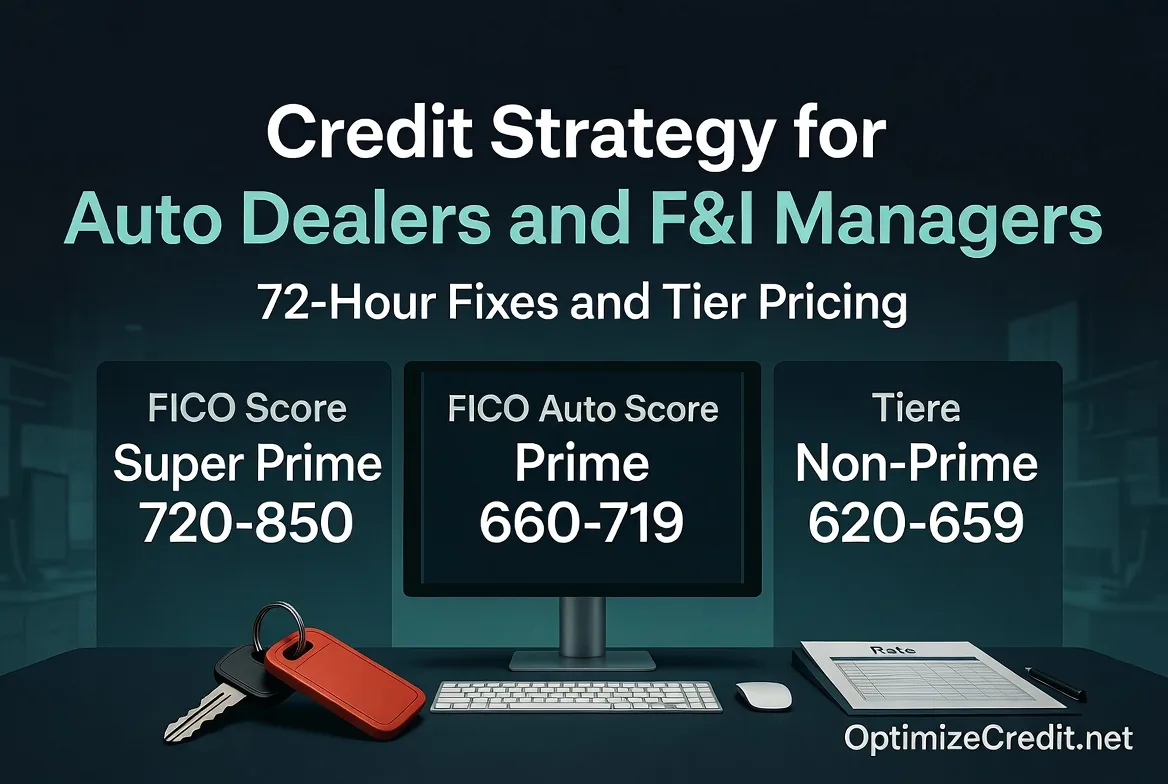
A customer is not always "bad credit." Sometimes they are just in the wrong tier, on the wrong bureau snapshot, at the wrong moment in the reporting cycle.
That is the real F&I problem. The customer walks in looking financeable, the lender call comes back one tier worse than expected, and the payment suddenly stops making sense. Now the desk has a decision: force the paper into a worse structure, send it to a weaker lender, or figure out whether the file is actually recoverable.
The stores that handle this well do not treat credit like a black box. They treat it like a workflow problem. Identify the score model that matters, identify the actual suppressor, decide whether the file is fixable in roughly 72 hours or not, and then move with discipline. That is how a file 10–20 points short of a better tier becomes a salvageable deal instead of a lost customer.
For a clean outside explainer on score versions, this is the best borrower-facing authority source to keep in your toolkit: myFICO's guide to FICO Score versions.
Why auto lending needs its own credit strategy
Many dealers still let customers anchor on the wrong number. The customer says, "My score is 700," but the finance source is underwriting on a different bureau, a different score version, and sometimes a different score range.
That is not a small difference. myFICO says auto lenders often use industry-specific FICO Auto Scores, not just a generic base FICO Score. It also says industry-specific FICO Scores generally use a 250–900 range, while base FICO Scores use 300–850. That means the score a customer saw on a consumer app is useful context, but it is not necessarily the score that controls the tier, the buy rate, or the final approval decision.
The practical lesson for F&I managers is simple:
- stop quoting consumer scores as if they are lender scores
- stop assuming a single number tells you everything
- start anchoring the conversation to the actual lender-facing score family and the actual bureau pull
If your team often has to explain why the number on the phone and the number in underwriting differ, the best internal companion is explaining credit to clients.
FICO Auto Score 8 and 9 are different from generic FICO
Auto lenders care about auto-loan risk, not just general credit risk. That is why FICO offers industry-specific models.
A safe way to explain it is this:
Generic FICO scores estimate general credit risk. FICO Auto Scores are tuned for auto-lending risk.
That does not mean every dealer can assume the same auto version, the same bureau, or the same lender grid. myFICO says lenders decide which score version they use and what other information they consider.
So the right operational rule is not "Auto Score 9 always does X." The right rule is "Know which finance source uses which score family, then desk the file accordingly."
Tier pricing is where credit strategy becomes deal strategy
A lot of credit conversations in dealerships are really pricing conversations in disguise.
If the customer is 15 points short of a better tier, that may mean:
- a worse buy rate
- less room for reserve or markup
- tighter advance
- more difficult payment presentation
- more reliance on weaker lenders
- lower backend penetration because the payment is already stretched
CFPB says the buy rate is the rate the financial institution quotes the dealer, and the customer's contract rate may be higher. CFPB also warns that dealer markup can create fair-lending risk if pricing discretion is not controlled. So tier movement is not just a borrower issue. It is a dealership profitability and compliance issue.
That is why the best stores ask two questions immediately:
- Is this a score problem or a structure problem?
- If it is a score problem, is it a fast bureau problem or a slow file problem?
Those are not the same thing.
The fixable-deal scenario: customer is 15 points below Tier 1
This is the classic salvage file.
The customer is not truly broken. They are just outside the lender's better bucket. That usually means one of these four suppressors is in play:
| Suppressor | What it usually looks like | Speed to fix |
|---|---|---|
| High revolving utilization | One or two cards reported high even though the customer already paid | Fastest |
| Thin file / low depth | Too few strong revolving tradelines, short age, weak profile depth | Slow |
| Inaccurate reporting | Wrong balance, stale collection balance, duplicate derogatory | Medium if documented well |
| Recent inquiry / new account / late | File changed recently and the new risk signal is real | Usually not a true fast fix |
The first job is not to promise points. It is to identify which bucket the file is actually in.
The 72-hour strategy: pay down, refresh the file, try for the better tier
This is the highest-value rescue path when the suppressor is utilization.
If the borrower is close to a better tier and one or two credit cards are reporting far too high, the fastest move is usually:
- identify the worst offending revolving account(s)
- pay those balances down aggressively
- document the payment
- determine whether the lender/credit-vendor stack supports an expedited bureau-refresh or rapid-rescore-type process
- re-pull once the updated information can actually be reflected
That is the core 72-hour strategy.
Why utilization is the best fast lever
FICO says amounts owed is one of the largest categories in scoring. In plain language, a maxed-out or near-maxed card can drag a workable file into the wrong pricing tier even if the customer has not missed a payment.
That is why utilization-driven misses are so salvageable:
- they are often real
- they are often documented
- and they are often fixable faster than structural file weaknesses
What to say to the customer
Use language like this:
"If the score shortfall is being driven by reported card balances, the fastest legitimate path is to lower those balances and get the updated information reflected in the lender-facing file. We are not changing the model. We are trying to make sure the lender sees the current balances instead of an outdated reported snapshot."
That is cleaner than promising a specific score gain.
Important operational caution
Official published rapid-rescore guidance is mostly mortgage-oriented. Experian describes rapid rescoring as a lender-initiated process that can reflect documented changes in days rather than weeks, but that does not make it a universal dealer tool. In auto, the right framing is:
- use it only if your actual lender and credit-vendor stack supports it
- treat it as an expedited update workflow, not a guaranteed score-creation mechanism
- never tell the customer they can simply "buy 20 points in 48 hours"
If your team needs the more detailed mechanics, this is the right internal handoff: rapid rescore guide.
Thin-file customers need a different playbook
Not every file belongs in a 72-hour rescue.
If the borrower is thin-file, lacks revolving depth, or has one weak primary card and little else, then a same-week tier jump may be unrealistic. In those cases, the more relevant lever is depth building, not just balance correction.
That is where tradeline strategy enters.
Tradelines for thin-file customers
A thin file can sometimes benefit from an authorized-user tradeline if the issuer reports it fully and the primary account is actually strong. For a deeper look at how AU tradelines interact with different file types, see the AU tradeline effect guide.
Potential benefits include:
- more available revolving credit
- lower aggregate utilization
- older age contribution
- stronger apparent depth if the tradeline is well-managed
But this is where a lot of F&I talk gets sloppy. Authorized-user tradelines are not a same-day save. Experian says they may take weeks or months to appear, and not every issuer reports them the same way. So AU strategy is better for:
- younger files
- weak-depth customers
- customers who are near-prime but not yet there
- customers worth retaining for a later delivery rather than forcing into bad paper today
It is not the right answer when the deal must fund immediately.
Prime vs. subprime: when to close now and when to refer to optimization
The biggest decision in the box is often not whether the customer can be approved. It is whether they should be approved today in the current structure.
Use this framework:
| Customer state | Best move |
|---|---|
| Close to a better tier because of utilization | Fast rescue strategy |
| Close to a better tier because of inaccurate reporting | Documentation + correction path |
| Thin-file but otherwise clean | Optimization referral or delayed re-entry |
| Truly subprime with recent serious derogatories | Use the right subprime paper or pause the deal honestly |
A customer who is 15 points short because one card reported too high is very different from a customer with multiple fresh lates, weak income support, and no usable revolving depth.
Do not desk them the same way.
Why "optimization referral" can be the right store move
A lot of dealers think referring a customer out means losing them. In reality, a structured optimization path can preserve:
- future unit potential
- store trust
- referral value
- backend opportunity on a later transaction
The wrong move is often forcing the customer into an expensive near-term contract they should not have taken.
Do not import mortgage-style DTI and threshold logic into auto lending
This is where a lot of F&I content goes off the rails.
Here is the cleaner reality:
- Auto lenders consider credit score, credit history, income, debts, and down payment, according to CFPB.
- But that does not mean auto lending uses Fannie Mae or FHA-style underwriting thresholds.
- Fannie Mae and FHA are mortgage frameworks, not dealer-arranged auto-finance tier grids.
- In mortgage, current Fannie and FHA rules have very specific DTI and score logic. Those are not the right rules to quote in an auto F&I article.
That is why this guide intentionally avoids dragging in Fannie/FHA thresholds except to say: do not use mortgage rules to explain auto paper.
Compliance: ECOA, adverse action notices, and fair lending
This is where F&I strategy needs discipline.
ECOA and adverse action
CFPB's Regulation B says a creditor generally must provide the required adverse-action notification within 30 days after receiving a completed application. CFPB also says vague reasons such as "failed to achieve a qualifying score" are not sufficient by themselves when specific reasons are required.
For dealership workflow, that means:
- know who is giving or relaying the notice
- document the actual principal reasons
- do not reduce the explanation to "the bank said no"
- do not invent a vague score story when the real issue was broader risk
Fair lending and markup
CFPB has repeatedly highlighted the fair-lending risks around discretionary dealer markup. That means any store talking about "credit strategy" needs to be serious about:
- consistent treatment
- documented exceptions
- controlled markup policy
- clear explanation of what changed in the file versus what changed in pricing
How to talk about optimization without sounding like a CRO
Dealers should stay in the lane of education and transaction strategy, not promises of "credit repair."
A safe script is:
"I can explain what in the file is suppressing the lender decision, what timing issues are involved, and whether this looks like a fast-fix utilization issue, a thin-file issue, or a file that needs more time. I am not promising a score gain, and I am not selling credit repair."
That keeps the conversation useful and controlled.
Building dealer partnerships with credit optimization
A real dealer partnership is not "send us your worst customers." It is a triage system.
The best partnership model sorts customers into three groups:
| Customer type | Best path |
|---|---|
| Utilization-driven near miss | Immediate rescue attempt |
| Thin-file / depth problem | Structured optimization over one or more billing cycles |
| Real reporting problem | Accuracy review and dispute path if warranted |
That kind of partnership helps the store because it:
- reduces wasted desk time on files that cannot move today
- preserves future buyers who should not be forced into bad contracts
- improves lender fit over time
- creates a cleaner customer story when the file returns stronger later
The wrong partnership model is one built on guaranteed score claims. The right one is built on documented file changes, realistic timelines, and disciplined communication.
Bottom line
Credit strategy for auto dealers and F&I managers is not about memorizing one magic score cutoff. It is about understanding:
- which score family the finance source likely uses
- what actually moves a customer from one tier to another
- when a 72-hour rescue is realistic
- when a thin-file customer needs time instead of pressure
- and how to protect the store on adverse-action and fair-lending workflow while doing all of that
The best stores do not just close more deals. They desk smarter deals.
See more strategies and frameworks in the For Pros hub.
Get Your Personalized Credit Roadmap
Upload your credit report and our Credit Analyzer identifies what may be holding your score back and provides a step-by-step report-based improvement plan.
Analyze My Credit Free →