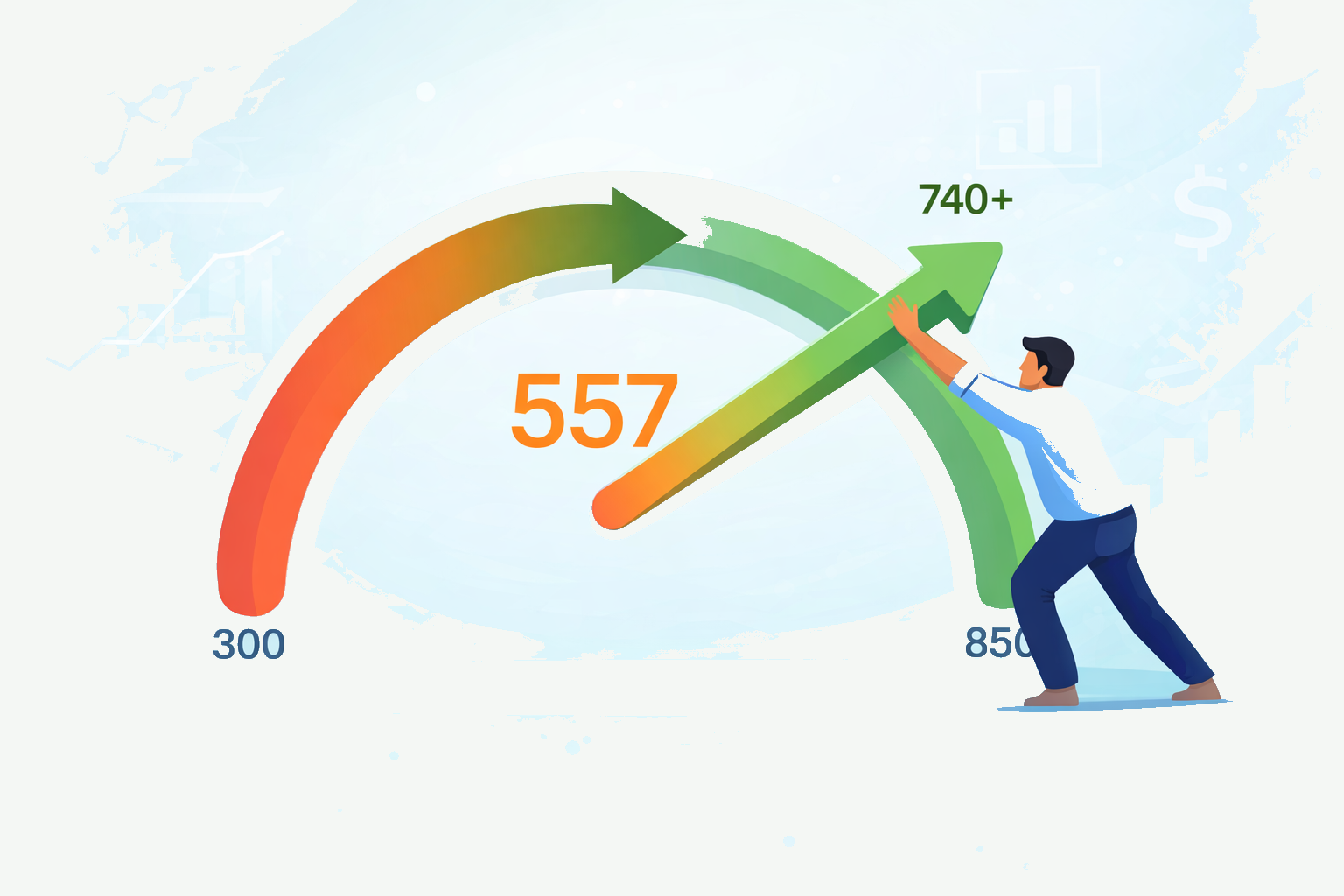
The jump from "thinking about buying" to "getting pre-approved" is where your credit file stops being a rough estimate and starts becoming underwriting data.
That is why mortgage pre-approval feels so different from checking rates online. One minute you are looking at listings and app scores. The next minute a lender is pulling real bureau data, comparing all three reports, assigning a qualifying score, and deciding whether your current file supports the payment, the program, and the risk.
For borrowers in the 550–680 band, that step matters a lot. A small score difference, a late-reporting balance, or an unresolved tradeline issue can change the middle score just enough to affect pricing, loan type, or whether the file needs more work before it is truly offer-ready.
For the cleanest consumer-facing explanation of the process, start with the CFPB's guide to getting a preapproval letter.
Pre-qualification vs. pre-approval vs. conditional approval
These terms sound similar, but they do not represent the same level of certainty.
The most important thing to know is that lenders do not use the words perfectly consistently. The CFPB says lender processes vary widely, so the label alone is less important than what actually happened to your file.
| Stage | What it usually means | Credit impact | Real-world value |
|---|---|---|---|
| Pre-qualification | Early estimate based on limited or self-reported data | Often soft pull or limited credit review | Good for early budgeting |
| Pre-approval | More serious review using documents and credit | Usually hard pull | Stronger support for making offers |
| Conditional approval | File is largely acceptable, but conditions must be cleared | Usually based on credit already pulled, but lender may refresh later | Much closer to final approval |
Pre-qualification
This is usually the lightest-touch stage. It may rely on self-reported income, assets, and debts. Some lenders use a soft inquiry. Some do not check credit deeply at all.
That makes it useful for:
- estimating budget
- deciding whether the process is worth starting
- comparing lenders at a very high level
But it is not the same as a lender saying, "We have verified your real file and are prepared to support an offer."
Pre-approval
This is where the lender generally starts acting like the file is real.
That usually means:
- a hard inquiry
- income and asset documents
- a fuller review of debts, DTI, and credit profile
- a stronger letter that sellers and agents take more seriously
A pre-approval is usually more meaningful than pre-qualification, but it is still not a guaranteed loan offer. The file still depends on the property, updated documentation, and the borrower not changing the risk profile before closing.
Conditional approval
Conditional approval generally happens later, after deeper underwriting review. It means the file is largely approvable if the borrower clears the listed conditions.
Those conditions often include:
- updated bank statements
- sourcing large deposits
- proof of insurance
- appraisal-related items
- explanations for credit or address history
- re-verification of employment or liabilities
That is why conditional approval should be understood as close, not done.
What happens to your credit when you get pre-approved
For most borrowers, mortgage pre-approval involves a hard inquiry.
That sounds scary, but the scoring hit is usually small. FICO says an additional hard inquiry will generally take less than five points from a FICO Score for most people. The bigger issue is often not the inquiry itself. It is that the lender is now looking at the actual mortgage-relevant version of your file.
In other words:
- the hard inquiry is usually a minor event
- the real mortgage score and bureau data are the major event
That distinction matters because borrowers often blame the inquiry for everything, when the bigger surprise is usually that the lender is seeing older mortgage scoring logic, all three bureaus, and a more complete risk snapshot than the borrower expected.
Tri-merge: why mortgage credit feels stricter than other lending
Mortgage lending often uses a tri-merge credit report, meaning the lender reviews data from Equifax, Experian, and TransUnion together.
In practical mortgage workflow, many lenders still use the classic "middle score" framework:
- three bureau scores are pulled
- the highest and lowest are ignored
- the middle score becomes the qualifying score
- on joint files, lenders often use the lower middle score of the two borrowers
That is why mortgage prep is more sensitive than a credit card application. One bureau reporting differently can change the middle score. One high-balance card hitting the wrong bureau at the wrong time can change pricing or program fit.
There is one important current nuance: FHFA has approved a transition path allowing Classic FICO or VantageScore 4.0 through the tri-merge mortgage framework for Enterprise loans. But in day-to-day borrower experience, many mortgage files still operate through the familiar tri-merge / middle-score logic. Understanding FICO vs. VantageScore differences helps clarify why your app score may not match the mortgage score the lender sees.
Rate shopping: how hard inquiries really behave
Mortgage shoppers often worry that five lenders means five separate score hits.
That is not how FICO usually treats mortgage shopping.
FICO gives mortgage inquiries special shopping treatment:
- older FICO versions generally use a 14-day shopping window
- newer FICO versions generally use a 45-day shopping window
The clean operational rule is this:
Do your mortgage shopping in a tight window.
That is safer than stretching lender pulls across months. It preserves the score treatment and gives you cleaner side-by-side comparisons of real loan terms. For a deeper look at how even small score differences affect your monthly payment, see mortgage rate math.
The real prep window: 30–60 days before pre-approval
This is where most of the useful work happens.
The best time to prepare for mortgage pre-approval is before the lender pulls the file, not after you are already trying to explain why the score or tradeline picture looks worse than expected.
1. Optimize utilization before the lender sees it
The mortgage lender is not looking at what you paid yesterday. It is looking at what the bureaus show today.
That means revolving utilization needs to be managed in relation to:
- statement closing dates
- bureau update dates
- the timing of the lender pull
If you pay a card down after the statement has already cut, the lender may still see the old high balance. That is why this topic overlaps directly with statement date vs. bureau update timing.
2. Check that your tradelines are actually reporting correctly
Do not assume:
- the balance update already posted
- the paid collection already cleared
- the authorized-user account already landed
- the bureau file already reflects the improvement you made
Mortgage lending is unforgiving about timing. A change that is "true in real life" but not yet "true on the bureau file" does not help the score you qualify on.
3. Handle real inaccuracies early, not at the last minute
This is where many articles either say too little or say the wrong thing.
You do not want to start broad, aggressive disputes right before mortgage pre-approval. But you also do not want to ignore a real error that could drag the file unnecessarily.
The best approach is:
- identify genuine inaccuracies early
- dispute only what is actually wrong
- expect real dispute timing, not magic timing
- keep documentation ready for the lender
Under standard federal dispute timing, a bureau generally has 30 days to investigate, but that can become 45 days in some cases, including when the dispute follows a free annual report or when additional information extends the timeline.
That means the sequencing matters:
- if you are 7 days away from applying, a fresh dispute may complicate more than it helps
- if you are 30–60 days out, genuine corrections may still be worth pursuing
- if the issue is already documented and the lender needs clarity, the file may need explanation rather than last-minute dispute activity
The current Fannie guidance is more nuanced than the old "all disputes kill the file" rule of thumb. DU may still assess risk on disputed tradelines, and lenders are expected to evaluate what is being disputed and whether it changes the borrower's real profile.
4. Make sure your file is stable enough to pull
A borrower should not enter mortgage pre-approval during active file chaos:
- major balance swings
- new accounts opening
- unresolved identity issues
- pending deletions that have not posted
- jobs changing
- co-sign decisions in progress
The cleaner the file is at pull time, the less the borrower will need to explain later.
What not to do after pre-approval
This is the stage where borrowers accidentally wreck their own file.
The simplest rule is:
Once pre-approved, keep the file boring.
Do not open new accounts
A new account can:
- add a hard inquiry
- lower average age
- increase monthly obligations
- affect DTI
- change the risk picture before final approval
Do not co-sign for anyone
Co-signing is often treated like a favor, but it can become your problem in underwriting. If the liability is yours on paper, the lender may have to count it.
Do not make large financed purchases
Furniture financing, a new appliance plan, or a large credit card balance can change utilization and DTI just before closing.
Do not close existing cards
Closing a card rarely helps mortgage prep and can reduce available credit, which may spike utilization and suppress the mortgage score.
Do not change jobs casually
A change in employment type, compensation structure, or stability can create income-verification problems even if the borrower technically earns as much or more.
How long pre-approval lasts — and why lenders may pull again
Mortgage pre-approvals do not last forever.
Most are good for 60 to 90 days, though some lenders use 30-day windows. If the borrower does not go under contract in time, the lender may need:
- updated pay stubs and bank statements
- a refreshed credit review
- re-verification of employment
- confirmation that no new debt has appeared
This is also where many borrowers get surprised. They think the first pre-approval froze the credit side permanently. It did not.
A lender may do:
- a refreshed hard pull
- a soft refresh
- an undisclosed-debt check
- another verification step close to closing
Exactly how that happens varies by lender and investor. The important point is that the file may still be checked again before money actually funds.
A practical optimization sequence that actually works
The cleanest sequencing for a mortgage-bound file looks like this:
| Timeframe | Best actions |
|---|---|
| 60+ days before pre-approval | Check all three reports, identify real errors, stabilize balances, avoid new credit |
| 30–45 days before pre-approval | Let utilization improvements report, verify corrections posted, confirm tradelines are showing correctly |
| During rate shopping | Compress lender pulls into a focused shopping window |
| After pre-approval | Freeze behaviorally: no new accounts, no co-signing, no financed purchases, no unnecessary job changes |
| If pre-approval nears expiration | Expect updated docs and possible credit refresh |
This is the part most borrowers underestimate: mortgage pre-approval is not just a credit event. It is a timing event. If your file is close to a score threshold, a rapid rescore through the lender can sometimes update bureau data faster than waiting for the next reporting cycle.
The biggest myths to avoid
Myth 1: Pre-approval locks my rate
Not automatically.
A pre-approval and a rate lock are related but separate. CFPB says a rate lock is a separate commitment that holds the interest rate for a defined period under defined conditions. Some lenders may lock when issuing a Loan Estimate; some may not.
Myth 2: One dispute remark automatically kills my mortgage file
Too absolute.
Disputes can complicate underwriting, especially if they affect important derogatory or balance information. But current agency guidance is more nuanced than the old blanket rule. The lender must evaluate what is being disputed and whether it changes risk materially.
Myth 3: Pre-approval means I am done with credit checks
Not safely true.
Many lenders will re-check or refresh the file in some form before closing, especially if the timeline stretches or there is concern about undisclosed debt.
Bottom line
Mortgage pre-approval is not where you discover what your credit file looks like. It is where you confirm that the file you prepared is stable enough for real underwriting.
The key rules are straightforward:
- understand the difference between pre-qual, pre-approval, and conditional approval
- expect a hard inquiry for real pre-approval
- remember that many mortgage files still use tri-merge and middle-score logic
- compress rate shopping into a tight window
- optimize utilization and reporting before the pull
- address real inaccuracies early enough for real timelines
- and once pre-approved, keep the file boring until closing
That is how you keep mortgage prep from becoming a preventable credit problem. Explore more strategy guides in the For Pros hub.
Get Your Personalized Credit Roadmap
Upload your credit report and our Credit Analyzer identifies what may be holding your score back and provides a step-by-step report-based improvement plan.
Analyze My Credit Free →