What LLPAs actually are
A borrower can be fully approvable and still be materially overpriced.
That is the part many clients — and too many referral partners — miss. A conventional file can clear DU or LP, show acceptable income and assets, and still land in a much worse price cell because the representative mortgage score sits on the wrong side of a threshold or because the loan hits the wrong LTV bucket. In practical terms, that means more points, less lender credit, or a higher rate than the borrower expected.
That pricing engine output is usually an LLPA problem.
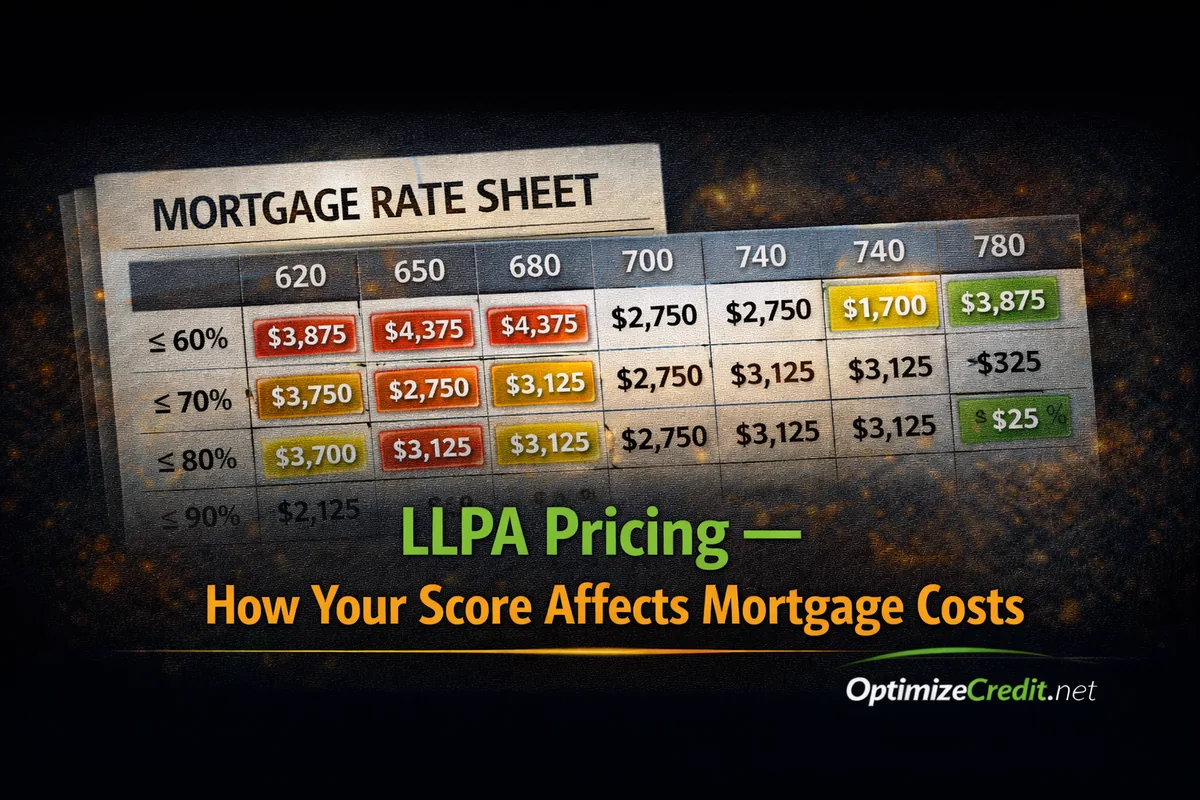
Loan-Level Price Adjustments (LLPAs) are the upfront risk-based fees Fannie Mae and Freddie Mac apply to conventional loans based on characteristics such as credit score, LTV, loan purpose, occupancy, and other loan features. Mortgage professionals do not need to memorize every cell in the matrix, but they do need to understand how the matrix behaves — because a borrower at 718 is not priced like a borrower at 740, and a 700-score borrower at 95% LTV is not the same economic file as a 700-score borrower at 75% LTV.
At the GSE level, LLPAs are upfront pricing adjustments tied to loan risk characteristics. Borrowers usually do not see a separate disclosure line that says "LLPA." Instead, the cost normally shows up one of three ways:
- more discount points,
- less lender credit, or
- a worse permanent note rate.
That is why two lenders can quote different rates on what looks like the same file. The base market rate may be similar, but the way the lender converts GSE price hits into retail execution can differ.
LLPAs are also cumulative. That point matters. A borrower is not just paying for credit score risk. They may also be paying for LTV, property type, occupancy, loan purpose, subordinate financing, or high-balance status. The cleanest way to think about LLPAs is this:
Representative score bucket + LTV bucket + loan purpose + stacked loan attributes = base GSE price hit before lender execution.
The current score tiers that actually matter
For current conventional purchase pricing, the thresholds that change the math are the familiar mortgage-score steps:
- 620–639
- 640–659
- 660–679
- 680–699
- 700–719
- 720–739
- 740–759
- 760–779
- 780+
That means the pricing engine treats 719 and 700 as the same bucket, but 719 and 720 as different buckets. Likewise, 739 and 740 are materially different from a pricing standpoint even though the consumer may hear both as "basically 740."
For mortgage professionals, this is where credit strategy stops being motivational and becomes economic. A 2-point move can matter if it crosses a bucket. A 19-point move can matter much less if it does not.
Current purchase-grid excerpt: where the money moves
The table below is a practical excerpt of the current standard purchase matrix logic for loans with terms greater than 15 years. These are base purchase-grid examples, not the borrower's all-in quote after stacked attributes, MI, lender overlays, or rate conversion.
| Representative score bucket | Base LLPA at 75.01%–80.00% LTV | Base LLPA at 90.01%–95.00% LTV |
|---|---|---|
| 620–639 | 2.750% | 1.750% |
| 640–659 | 2.250% | 1.500% |
| 660–679 | 1.875% | 1.250% |
| 680–699 | 1.750% | 1.125% |
| 700–719 | 1.375% | 0.875% |
| 720–739 | 1.250% | 0.750% |
| 740–759 | 0.875% | 0.500% |
| 760–779 | 0.625% | 0.250% |
| 780+ | 0.375% | 0.125% |
The critical point is not just the direction of the grid. It is the step-change behavior. Every time the borrower crosses one of those thresholds, the fee can change immediately.
On a $400,000 loan:
- 0.125 point = $500
- 0.250 point = $1,000
- 0.375 point = $1,500
- 0.500 point = $2,000
- 1.000 point = $4,000
That is why credit-score work for a mortgage file should always be discussed in bucket value, not generic score improvement language.
LTV interaction: why a 700 at 95% is not the same as a 700 at 75%
The easiest way to confuse a client is to say "your score drives the price." It does, but only partially.
LTV changes the price too, and sometimes in ways that surprise people. On the current purchase base grid, a 700–719 borrower can show a lower base LLPA at very high LTV than at mid-LTV. That does not mean the high-LTV loan is cheaper overall. It means LLPA is only one part of the total cost picture.
At higher LTVs, mortgage insurance usually enters the stack. So a pro who says, "Your LLPA is lower at 95%, therefore your total cost is lower," is telling an incomplete story. The correct professional explanation is:
- the base GSE fee may be lower in one LTV band,
- but the all-in borrower cost may still be higher once MI and final execution are added.
This is why the best pricing conversations separate:
- base LLPA math, and
- actual borrower quote math.
Those are related, but they are not identical.
Dollar impact on a $400,000 loan
Now the practical examples.
Example 1: 718 versus 740 at 80% LTV
A borrower at 718 prices in the 700–719 bucket. On the standard purchase grid at 75.01%–80.00% LTV, that base LLPA is 1.375%.
A borrower at 740 prices in the 740–759 bucket. In that same LTV band, the base LLPA is 0.875%.
Difference: 0.500 point = $2,000 on a $400,000 loan.
Example 2: 720 versus 740 at 80% LTV
At 75.01%–80.00% LTV, the move from 720–739 to 740–759 changes the base LLPA from 1.250% to 0.875%.
Difference: 0.375 point = $1,500 on a $400,000 loan.
Example 3: 720 versus 740 at 95% LTV
At 90.01%–95.00% LTV, the move from 720–739 to 740–759 changes the base LLPA from 0.750% to 0.500%.
Difference: 0.250 point = $1,000 on a $400,000 loan.
So where does the "$3,000 to $8,000" claim come from?
That number can happen in real borrower-facing pricing, but usually not from the base purchase LLPA alone.
A larger real-world gap usually means one or more of these are also in play:
- lender rate conversion,
- mortgage insurance pricing,
- stacked attribute fees,
- higher loan amount,
- longer lock,
- weaker lender execution,
- or comparing one file structure to another instead of isolating one score bucket change.
That distinction matters because it prevents pros from overstating what a score move alone can do.
The 2023–2024 changes that actually mattered
The biggest structural change came in 2023, when FHFA redesigned and recalibrated the single-family upfront fee framework and introduced separate matrices by loan purpose. That made it much more important to distinguish purchase, limited cash-out, and cash-out instead of speaking about LLPAs as one universal grid.
Just as important: the much-discussed DTI-based LLPA did not survive into current practice. It was scheduled, delayed, and then rescinded before it became a lasting operating feature of the current matrix. So if someone says that LLPAs "now include DTI" as a standing pricing rule, that is outdated.
The more durable 2024-era development was not a broad score-grid rewrite. It was the continued use of targeted waivers and credits in certain affordable-lending scenarios, including current Fannie waivers and credits tied to qualifying first-time buyer and HomeReady-type structures.
That is why old rule-of-thumb pricing narratives from before 2023 can now mislead both consumers and referral partners.
Client use case: "At 718, what is getting to 740 actually worth?"
This is where pros either sound sophisticated or generic.
The weak version is:
"Let's try to raise your score."
The useful version is:
"At this LTV, you're currently in the 700–719 bucket. If we get you to 740, the base GSE fee improves by about 0.50 point, which is about $2,000 on this $400,000 loan before lender execution. If we only get you to 720, the improvement is smaller but still real."
That framing does three things:
- It gives the borrower a dollar reason to care.
- It helps the borrower decide whether the work is worth the delay.
- It prevents the pro from promising vague "better pricing" without quantifying the value.
For the downstream rate effect of points versus execution, the most relevant companion piece is Mortgage Rate Math.
When it is smarter to buy down the rate than wait for the score increase
Waiting is not automatically the smart move.
Sometimes the file is 15 to 20 points away from the next useful bucket, but the contract clock is short, the lock environment is unstable, or the score path depends on one or two reporting cycles that may not cooperate. In those cases, the correct comparison is not "better score versus worse score." It is:
- expected savings from crossing the bucket, versus
- cost of waiting, including rate risk, seller pressure, relock cost, and timeline failure.
A practical framework looks like this:
| Scenario | Usually better move |
|---|---|
| Borrower is 1–5 points from the next bucket and the improvement is based on already-paid revolving balances that only need to update | Waiting may be rational |
| Borrower is 15–25 points away and the file has permanent derogatories, thin-file issues, or no clear one-cycle fix | Price the loan where it sits |
| Borrower is under contract with tight seller deadlines and rates are moving | Compare the bucket savings against lock and extension risk before waiting |
| Borrower can cross a threshold, but only after open-ended "credit work" with no reliable reporting timeline | Usually do not build the transaction around the hoped-for score |
For pros, the operational lesson is simple: bucket math is real, but contract math is real too.
Real estate timelines: where mortgage strategy meets transaction reality
A score move is only valuable if it arrives in time to matter. In a live purchase, that usually means it must occur early enough to affect:
- preapproval credibility,
- lender pricing,
- rate lock strategy,
- final underwriting timing,
- and the purchase contract calendar.
That does not mean every file needs a rushed score-intervention plan. It means professionals should avoid pretending that every 20-point target is a 30-day project. Some are. Many are not. The cleanest score moves are usually the ones tied to already-changed facts that simply need to report, such as utilization paydowns reflected on updated bureau data.
The official place for clients to review the underlying bureau files before mortgage strategy work is AnnualCreditReport.com.
Realtor compliance and referral-partner guardrails
For real estate agents and other referral partners, there is a practical and a compliance boundary.
The practical boundary: it is fine to explain, at a high level, that a borrower's mortgage cost can change sharply when the representative score crosses a pricing threshold.
The compliance boundary: referral partners should avoid acting like the mortgage licensee of record. That means avoiding definitive statements like:
- "You will definitely save X if you wait,"
- "This lender will price you at Y,"
- or "Delay the closing because I know your score will be 740 in three weeks."
Those are lender-execution and timing calls that belong with the licensed mortgage professional handling the file.
There is also a RESPA boundary. If a realtor, team, platform, or other referral source is steering mortgage business in exchange for fees, kickbacks, or other things of value tied to referral activity, that creates a separate compliance problem unrelated to LLPA math itself. So the safe version of collaboration is:
- explain pricing mechanics,
- coordinate on realistic timing,
- let the lender own the final pricing advice,
- and keep referral arrangements clean.
The mistake pros make most often
The most common error is calling 740 the magic number without context.
740 matters, but it matters differently:
- on purchase versus cash-out,
- at 80% LTV versus 95% LTV,
- with and without subordinate financing,
- on vanilla owner-occupied files versus stacked-risk files,
- and on base GSE fee versus final retail quote.
The better habit is not "get them to 740."
The better habit is:
"For this exact file, the next useful threshold is X, and it is worth approximately Y dollars if it arrives in time."
That is the language of a mortgage strategist, not a generic credit explainer.
Bottom line
LLPAs are published risk-based pricing adjustments, not random lender markup. The score thresholds at 620, 640, 660, 680, 700, 720, 740, 760, and 780 matter because the pricing grid is a step function, not a smooth line.
But the real professional skill is not memorizing the chart. It is knowing when a threshold change is worth pursuing, when the LTV interaction changes the story, when the retail quote gap is larger than the base grid implies, and when transaction timing makes "better pricing later" more expensive than "clean execution now."
That is how you use LLPA math to protect both the borrower and the deal.
Explore more professional credit strategy content in the For Pros hub, or see how credit score ranges map to real lending decisions.
Get Your Personalized Credit Roadmap
Upload your credit report and our Credit Analyzer identifies what may be holding your score back and provides a step-by-step report-based improvement plan.
Analyze My Credit Free →