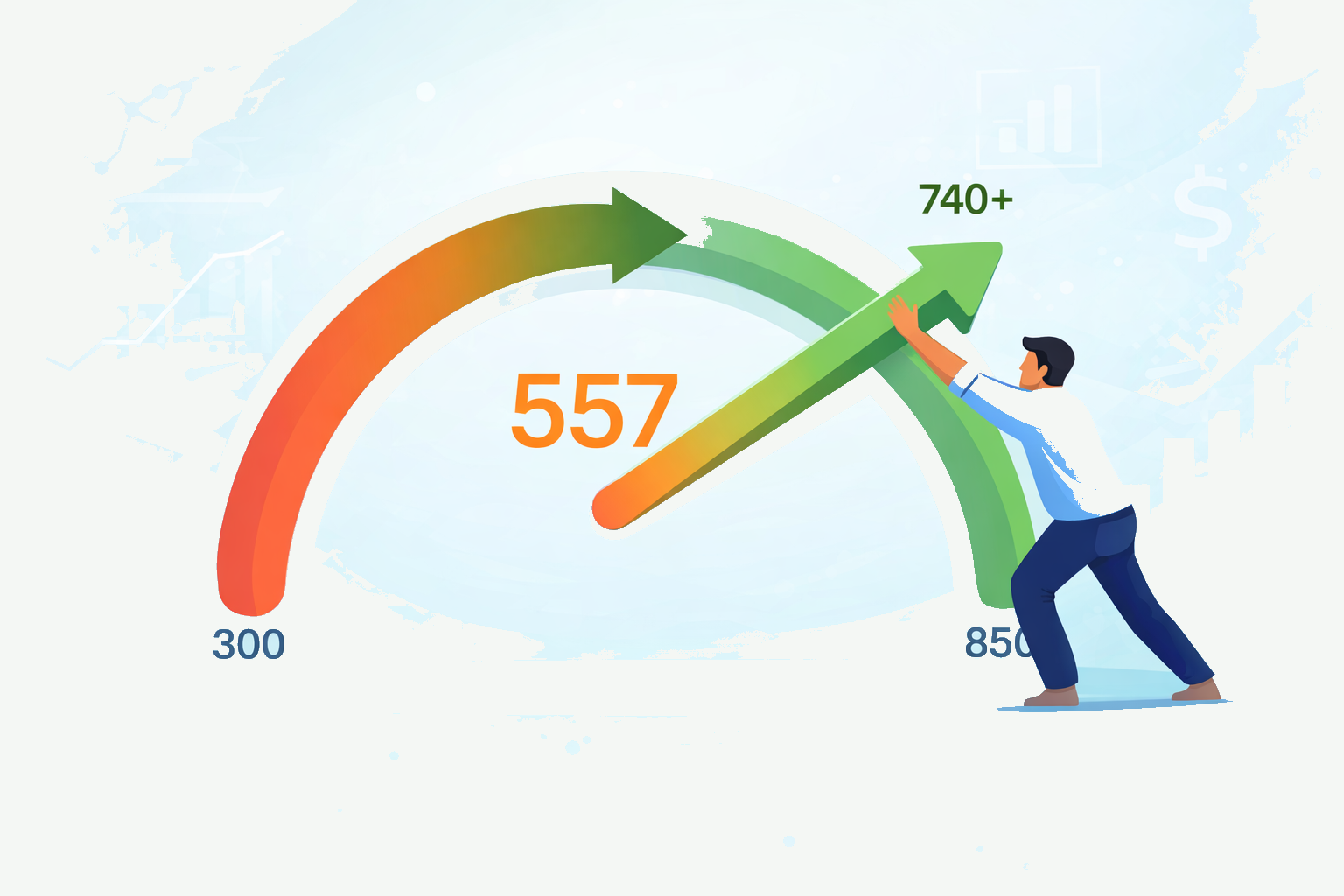
The first rule of deal recovery: do not diagnose from the score alone
A client is 10 to 30 points short. The rate lock is real. The purchase contract is real. The anxiety is real. And now the file that looked clean at pre-approval no longer fits the score line that matters for this loan, this lender, and this timeline.
This is where professionals either lose control of the deal or prove they actually understand credit. A near-miss file should not be treated like bad luck. It should be treated like a diagnostic problem: identify the suppressor, pick the fastest legal lever, and decide quickly whether the right move is rapid rescore, tradeline timing, waiting for natural reporting, or changing the deal structure.
That framing matters because "score falls short" does not mean the same thing in every scenario. A file at 608 can be a hard stop in one channel, a recoverable conventional/Freddie or overlay problem in another, and a workable FHA file if the borrower has sufficient down payment and the lender's own overlays allow it. A file at 724 may not be an approval problem at all; it may be a pricing problem, especially where a better score tier materially improves LLPAs, rate, or DTI flexibility.
The professional move is to stop asking, "Can we save this?" and start asking, "What exactly is suppressing this score, and what can realistically change before closing?"
If you want a borrower-facing authority source when reviewing disputes or file accuracy, use annualcreditreport.com. It is the correct starting point for pulling the reports and identifying what is actually reporting before you decide whether the right tool is a payoff, a dispute, a rapid rescore, or a pivot.
A score is not a diagnosis. It is an output.
If the borrower is 10 to 30 points short, the recovery path depends on what changed and how fast it can be reflected in the bureau file. In practical terms, the most common suppressors are:
- revolving utilization that reported higher than expected
- a collection or derogatory item that is inaccurate or newly updated
- a thin file or lack of depth
- a recent late payment, inquiry, or new account
- a lender/program threshold or pricing tier that no longer fits
The cleanest way to triage the file is to compare the current tri-merge or current lender report against the prior pull and isolate the actual change.
Step 1: Identify the suppressor
Start with the suppressors that move fastest and matter most.
| Suppressor | What to check first | Why it matters |
|---|---|---|
| Utilization spike | Statement-date balance, not just current balance | Revolving utilization can move a score quickly and often has no long memory once corrected |
| Collection or derogatory inaccuracy | Balance status, duplicate reporting, wrong dates, wrong ownership | Inaccurate negatives can suppress both score and underwriting findings |
| Thin file / low depth | Number of usable revolving tradelines, age, recent AU removal | A file can have a decent score but still look weak from a depth standpoint |
| Recent late / inquiry / new account | Date updated, inquiry date, new tradeline age | These can push a borrower below a threshold even if payment history is otherwise clean |
1) Utilization is still the fastest fix in most near-miss files
This is the most common deal-recovery lever because it is often both real and fixable.
A borrower may think they are at 12% utilization because they paid the card down yesterday. But if the issuer already reported the higher statement balance, the lender is still seeing the pre-payment version of the file. Credit reports update on each furnisher's own schedule, typically monthly, and that timing mismatch is exactly why a borrower can pay and still look "maxed" to underwriting for a while.
In plain language: the lender does not underwrite the borrower's checking-account activity. The lender underwrites the bureau file.
2) Collections and derogatory items need a truth test before a strategy test
Do not jump straight to "pay it" or "dispute it." First determine whether the item is:
- accurate and current
- accurate but old
- inaccurate
- already paid but not updated correctly
- duplicated or reporting inconsistently across bureaus
This distinction matters because an inaccuracy may support a dispute path, while an accurate derogatory usually means either waiting, paying according to strategy, or changing loan structure. Do not tell a borrower to dispute accurate information just because the deal is tight.
3) Thin file issues are often misdiagnosed as "low score" problems
Some files are not primarily broken by utilization or a single derogatory. They are weak because the credit profile lacks depth, age, or usable revolving history.
That matters in purchase lending because a 680-looking file with only one young card is not the same thing as a 680 file with several seasoned, low-utilization tradelines. Score alone does not tell the whole story.
4) Recent lates, inquiries, and new accounts are harder to fix quickly
A hard inquiry or a new account can suppress a score, but those are usually not "rapid rescore" problems unless the reporting itself is incorrect. The same is true for a recent late payment: if the late is accurate, you generally do not "rescore it away." You either wait, document the file for the underwriter, or pivot the deal structure.
Step 2: Use the right decision tree
Once you identify the suppressor, the next question is not "What is the biggest score trick?" It is "Which fix can realistically hit the bureau file in time for this closing?"
| If the suppressor is… | Best first move | Typical timeline | Best use case |
|---|---|---|---|
| High revolving utilization that can be paid down now | Pay down + rapid rescore | Often a few business days after documented update | Borrower is near threshold and timing is tight |
| Thin file / low depth / low available credit | Authorized-user tradeline or time-based depth fix | Usually one to two billing cycles, sometimes longer | Borrower is not closing in the next few days |
| Inaccurate derogatory, balance, or duplicate reporting | Dispute the error, then use rapid rescore after documented correction if needed | Dispute timing varies; rescore can be quick once correction is documented | The reporting is actually wrong |
| Accurate derogatory or insufficient time for bureau movement | Wait or pivot program/structure | Depends on reporting and closing clock | The file cannot be honestly moved fast enough |
That is the core deal-recovery framework. Most files do not need a dramatic solution. They need the right solution.
Utilization fix: pay down first, then consider rapid rescore
This is the most common save.
If the borrower is sitting at 608 and needs to get to 620, or is at 724 and wants to clear a pricing tier around 740, the first thing to check is whether one or two cards are reporting at a much higher percentage than the borrower believes.
A simple example:
- total revolving limits: $12,000
- reported balances on the lender pull: $3,300
- aggregate utilization showing: about 27.5%
- one card with a $2,000 limit is reporting $1,750
That borrower may not need "credit repair." They may need one targeted payoff and the right timing.
How to explain the move
"If the score shortfall is being driven by utilization, the fastest legal fix is usually to lower the reported revolving balance and then have the lender evaluate whether a rapid rescore makes sense. The goal is not to change the score formula. The goal is to get the current, documented balance into the credit file faster than the normal monthly reporting cycle."
That is the correct language because rapid rescore does not create a better score by magic. It accelerates the appearance of a documented update. Equifax and Experian both describe rapid rescoring as something the lender initiates, not the consumer, and describe typical turnaround in a few business days, though exact timing depends on documentation and the parties involved.
What not to promise
Do not promise:
- a guaranteed point gain
- same-day results
- a universal 24-hour turnaround
- that every lender or credit vendor handles rescoring the same way
- that the borrower can order it directly
The safer explanation is: "If the balance is the real suppressor, and if the lender/credit vendor supports rescoring on this file, this is often the fastest path."
Tradeline fix: when depth, age, or available credit is the real problem
If the file is thin, a same-week rapid rescore may not be enough because there is no meaningful positive structure to accelerate. In those cases, the more relevant lever may be a well-qualified authorized-user tradeline or simply waiting for a new tradeline cycle to report.
This can help in three ways:
- increases available revolving capacity
- can improve aggregate utilization
- can add age and payment-history depth if the issuer reports authorized users fully
But this is where professionals need to stay honest: authorized-user reporting is issuer-dependent and timing-dependent. Experian says creditors generally report monthly, and authorized-user accounts may take up to a couple of months to appear if they report at all. So "one to two billing cycles" is a common operating assumption, not a guarantee.
When AU is more realistic than rapid rescore
AU is the better discussion when:
- the file is thin
- the borrower lacks enough usable revolving history
- the closing is not in the next few days
- the problem is structural depth, not just a temporary balance spike
When AU is not the immediate answer
AU is usually not the first move when:
- the closing deadline is immediate
- the problem is clearly a single high statement balance
- the lender overlay or underwriter will heavily scrutinize non-primary depth
- the borrower is relying on AU alone to offset a fundamentally weak primary file
Use AU as a depth tool, not as a fantasy shortcut.
Dispute fix: only for real inaccuracies
A dispute path belongs in deal recovery only when the reporting is actually wrong.
Examples:
- collection already paid but still showing the wrong balance
- tradeline belongs to someone else
- duplicate derogatory reporting
- wrong late-payment coding
- wrong open/closed status
Both the CFPB and annualcreditreport.com say consumers can dispute inaccurate information for free. That is the correct standard. A dispute is not supposed to be a pressure tactic against accurate reporting.
The right sequence
- Confirm the item is inaccurate.
- Dispute with the bureau and/or furnisher.
- Gather documentation.
- If the correction is made and timing is still tight, evaluate whether rapid rescore can accelerate the corrected data into the lender-facing file.
That last step matters. The clean framing is dispute + documented correction + possible rescore. Not "file a dispute and rescore the problem away."
Pivot moves: save the transaction when the score will not move in time
Some deals should be saved by changing structure, not by forcing the credit file.
Conventional to FHA
This is the classic pivot, but it needs precision. FHA is often more forgiving on credit, and public FHA guidance continues to center 580 for 3.5% down and 500 to 579 with 10% down. But do not turn that into a blanket promise. Lender overlays still matter.
Also note the current conventional nuance: a "620 needed" scenario is still common in practice, especially because Freddie guidance continues to publish 620-related score rules in many contexts and many lenders keep their own overlays, but 620 is not a universal Fannie DU floor anymore. Fannie announced that DU no longer requires a minimum third-party credit score starting in November 2025. That means the phrase "620 needed" should be presented as a common program or lender threshold, not as an immutable law of conventional lending.
Jumbo to conforming
If the score shortfall makes jumbo pricing or approval unattractive, one save is to reduce the loan amount, bring in more cash, or restructure into a conforming execution where score requirements and pricing may be more forgiving.
Add a co-borrower
This can save deals when the real constraint is not just score, but the total risk picture. A co-borrower can strengthen:
- income
- DTI
- reserves
- compensating factors
But do not oversell it as a score fix. In mortgage, representative or indicator score rules still apply, so a co-borrower can improve the file without automatically curing the score line itself.
The two patterns every deal saver sees
Pattern 1: "620 needed," file at 608
This is still a very real scenario in practice, even though it is no longer correct to describe 620 as a universal conventional minimum.
Usually this file is one of three things:
- a utilization problem
- an inaccurately reporting collection/problem tradeline
- a weak file that might be better executed through a different channel
If the suppressor is utilization, a targeted paydown plus lender-initiated rapid rescore can often close the gap in days. If the suppressor is accuracy, dispute and documentation come first. If the suppressor is structural, a program pivot may be cleaner than forcing the score.
Pattern 2: "740 needed," file at 724
This is often not an approval crisis. It is a pricing and DTI crisis.
At this level, the file is usually good enough to function, but not good enough to hit the better pricing tier. That makes utilization the first place to look. A borrower at 724 may simply have one card reporting too high, and a fast balance correction may do more than any other tool.
The professional language here is:
"We may not be trying to save approval. We may be trying to save pricing."
That distinction matters because it changes how you explain the urgency and the options.
Realtor compliance: what real estate professionals should and should not say
This is where confident blog posts often get reckless.
Real estate agents, mortgage originators, and other transaction professionals can absolutely explain credit mechanics. But once someone starts offering or selling credit-repair services, promising score increases, or charging separately for "fixing" credit, CROA and related state-law issues become relevant very quickly.
The safest posture is:
- explain what the report shows
- explain what changed
- explain what may help based on known scoring mechanics
- refer borrowers to pull and dispute their own reports for free
- avoid promising a score increase or guaranteed approval
- avoid charging a separate fee for "credit repair"
A safe real-estate-professional script sounds like this:
"I can explain what is suppressing the file and what timing or structural options may help this transaction. I am not promising a score increase, and I am not selling credit repair."
That keeps the conversation in the lane of transaction advice and underwriting education.
Bottom line
Deal recovery is not about gimmicks. It is about matching the suppressor to the clock.
- If the problem is utilization, pay down and assess rapid rescore.
- If the problem is inaccuracy, dispute it and use rescore only after the correction is documented if timing is tight.
- If the problem is depth, AU or time may help, but usually not overnight.
- If the problem is time, change the structure instead of pretending the file can become something it is not before closing.
A near-miss file is not automatically a dead deal. But it does require discipline: identify the suppressor, choose the fastest honest lever, and explain the timeline correctly. If you are not sure where the last-mile problem actually sits, start there before choosing a tool.
Get Your Personalized Credit Roadmap
Upload your credit report and our Credit Analyzer identifies what may be holding your score back and provides a step-by-step report-based improvement plan.
Analyze My Credit Free →