What Is a Charge-Off?
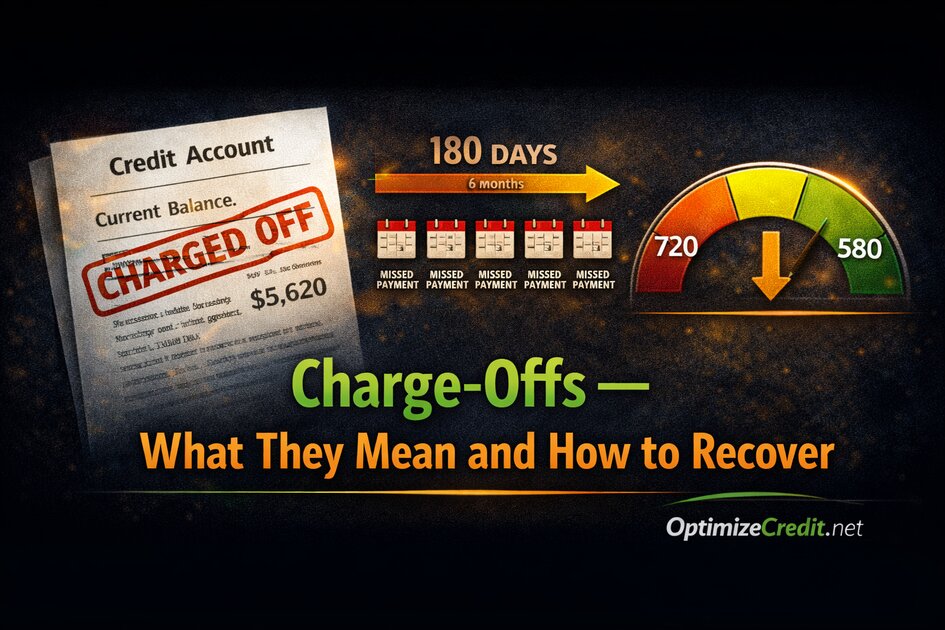
A charge-off occurs when a creditor determines your debt is unlikely to be collected and reclassifies it from a "receivable asset" to a "loss." Under federal banking regulations, creditors are required to charge off revolving accounts (credit cards) after 180 days of delinquency and installment loans after 120 days.
Here's what most people get wrong: a charge-off does not mean you no longer owe the debt. It's an internal accounting action by the creditor. The full balance — plus accrued interest and fees through the charge-off date — remains legally collectible. The creditor can continue collection efforts, sell the debt to a third-party collection agency, or file a lawsuit within your state's statute of limitations.
The charge-off gets reported to the credit bureaus as a status update on your account. But the damage started months earlier — every missed payment along the way was also reported individually, and the cumulative effect is what makes charge-offs so devastating.
The 180-Day Cascade
The path to a charge-off follows a predictable sequence, and each stage independently damages your score:
- 30 days late — initial delinquency reported, first major scoring hit
- 60–90 days late — algorithm shifts you into a higher risk tier
- 120–150 days late — severe delinquency, most recovery options closing
- 180 days late — charge-off posts, terminal derogatory status
FICO doesn't just score the charge-off event. It scores the entire payment history chain — every 30-day increment carries its own penalty. This is why a charge-off often represents a cumulative 100–150 point drop rather than a single event.
How Charge-Offs Impact Your FICO Score
Payment history accounts for roughly 35% of your FICO score, and a charge-off represents the worst possible outcome in that category. But the scoring damage goes beyond payment history.
The Utilization Penalty (The Hidden Mechanic)
This is the part most advice articles miss. When a credit card with a $5,000 balance is charged off, that $5,000 balance continues to be reported. But because the account is closed, your available credit on that account is $0. The scoring algorithm sees $5,000 against a $0 limit — effectively infinite utilization on that tradeline.
Since utilization accounts for approximately 30% of your FICO score, this creates a compounding penalty: the charge-off hammers your payment history AND your utilization ratio simultaneously. This hidden utilization drag suppresses your score month after month for as long as the balance remains unpaid.
This mechanic is the primary reason paying a charge-off often produces a score increase even under FICO 8 — not because the derogatory status changes (it doesn't), but because zeroing the balance eliminates the toxic utilization penalty.
Real-World Point Impact
The damage depends on your starting score and file thickness:
- Single charge-off on a 680+ file with 5+ accounts: expect an 80–120 point drop
- Single charge-off on a thin file (fewer than 5 accounts): can exceed 150 points
- Charge-off itself after delinquency already posted: often an additional 20–50 point drop when the status flips
- Multiple charge-offs: compound the damage, though with diminishing marginal impact per additional charge-off
Recency Drives Severity
FICO weighs recent derogatory events far more heavily than older ones. A charge-off from six months ago is devastating. The same charge-off at year four has lost much of its scoring weight. This decay curve is critical to every strategic decision below.
The 7-Year Clock: When Does It Fall Off?
Under the Fair Credit Reporting Act (FCRA), a charge-off can remain on your credit report for seven years plus 180 days from the Date of First Delinquency (DoFD).
The DoFD is the single most important date on the entry. It's the day you first missed a payment and never brought the account current again. If you first missed a payment in January 2024 and the account was charged off in July 2024, the clock started in January 2024 — not July.
This date cannot be legally changed. If a creditor, debt buyer, or collection agency reports a DoFD that's later than the original — a practice called "re-aging" — that is an FCRA violation and grounds for dispute.
Should You Pay, Settle, or Wait? The Strategic Calculus
This is where most generic credit advice fails. The right answer depends on which FICO model your lender uses, the age of the charge-off, and your specific credit goal.
Option 1: Paying in Full
The account status updates from "Charged Off" to "Paid Charge-Off" and the balance drops to $0.
Under FICO 8, the charge-off is still classified as a major derogatory event — the status change alone doesn't improve your score. However, zeroing the balance eliminates the utilization penalty, which often produces a meaningful lift. Real-world results show 20–60 point improvements within 3–6 months of payment, primarily from utilization relief.
Under FICO 5/4/2 (used for mortgage lending), the derogatory status likewise remains. But mortgage underwriters review every line of your credit report manually. FHA guidelines generally require borrowers to pay off or establish a payment plan for outstanding charge-offs exceeding approximately $1,000–$2,000 in aggregate. An unpaid charge-off is often a deal-breaker in manual underwriting regardless of score.
Option 2: Settling for Less Than Full Balance
Creditors and debt buyers frequently accept 40–60% of the original balance. The account updates to "Settled" or "Settled for Less Than Full Balance."
Under FICO 8, settled status scores marginally worse than paid-in-full — roughly a 10–30 point difference in practice. But both are still classified as derogatories, and the utilization relief from reducing the balance is similar. If the balance is large and cash is tight, settling is usually the rational financial decision.
Some manual underwriters (particularly for mortgage) view settled status less favorably than paid-in-full, but the practical difference is usually marginal compared to the cash savings.
Option 3: Strategic Waiting
If the charge-off is already 5+ years old and approaching the 7-year drop-off, paying it may not be mathematically justified — especially if you're past your state's statute of limitations for collections lawsuits.
Critical distinction: The FCRA 7-year reporting limit and your state's statute of limitations (SOL) for debt collection are completely separate clocks. The SOL governs whether a creditor can sue you (typically 3–6 years depending on the state and debt type). Making a payment on a time-barred debt can restart the SOL clock in some jurisdictions. Consult a consumer attorney before paying old charge-offs near or past the SOL.
Decision Framework
- Charge-off less than 2 years old + mortgage goal within 12 months — pay or settle
- Charge-off 2–4 years old + auto loan or rental goal — settle if you can negotiate 50% or better; otherwise the marginal score benefit may not justify the cash outlay
- Charge-off 5+ years old + past state SOL — waiting is often the most mathematically sound strategy
- Any age, if you can negotiate pay-for-delete — always worth pursuing; get the agreement in writing before sending payment
Disputing Charge-Off Inaccuracies
Under the FCRA, you have the right to dispute any information that is inaccurate, incomplete, or unverifiable. Common disputable errors on charge-off entries include:
- Incorrect DoFD — directly affects the 7-year removal date; re-aging by a debt buyer is an FCRA violation
- Wrong balance — particularly after partial payments or settlements that weren't updated
- Duplicate reporting — both the original creditor and a collection agency reporting balances for the same debt, creating a double utilization penalty
- Inaccurate payment history chain — the sequence of 30/60/90/120-day lates doesn't match actual payment records
- Status not updated after payment — you paid or settled, but the creditor never updated the bureau
- Account not yours — mixed files are more common than people realize, especially for consumers with common names
File disputes directly with each bureau via their online portals or certified mail, and include supporting documentation. Under the FCRA, the bureau has 30 days to investigate (45 days if you submit additional information during the investigation). You can also dispute directly with the data furnisher (the creditor or collection agency), which sometimes produces faster results than going through the bureaus.
For a deeper walkthrough of identifying and resolving inaccuracies across your entire report, see our guide on credit score debugging.
Rebuilding Credit After a Charge-Off
Recovery from a charge-off requires building enough positive credit data to outweigh the derogatory over time. The strategy attacks multiple FICO scoring factors simultaneously.
Secured Credit Cards
A secured card is the most accessible rebuilding tool. You deposit cash as collateral ($200–$500 typically), and the issuer extends a credit line near that amount. The card reports to all three bureaus identically to an unsecured card.
The key is managing utilization aggressively. On a $300 limit card, carry a $10–$25 statement balance (3–8% utilization) and pay in full after the statement posts. The target is under 9% per-card utilization — this is the range where FICO scoring models reward the most points. After 6–12 months of clean history, many issuers will graduate you to an unsecured card.
Credit Builder Loans (CBLs)
A CBL works in reverse: the lender holds the loan amount in a savings account while you make monthly payments over 12–24 months. Once paid in full, you receive the funds. Every on-time payment reports to the bureaus as installment account history.
This matters because FICO's credit mix factor (10% of your score) rewards consumers who demonstrate they can manage both revolving and installment accounts. If your file is revolving-heavy, a CBL diversifies your profile and can produce a measurable lift.
Authorized User Tradelines
Being added as an authorized user (AU) on a well-established credit card can inject years of positive payment history and low utilization into your credit file. When the primary cardholder adds you, most major issuers report the full account history — including the account's age, payment record, and utilization — to your credit file.
A card with 8+ years of perfect payments and under 5% utilization suddenly appearing on your report alters your average age of accounts, your aggregate utilization ratio, and your payment history depth. On a thin file dominated by a charge-off, a strong AU tradeline can produce a 30–50+ point increase. Most tradelines take one to two billing cycles to appear after being added.
Real-World Recovery Scenarios
- 620 FICO, 18-month-old $3,200 charge-off, paid in full: with utilization under 10% and two AU tradelines, expect a 40–70 point lift within six months
- 570 FICO, two unpaid charge-offs, DoFD 4+ years ago: building positive history while waiting for age-off often produces faster net gains than paying and triggering a "date of last activity" update
- 680 FICO, one recent charge-off: pay immediately — the utilization relief alone makes this almost always the winning move
The Recovery Timeline
- Months 1–6: Open a secured card and/or CBL. Establish a perfect payment pattern. Add an AU tradeline if score lift is time-sensitive.
- Months 6–12: Score begins recovering as positive history accumulates and the charge-off ages. Potential 40–80 point recovery depending on starting profile.
- Years 1–3: Positive reporting compounds. Charge-off scoring impact decays significantly. Many consumers return to the mid-600s or higher.
- Years 5–7: Charge-off has minimal scoring weight. Removal at year 7 may add a modest bump, but most recovery has already occurred organically.
The critical mistake is inaction. Every month without positive tradeline activity is a month where the charge-off dominates your file unopposed.
Not sure which factors are holding your score back the most? Start with our troubleshooting hub for a structured approach to diagnosing and fixing credit report issues.
If late payments preceded your charge-off and you suspect reporting errors in the delinquency chain, our late payment impact guide covers how to verify and dispute those entries.
Get Your Personalized Credit Roadmap
Upload your credit report and our Credit Analyzer identifies exactly what is holding your score back and gives you a step-by-step 90-day plan to reach 740+.
Trusted by 500+ successful placements and excellent reviews on TrustPilot ★★★★★
Analyze My Credit Free →