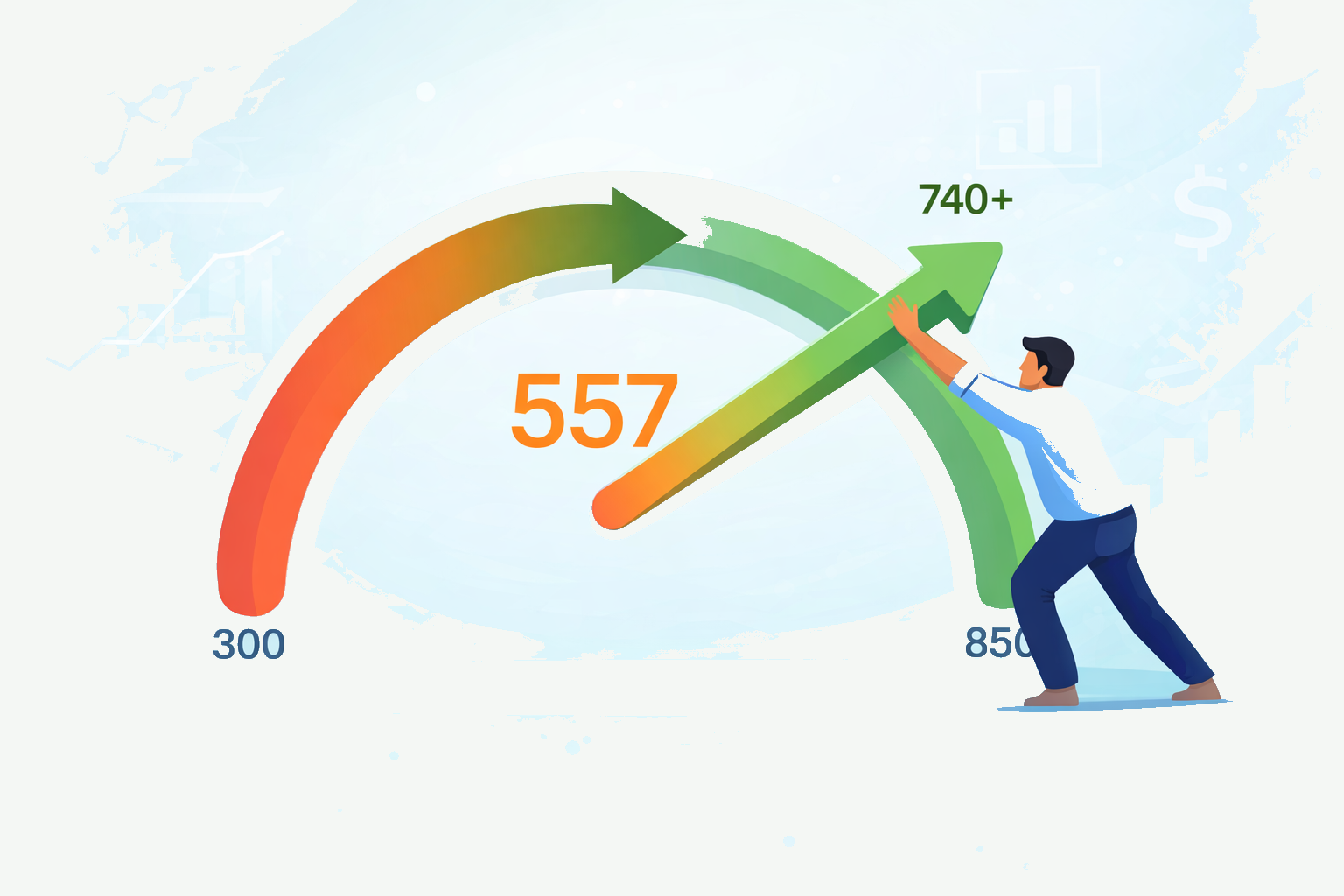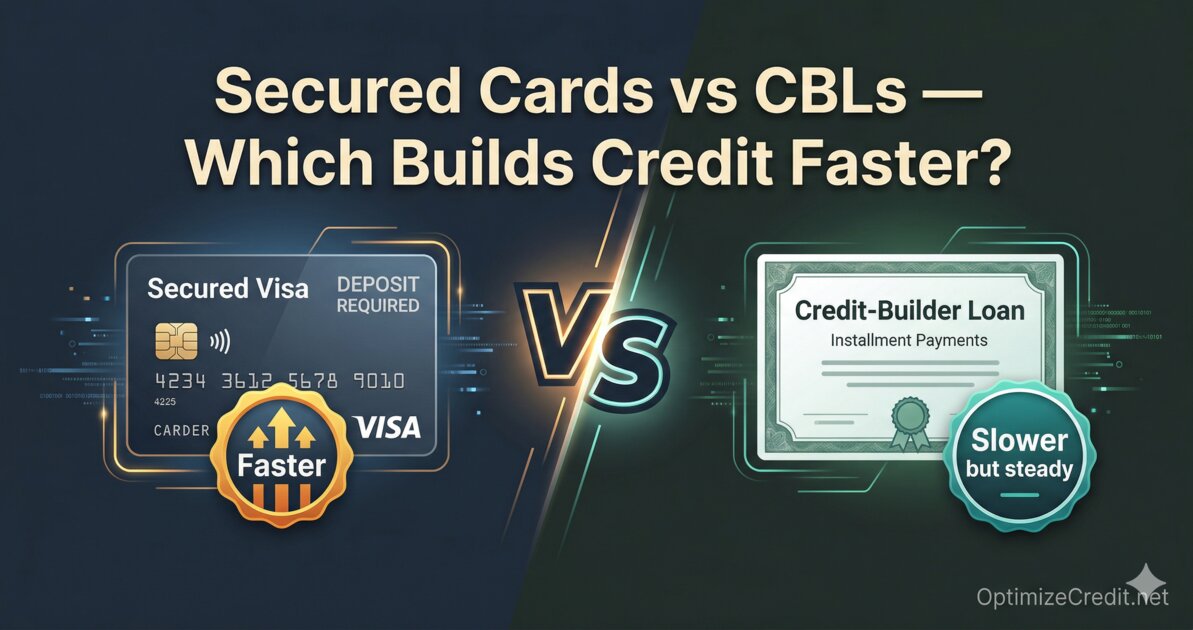
When you're stuck in the 550–680 credit score range, the path forward feels painfully slow. Whether you're recovering from late payments and collections or building a credit file from scratch, traditional unsecured lenders see you as high risk. Two tools are specifically engineered to force positive data onto your credit report: the secured credit card and the credit-builder loan.
Both work. Both generate the payment history that mortgage, auto, and rental underwriters want to see. But they interact with the FICO scoring algorithm in fundamentally different ways — and if you're racing against a pre-approval deadline, that difference matters.
Here's the technical breakdown of how each tool functions, which FICO factors they activate, and which one actually moves your score faster.
How Secured Credit Cards Work (Revolving Credit)
A secured card requires a refundable cash deposit — typically $200 to $2,000 — that becomes your credit limit. Deposit $500, get a $500 limit. You use it like any standard credit card, and the issuer reports it to the bureaus as a revolving account. That classification is the critical distinction. FICO treats revolving credit differently from installment credit, and the difference determines how fast your score responds.
What Happens on Your Credit Report
When you open a secured card, the issuer sends a Metro 2 data file to the bureaus flagging the account as "Revolving." From a scoring standpoint, FICO processes it identically to a premier unsecured rewards card. The algorithm reads your credit limit, current balance, and payment status — it does not penalize you for the card being secured.
Within 30–45 days of account opening:
- A new revolving tradeline appears on your report.
- Your utilization ratio becomes a live, adjustable variable. If your limit is $500 and your statement closes with a $50 balance, you're at 10% utilization.
- Payment history starts accumulating — every on-time payment builds the factor that represents 35% of your FICO score.
The utilization lever is what makes secured cards powerful. Revolving utilization is a major component of the "Amounts Owed" category (30% of your FICO score). A thin-file borrower who opens a $500 secured card and keeps reported utilization between 1–9% can see meaningful score movement within one to two billing cycles.
Most major secured cards — Discover it Secured, Capital One Platinum Secured — report to all three bureaus. Always verify before you apply. A card that only reports to one bureau is doing one-third of the work.
The Graduation Path
Most modern secured cards offer automatic graduation to unsecured status after 6–12 months of on-time payments. When this happens, you get your deposit back and often receive a credit limit increase — which further drops your utilization ratio without any action on your part. Crucially, the original "Date Opened" stays the same, preserving your account age indefinitely.
How Credit-Builder Loans Work (Installment Credit)
A credit-builder loan (CBL) flips the traditional loan structure. Instead of receiving money upfront and paying it back, your payments go into a locked savings account, and you receive the funds after the loan term ends — typically 6 to 24 months. The lender reports this to the bureaus as an installment account, the same category as auto loans, mortgages, and student loans.
What Happens on Your Credit Report
- A new installment tradeline appears on your report.
- No revolving utilization impact. Installment loans don't factor into revolving utilization calculations at all. However, FICO does track installment loan balances relative to original amounts. When you first open a CBL, your installment utilization is at 100% — you owe the full amount. This can cause a slight initial score dip before the balance begins to pay down. This is a point most guides miss.
- Payment history builds monthly, same as a secured card.
- Credit mix improves — which matters most for thin files that only have revolving accounts or nothing at all.
Typical CBL amounts range from $300 to $3,000, with monthly payments between $25 and $150. Providers like Self (formerly Self Lender), MoneyLion, and many credit unions offer them. Total interest cost over the loan term usually runs $30–$75 on a $1,000 loan.
The Forced Savings Benefit
The locked savings account is a genuine advantage. At the end of a 12-month, $1,000 CBL, you have a payment history and roughly $1,000 minus interest sitting in savings. For someone rebuilding after financial difficulty, this structure removes the temptation to spend borrowed funds. If you default, the lender takes fees owed from the locked funds and returns the rest — but the missed payments still hit your credit report.
FICO Scoring Mechanics: Why They Don't Build Credit the Same Way
This is where most comparison articles stop at "both build credit" and move on. But the type of tradeline determines which scoring factors get activated — and by how much.
Secured Card (Revolving) → Two Major FICO Factors
- Payment History (35%) — Every on-time payment adds positive data.
- Amounts Owed / Utilization (30%) — Your balance-to-limit ratio directly moves this category. Because FICO has no memory for utilization, you can optimize this metric month-to-month before a credit application. A $200 card with a $10 reported balance = 5% utilization, and the algorithm rewards that restraint immediately.
Credit-Builder Loan (Installment) → One Major + One Minor Factor
- Payment History (35%) — Same as above.
- Credit Mix (10%) — Adding an installment loan when you only have revolving accounts gives a modest but real boost. According to myFICO, FICO actively rewards consumers who demonstrate the ability to manage different types of debt.
The Bottom Line on Speed
Secured cards give you direct access to the utilization lever — the single most adjustable FICO variable. It updates every billing cycle. A CBL doesn't touch utilization at all.
For a thin-file consumer going from zero tradelines to one, a secured card typically produces faster initial score gains. A CBL's credit mix benefit is real but smaller in magnitude and more gradual.
One important note on both: whenever you open any new account, your Average Age of Accounts drops, typically causing a temporary 5–15 point dip. This is identical for both tools — it's the cost of entry.
Head-to-Head Comparison
| Factor | Secured Credit Card | Credit-Builder Loan |
|---|---|---|
| Upfront cost | $200–$2,000 deposit (refundable) | $0–$15 setup fee |
| Monthly cost | $0 if paid in full | $25–$150/month |
| Total interest cost | $0 if paid in full monthly | $30–$75 typical on a $1,000 loan |
| Reports as | Revolving | Installment |
| Utilization impact | Direct — major scoring factor | None on revolving; starts at 100% installment utilization |
| Credit mix impact | Adds revolving (if you lack it) | Adds installment (if you lack it) |
| Score impact speed | Fastest — utilization responds in 1 billing cycle | Slower — mix benefit is gradual, payment history builds monthly |
| Risk if mismanaged | High utilization tanks score; potential interest/fees | Missed payment hurts score; lose savings progress |
| Graduation / end benefit | Upgrades to unsecured card; deposit refunded; account stays open indefinitely | Account closes when term ends; savings released |
| Long-term value | High — anchors your credit file age for decades | Low — closed account, though positive history stays 10 years |
| Best for | Fast utilization optimization, long-term account building | Forced savings, adding installment mix diversity |
When to Choose a Secured Card
A secured card is the better tool if:
- You need score movement fast. Utilization is the quickest-responding FICO variable. Going from zero revolving tradelines to one with under 10% utilization can produce noticeable changes within 30–60 days.
- You already have installment loans (student loans, auto loan). Adding another installment account via a CBL won't help your credit mix — a revolving account will.
- You have the deposit available and can leave $300–$500 tied up for 6–12 months.
- You want a permanent account that graduates to unsecured status and anchors your credit file age for decades.
When to Choose a Credit-Builder Loan
A CBL is the better tool if:
- You can't afford a lump-sum deposit. CBLs require no money upfront — just consistent monthly payments.
- You only have revolving accounts. Adding an installment tradeline fills the credit mix gap directly.
- You need forced savings discipline. The locked account removes spending temptation.
- You're rebuilding after bankruptcy. Some CBL providers are more lenient on recent bankruptcies than secured card issuers.
For a deeper look at how all rebuilding strategies compare, explore the credit basics hub.
Why Using Both Gives the Best Result
FICO's credit mix factor specifically rewards having both revolving and installment accounts. A thin file with only one tradeline type is leaving points on the table.
The ideal credit-building stack:
- Secured card — controls utilization, builds revolving payment history, creates a permanent account.
- Credit-builder loan — builds installment payment history, adds mix diversity, forces savings.
A 2020 CFPB study on building credit found that consumers who opened both a credit card and an installment loan within their first year of credit history reached prime scores (660+) faster than those who used only one product type.
The combined approach attacks three FICO factors simultaneously: payment history, utilization, and credit mix — that's 75% of your score being actively worked.
For mortgage applicants specifically, this matters even more. Mortgage lenders pull specialized FICO models (FICO Score 2 for Experian, FICO Score 4 for TransUnion, FICO Score 5 for Equifax). These older models are stricter than FICO 8 and place extra weight on demonstrated ability to manage multiple debt types without defaulting.
The Authorized User Tradeline Shortcut
Both secured cards and CBLs require you to start from Month 0. For consumers preparing for a pre-approval in 60–90 days who can't afford to wait a year, there's a third mechanism: the authorized user (AU) tradeline.
When you're added as an AU on someone else's established credit card, the entire account history can appear on your credit report — including years of on-time payments, the account's age, and its credit limit. This means:
- Instant age boost. A 10-year-old tradeline shifts your Average Age of Accounts dramatically.
- Immediate utilization benefit. The card's limit counts toward your total available revolving credit.
- Payment history depth. Years of positive data appear on your report, not just the months since you were added.
The most effective combination for someone on a mortgage timeline: an AU tradeline for history depth and limit, plus a secured card for a self-owned, controllable revolving account. The AU provides the imported track record; the secured card proves independent credit management.
Common Mistakes That Undermine Both Strategies
With secured cards:
- Maxing out the card and carrying a balance. A $500 card with a $450 reported balance is 90% utilization — actively damaging your score.
- Applying for multiple secured cards simultaneously, generating unnecessary hard inquiries.
- Choosing a card that doesn't report to all three bureaus.
With credit-builder loans:
- Missing even one payment. A single 30-day late does the same damage here as on any other account.
- Not verifying three-bureau reporting before signing up.
- Paying the loan off early — you only generate payment history for the months you actually make payments. A 12-month CBL paid off in month two creates two months of history, not twelve.
If you've already made payments on a secured card or CBL and your score hasn't budged, the score not changed after payoff guide walks through reporting delays, utilization snapshots, and other reasons the expected movement may not have appeared yet.
Get Your Personalized Credit Roadmap
Upload your credit report and our Credit Analyzer identifies exactly what is holding your score back and gives you a step-by-step 90-day plan to reach 740+.
Trusted by 500+ successful placements and excellent reviews on TrustPilot ★★★★★
Analyze My Credit Free →