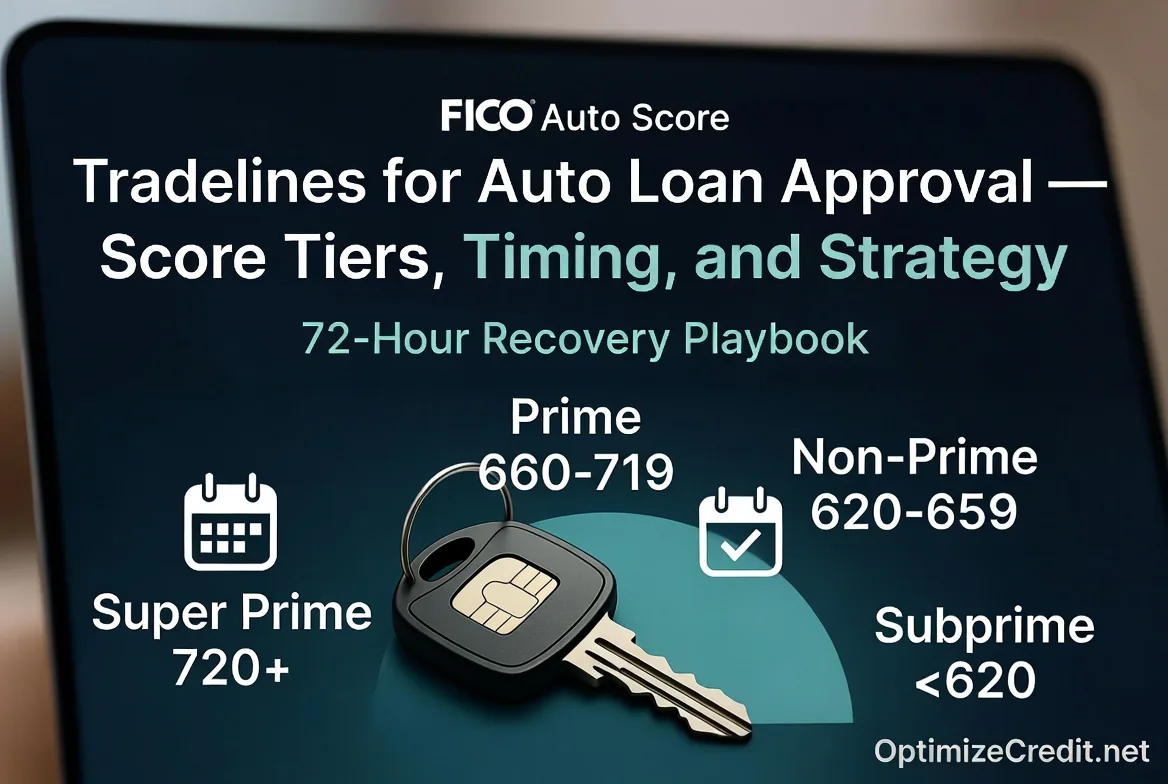
Auto-loan score tiers: practical buckets vs published rate bands
If you walk into a dealership with a weak credit file, the biggest number on the deal usually is not the sticker price. It is the APR. Two buyers can negotiate the same vehicle price and still end up thousands of dollars apart in total loan cost because the lender sees them as different risk tiers. That is why auto-loan strategy is not just about "What's my score?" It is also about tradeline depth, utilization, recent inquiries, prior auto history, down payment, and how cleanly your file presents on the day it gets pulled. CFPB says lenders generally consider credit score and history, income, amount of loan, down payment, and loan terms when deciding what rate and terms to offer.
The tricky part is that a lot of auto-loan content online oversimplifies the tier system. There is not one universal lender table that says "720 always gets X" or "680 always gets Y." Experian's publicly published APR-by-tier data uses VantageScore 4.0 bands, while Experian also says auto lenders may use VantageScore, generic FICO, or industry-specific FICO Auto scores. So the right way to think about "score tiers" is as practical shopping buckets, not one official rulebook used by every lender.
Here is the cleanest way to think about the score conversation.
Practical shopping buckets borrowers hear about
| Practical bucket | What it usually means in the market |
|---|---|
| 720+ | Stronger approval odds, more lender options, better odds of prime-like pricing |
| 680–719 | Generally financeable with many mainstream lenders, but pricing may vary more by file quality |
| 620–679 | Near-prime to non-prime territory where APRs often rise quickly |
| Below 620 | Subprime territory where down payment, vehicle age, LTV, and lender choice matter much more |
These are useful operating buckets, but they are not a universal industry table. Different lenders use different models and overlays. Experian says lenders may use VantageScore, generic FICO, or auto-specific FICO scores, and there is no single published minimum score for all car loans.
Published Experian average APR bands for used-car loans
Experian's public Q4 2024 used-car average APR table uses these VantageScore 4.0 bands:
| Published Experian band | Used-car average APR |
|---|---|
| Super prime (781–850) | 7.67% |
| Prime (661–780) | 9.95% |
| Near prime (601–660) | 14.46% |
| Subprime (501–600) | 19.38% |
| Deep subprime (300–500) | 21.81% |
That table is helpful because it shows the rate spread, but it should not be mislabeled as "the FICO Auto 8/9 tier table every lender uses." It is published Experian market data based on VantageScore 4.0.
What a 60-point difference can cost on a $30,000 auto loan
The most useful way to show the money impact is with a realistic example. Suppose one borrower is roughly "650-like" and prices into Experian's near-prime used-car average APR of 14.46%, while another borrower is roughly "710-like" and prices into Experian's prime used-car average APR of 9.95%. On a $30,000 used-car loan over 60 months, the math looks like this:
| Scenario | APR | Monthly payment | Total interest |
|---|---|---|---|
| 650-like / near-prime example | 14.46% | about $705 | about $12,313 |
| 710-like / prime example | 9.95% | about $637 | about $8,200 |
That is a difference of roughly $69 per month and about $4,113 total interest over five years. If the stronger file prices closer to super-prime territory, the gap can widen further. The exact loan offer will depend on lender, vehicle, term, down payment, and broader file quality, but the basic lesson is stable: a score move that changes your pricing bucket can be worth real money.
What auto lenders actually look at beyond the score
Credit history, not just the score number
CFPB says lenders generally consider credit score and history when setting rate and loan terms. That means two people with similar scores can still get different offers if one file has better depth, older accounts, lower utilization, cleaner inquiry behavior, or stronger past installment performance. This is one reason thin files can price worse than borrowers expect.
Down payment and amount financed
CFPB also says lenders consider the amount of loan and down payment. That matters because a larger down payment reduces lender risk, lowers the amount financed, and can help when the borrower's score is borderline. In real underwriting, cash down often does more than consumers realize because it improves both affordability and the lender's collateral position.
Income and debt load
Income is not a side detail. CFPB explicitly includes income among the factors lenders review. A borrower with slightly weaker credit but stable income and more down payment may outperform a stronger-score borrower whose payment burden is stretched. This is why "score only" thinking leads people astray in auto finance.
Prior auto-loan history
Prior auto-loan performance matters. Experian says some lenders may use auto-specific FICO models, which are designed for auto lending. That does not mean every lender uses the same version, but it does support the broader point that past auto-payment behavior can matter more in car lending than it does in generic consumer-credit contexts.
Recent inquiries
Both CFPB and myFICO say rate shopping for an auto loan is treated specially if you keep your applications within a focused window. Newer FICO versions use a 45-day rate-shopping window; older versions use 14 days. That means multiple auto-loan inquiries inside that window are generally treated as one inquiry for scoring purposes. Outside that window, the file can look noisier.
How tradelines can help before an auto-loan application
Tradelines can help an auto-loan file in three realistic ways:
- They can increase depth if the file is too thin.
- They can lower aggregate utilization if a legitimate revolving line adds available credit.
- They can improve stability if the file stops looking like a borrower with too little room or too much recent stress.
Those are real mechanics. What is not safe to promise is that one AU tradeline will automatically add 20, 40, or 60 points, or that it guarantees approval. Lenders still look at the broader file, income, amount financed, and other risk factors. CFPB's underwriting-factor list supports that broader view.
The practical takeaway is this: if a tradeline strategy is going to help, it works best when it solves an actual weakness the lender cares about—usually weak depth or high reported utilization—not when it is used as a cosmetic shortcut. For more on how AU tradelines interact with different file types, see AU tradelines vs credit repair.
Timing strategy: when tradelines and cleanup need to happen
A safe planning rule is to make helpful credit changes 2 to 3 months before shopping seriously. Credit accounts typically report monthly, lenders pull a current snapshot, and rate-shopping windows are short. If you want lower balances, cleaner utilization, or a helpful tradeline to show up in a stable way, last-minute changes are risky. myFICO says auto-loan shopping inquiries are best compressed into 14 to 45 days, depending on the scoring version, and CFPB gives the same general guidance.
So the operational sequence is:
- Clean up balances first
- Let reporting catch up
- Avoid unnecessary new accounts
- Compress serious rate shopping into one short window
That sequence is much safer than trying to optimize while dealerships are already pulling your credit.
BHPH vs. traditional financing: when BHPH is really a last resort
CFPB's current auto-loan guide is the right source here. It says "buy here, pay here" dealership financing is usually likely to carry a higher interest rate than loans from a bank, credit union, or other lender, and it suggests that even borrowers with poor or no credit may still save money by getting a quote from a bank or credit union first. That is a careful, fact-based way to say what many consumers learn the hard way: BHPH is usually a fallback option, not the first option.
That does not mean every BHPH deal is automatically predatory or that every traditional lender will approve you. It means BHPH should usually be treated as a last resort after conventional and credit-union shopping, especially if your file has any realistic path into a stronger pricing bucket.
Why pre-approval gives you leverage
CFPB is direct on this point. Their auto-loan guide says you can get a quote or preapproval from a bank, credit union, or other lender before choosing the vehicle, and that doing so puts you in a better bargaining position and could save you hundreds or thousands of dollars over the life of the loan. CFPB also says the dealer might not offer you the lowest rate you qualify for.
That matters for two reasons:
- It tells you what market financing looks like for your file before the dealer frames the conversation
- It limits the dealer's ability to sell you a higher-rate loan when a cheaper one may be available
Dealer markup: why knowing your tier gives you negotiating power
CFPB says dealer-arranged financing works through a buy rate quoted by the lender to the dealer, and that the dealer may have an incentive to charge you more than that rate. CFPB also says the interest rate is negotiable and that getting preapproved by a bank or credit union lets you show competing offers to the dealer.
This is where your tier knowledge becomes negotiating power. If you walk in knowing that your file probably belongs in a stronger market bucket, and you have outside financing or competing quotes, it becomes much harder for the finance office to treat your ignorance as profit margin.
What not to do right before applying
- Do not open unnecessary new accounts. New accounts and inquiries can complicate the file right before the lender pull.
- Do not let cards report high balances. Utilization can move faster than most other scoring variables and can easily make a borderline file weaker.
- Do not assume dealership financing is automatically competitive. CFPB says it may not be the lowest rate available.
- Do not treat BHPH as a first stop. Check bank and credit-union options first.
Bottom line
A better auto-loan tier saves real money, and lenders are evaluating a risk file, not just a score. The market is less standardized than many guides imply. Public APR tables come from broader VantageScore bands, while lenders may use different models and overlays. So the smart move is not to obsess over one mythical universal tier chart. It is to build a file that looks stronger from every angle: lower utilization, enough depth, minimal recent noise, realistic down payment, and disciplined rate shopping in a short window.
If you remember one rule, make it this: for auto financing, a cleaner file before the pull is worth more than aggressive negotiating after the pull. Start with the credit basics hub to understand the fundamentals that drive your file quality.
Tradelines That Actually Report
We focus on what actually moves credit scores: utilization, account age, and clean reporting. Every tradeline is screened for reporting consistency before it is listed.