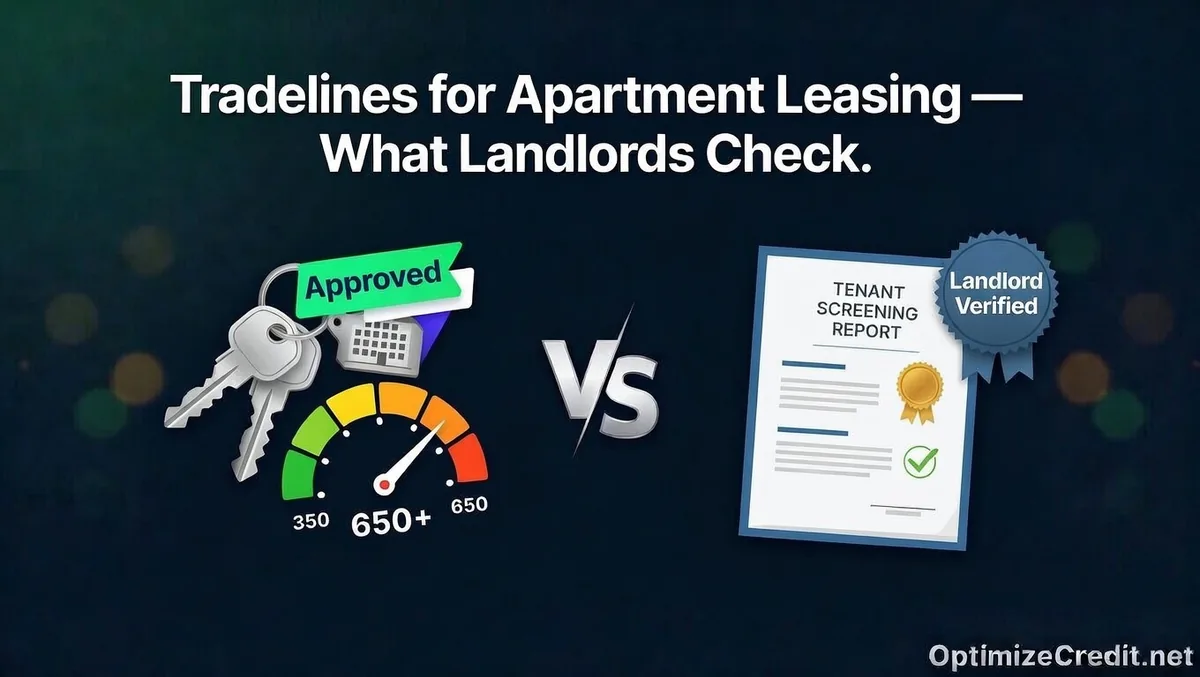
You find a good apartment, your income looks fine, your references are decent, and then the application comes back denied for "credit profile" or "screening criteria." That happens all the time in the 550–680 range because apartment approvals are usually not based on just one three-digit score. Landlords and property managers often use a tenant screening report, and that report can include credit data, rental history, eviction actions, criminal/background information, employment or income verification, and sometimes a separate rental risk score or recommendation.
That is why tradelines can help, but only in the right lane. A tradeline can improve the credit side of the file by thickening a thin profile, lowering utilization, and sometimes moving you above a score cutoff. It does not erase an eviction, fix unpaid rent in collections, or replace weak income documentation. If you want the best plain-English overview of what can be in a rental screening report, CFPB's explainer on tenant screening reports is the best starting point.
What landlords actually check
A tenant screening report is broader than a normal lender credit pull. CFPB says tenant screening reports can include credit reports, rental history including eviction actions and lawsuits, employment verification, criminal history, and even a risk score or recommendation based on criteria selected by the landlord. FTC says landlords may also use background-check companies that report things like housing court cases, judgments, arrests, and bankruptcies, subject to legal reporting limits.
That means many landlords are not looking only at "your FICO." Some use a traditional credit score, some use tenant screening services, and some use proprietary rental-scoring products. For example, TransUnion SmartMove markets ResidentScore as a score designed specifically for rental risk and says it is intended to predict eviction risk better than a traditional credit score. Experian, meanwhile, says many landlords use FICO Score 8, but some may use VantageScore.
The score bands that matter in practice
There is no universal legal minimum credit score to rent an apartment. Experian says that directly. But renters do run into predictable score bands in the market.
| Rental environment | Practical shorthand | What it usually means |
|---|---|---|
| Luxury or highly competitive | 700+ | Easiest path if income and rental history are clean |
| Mid-tier professionally managed | 650+ | Often workable if there are no major housing negatives |
| Flexible/private landlord/tougher-credit cases | 600+ | Often possible, but income, deposits, and references matter more |
That table is a strategy shorthand, not a published rulebook. The source-backed part is that many landlords prefer applicants in the 600–650 zone or better, 670+ usually reads as stronger creditworthiness, and higher scores may be needed in more competitive rental markets.
The real deal-breakers
Evictions and rental history
An eviction is usually a much bigger apartment problem than an ordinary subprime score. Experian says evictions are major red flags to landlords. It also notes that evictions do not appear on standard credit reports themselves, but unpaid rent or fees after an eviction can end up in collections and then show on your credit report. If a landlord uses a tenant screening company, they may also see eviction history directly in the rental-history portion of the report. FTC says most housing court cases and judgments generally cannot be reported after seven years, but within that window they can be very damaging.
Landlord and utility collections
Not all collections are equal in a rental context. If the collection is tied to a prior apartment or household utility, that tells a landlord something very specific: this applicant may have trouble paying housing-related obligations. Experian explicitly notes that unpaid rent or fees after an eviction can show up as a collection account, effectively turning a rental problem into a credit problem too.
Income ratio and stability
Experian says landlords often verify employment and income and may ask for pay stubs, W-2s, and bank statements. It also uses the standard 30% affordability rule to explain rent-to-income math: someone making $6,000 gross per month should generally target rent around $1,800 or less. That aligns with the common "about 3x rent in gross monthly income" rule renters hear from leasing offices.
Criminal/background screening
CFPB and Experian both note that tenant screening can include criminal history or broader background information. How heavily this matters varies by property and jurisdiction, but it is one more reason apartment approval is not purely a credit decision.
Why thin files get denied even without negatives
A clean file is not automatically a strong file. Experian says a thin credit file generally means having fewer than five active credit accounts or tradelines on one or more reports. It also says thin files can make approvals harder even when there are no late payments or collections.
That is a big deal for renters because thin files often look risky to screening models and manual reviewers. A renter can have no derogatories and still get denied because there is not enough history to prove consistent payment behavior. This is especially common for younger renters, recent immigrants, or applicants who mostly use cash and debit. Experian specifically says slim credit history can be a problem in apartment approval. If this describes your situation, the thin file problem guide explains why sparse data creates denial risk even on clean reports.
Where tradelines actually help
Tradelines help most when the problem is file structure, not severe housing negatives.
They can add depth to a thin file
If your file only has one or two small revolving accounts, adding a seasoned tradeline can make the report look more established. That can matter because thin files are defined by too few active tradelines, and myFICO says authorized-user accounts can appear on your report and affect your FICO Scores. For a deeper look at how AU accounts influence different file types, see why AU tradelines help some files more than others.
They can lower utilization
This is the clean math case. myFICO says revolving utilization is part of the "Amounts Owed" category, which is about 30% of a typical FICO Score, and that both overall utilization and the highest utilization rates on specific revolving accounts matter. A well-matched tradeline with a strong limit and low reported balance can sometimes materially improve the credit side of a rental file.
They can push you above a cutoff
This is the practical apartment use case. If a property's effective screening comfort zone is somewhere around the mid-600s, moving from 622 to 652 can matter far more than moving from 742 to 772. That does not mean the tradeline "beats the system." It means the application now clears an initial credit screen and gets judged on the rest of the file. Experian supports the broader point that landlords often become more comfortable as scores move into the 600–650 range and above, while stronger scores get easier treatment in competitive markets.
Where tradelines do not solve the problem
Use this table as the real decision filter:
| If your main problem is | Tradelines can help? | Why |
|---|---|---|
| Thin file | Yes | Adds depth and often improves score stability |
| High utilization | Yes | More limit and lower reported utilization can help |
| Just under a score cutoff | Often | Can move you above a screening threshold |
| Prior eviction | Usually not enough | Evictions are rental-specific red flags |
| Landlord collection | Usually not enough | Housing-related collections are heavily scrutinized |
| Income too low for rent | No | Tradelines do not fix affordability |
| Missing paperwork or weak employment proof | No | Screening still needs verifiable income and stability |
Timing: the tradeline must report before you apply
Apartment screening often moves fast. SmartMove says most reports are delivered the same day and that its process creates a soft inquiry with no score impact. That same speed is exactly why tradeline timing matters: if the tradeline is not already on the report when the landlord runs screening, it usually does nothing for that application.
That is why renters should think about tradelines before the apartment hunt, not after a denial. If you want the timing details, see the AU tradeline timing guide. Experian's safer AU-reporting language is that it may take several weeks or months for an authorized-user account to appear, depending on the issuer and bureau. So "I got added yesterday" is rarely useful for an application submitted today.
Workarounds when your file is not ready
If the tradeline is not posted yet, or if the real issue is not the score, you still have options. Experian says renters with bad or no credit may improve approval odds by renting from a private landlord, getting a guarantor, applying with roommates, offering to pay more upfront, or providing stronger proof of income and responsible history. It also notes that larger apartment complexes often have more rigid policies than smaller landlords.
The most practical fallback stack is:
- Recent pay stubs and bank statements
- A guarantor or co-signer
- A larger security deposit or more upfront payment if allowed
- Landlord references
- Targeting private landlords or more flexible properties
FTC also notes that adverse action can include requiring a co-signer or charging a larger security deposit because of something in the report. That is important because it means a "conditional approval" is still a screening outcome you can sometimes work with.
If you get denied, audit the report instead of guessing
If a tenant screening report helped cause the denial, CFPB says the landlord must give you an adverse action notice with the screening company's contact information, your right to a free copy if requested within 60 days, and your right to dispute inaccurate information. CFPB also says the screening company generally has 30 days to investigate disputes, though sometimes 45 days.
FTC adds that common errors include mixed files, duplicate records, incomplete case outcomes, outdated information, and even sealed or expunged criminal or eviction records still appearing. That matters because rental denials are often caused not only by bad data, but by wrong data.
Tradelines That Actually Report
We focus on what actually moves credit scores: utilization, account age, and clean reporting. Every tradeline is screened for reporting consistency before it is listed.