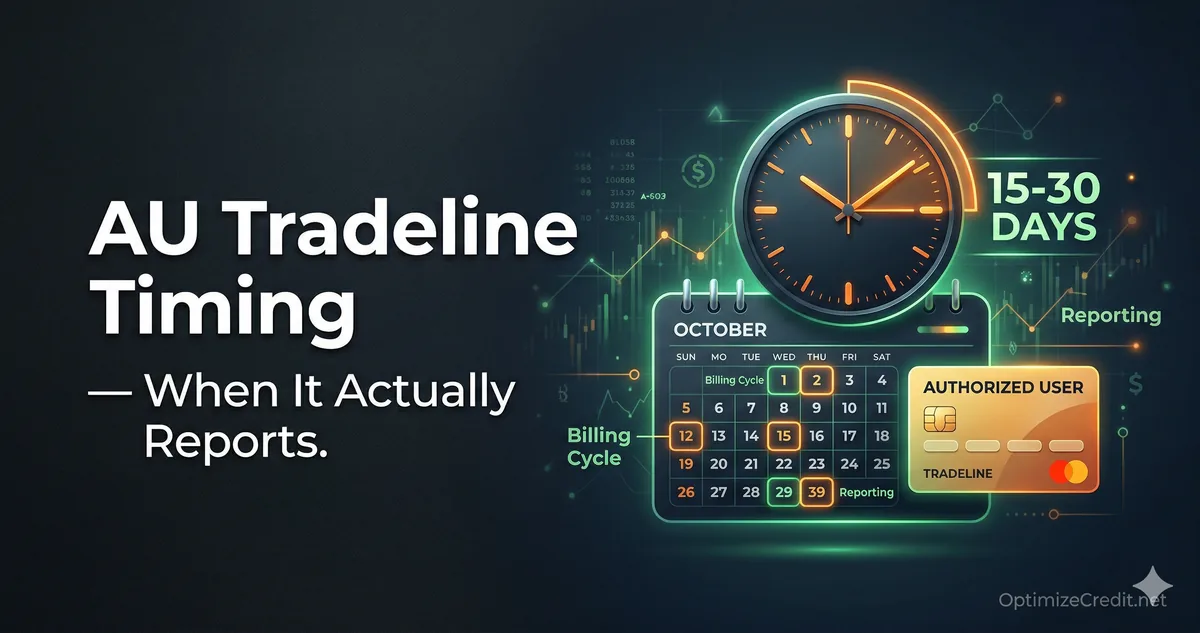
What actually happens after you are added as an authorized user
An authorized user tradeline can help, but timing matters almost as much as the tradeline itself. The tradeline has to be reported by the issuer, picked up by the bureau that matters, and still look legitimate when a lender or underwriter reviews the file. That is why the right question is not just "Should I be added?" It is "When should it start reporting, how long should it stay, and when could it create underwriting friction?" myFICO says authorized-user accounts can appear on your credit report and affect your FICO Score, while Experian notes that issuers choose whether to report them and to which bureaus.
The sequence is straightforward:
- The primary cardholder adds you with the issuer.
- The issuer decides whether it reports authorized-user data at all.
- If it does, the tradeline is sent on the issuer's reporting cycle.
- The bureau updates your file after receiving that data.
That sounds simple, but the timing is not instant. Experian says some issuers report AU accounts to all three bureaus, some do not, and it may take several weeks or months for the account to appear. In another Experian article, the bureau says you will typically see an authorized-user account appear within a couple of months after being added if the lender reports AU accounts.
That is why "I was added yesterday" is not the same as "the tradeline is now usable." The only date that matters for scoring and underwriting is the date the tradeline actually appears on the report used by the lender. If you want to verify that, pull reports from AnnualCreditReport.com, which is the authorized source for free credit reports from Equifax, Experian, and TransUnion.
The best time to add an AU tradeline
From a pure timing standpoint, the best window is usually before you enter a major application cycle.
Why? Because the tradeline needs time to:
- start reporting,
- hit the right bureau,
- show the right utilization at statement cut,
- and settle before a lender reviews the file.
Experian says authorized-user accounts may take weeks or months to appear, and mortgage lenders often re-check credit not just at preapproval but again after application and shortly before closing. That makes last-minute AU additions risky and unreliable. A practical planning rule is 1 to 2 months before a mortgage, auto, or high-stakes rental application, with the understanding that this is a strategy guideline rather than a formal industry rule.
That window matters even more if the file is in the 550–680 range, where modest profile changes can move approval odds, pricing tiers, or automated underwriting feedback. The AU account is not magic. It just changes the data in the file. If it is going to help, you want it there early enough to actually report cleanly and be reflected in the score model the lender uses. myFICO says authorized-user accounts have less impact in recent FICO versions than primary accounts, which is another reason to avoid treating AU timing as a last-minute miracle fix.
The worst time to add or remove one
The worst time is usually during mortgage underwriting.
That does not mean an AU tradeline is forbidden. It means it can create more scrutiny exactly when you want fewer moving parts. Fannie Mae says DU takes AU tradelines into account, but lenders must review whether they are an accurate reflection of the borrower's credit history. Fannie also says that if the borrower has several AU accounts but only a few accounts of their own, the lender should review the relationship to the account owner, whether the borrower uses the account, and whether the borrower makes the payments.
For manually underwritten Fannie Mae loans, the rule is even tighter: AU tradelines generally cannot be considered unless another borrower on the mortgage owns the tradeline or the borrower can document that they were the actual and sole payer for at least 12 months before application. If documented, the payment history and monthly payment must then be included in the analysis and debt-to-income ratio.
Experian also notes that lenders may not give much weight to AU-driven score strength if you have few accounts of your own or cannot show that you have been making the payments. And mortgage lenders typically review credit again before closing. So adding or removing an AU account mid-underwriting can trigger new questions, fresh conditions, or even a changed DTI picture. That is why, as a practical matter, underwriting is the wrong time to experiment.
How to choose the right AU tradeline
Not every AU tradeline is helpful. The useful ones usually share four traits:
1) Real age
Older accounts can help more because age is part of the credit picture. Experian says an AU account may help if it is an old account and that history gets added to your report. But older only helps if the tradeline actually reports and the rest of the account is clean.
2) Low utilization
A high-limit card is not enough by itself. What matters is the relationship between balance and limit. myFICO says both positive and negative information on an AU account can affect the AU's FICO Score, and Experian specifically says high utilization on the primary cardholder's account can hurt the authorized user.
3) Clean payment history
An AU tradeline works only if the primary cardholder manages it well. myFICO says missed payments or high utilization on the primary holder's account can hurt the authorized user's FICO Score. Experian adds a nuance: Experian itself says it will not include missed-payment information on an AU's credit report, but high utilization can still appear and hurt. That means bureau treatment may differ, which is another reason to verify the actual bureau data instead of assuming.
4) The right bureau coverage
Experian says issuers are not required to report to all three bureaus and can change reporting policies without notice. So a tradeline that reports only to one bureau may do little if a lender pulls another. For mortgage applications especially, bureau matching matters.
How long should you keep the tradeline?
If the goal is ongoing scoring support, the conservative answer is: keep it on as long as it is still helping and not creating underwriting or risk problems.
This is where bad credit content often gets sloppy. Some people assume once an AU tradeline has reported, the full age and benefit will safely remain after removal. That is not a safe assumption to build strategy around. myFICO says an AU account can be removed from your report when you request removal from a delinquent AU account, and Experian says once the lender removes your name, it should no longer report the account to your credit history. So the safe planning assumption is that ongoing benefit generally requires ongoing reporting.
That does not mean every issuer and bureau will handle historical display the same way in every case. It means you should not count on "I'll remove it later and keep the upside forever." If you need the benefit for a live application, treat the tradeline as something that probably needs to remain on the report until the lender is done using that file.
When removal makes sense
Removal makes sense in five common situations:
| Situation | Why removal may help |
|---|---|
| The primary cardholder is carrying high balances | High utilization can damage the AU's score |
| The primary cardholder is becoming risky or late | Negative data can hurt the AU |
| An underwriter is questioning the account | Removing it may simplify the file, though timing matters |
| The AU debt is complicating DTI analysis | Some programs may require it to be considered unless documentation supports exclusion |
| The tradeline is no longer helping because you now have your own strong profile | You may not need the extra underwriting friction |
That table is based on the core source mechanics: AU accounts can help or hurt depending on reported utilization and payment history, and agency underwriting rules may require review or inclusion of AU-related obligations in certain circumstances.
The mortgage-specific "piggyback" issue
The basic truth is this: agency underwriting does not ban authorized-user tradelines outright, but it does not blindly trust them either.
Fannie Mae explicitly recognizes AU accounts as a legitimate practice that can help someone establish credit history and score based on the owner's account history. DU considers AU tradelines in risk assessment, but lenders still have to determine whether those lines are an accurate reflection of the borrower's credit history. For manual Fannie underwriting, AU tradelines generally do not count unless narrow documentation standards are met.
HUD guidance also shows AU accounts are not ignored. Recent HUD handbook search results state that AU account obligations must be included in a borrower's DTI ratio unless the required exception documentation is present. That means FHA-style underwriting does not treat AU accounts as prohibited, but it definitely treats them as something that may need documentation and debt analysis.
So the clean version of the "piggyback" issue is:
- FHA / agency logic: not automatically disallowed, but subject to review and sometimes documentation.
- Manual underwriting: more restrictive.
- Lender overlays / portfolio judgment: can be stricter than the baseline rules.
That last point is an underwriting inference, but it is the practical takeaway from the fact that Fannie says lenders must use judgment when AU tradelines may not reflect the borrower's own history.
The practical timing playbook
If you are thinking purely like a systems operator, the cleanest AU timing workflow looks like this:
- Add the AU early enough for at least one clean reporting cycle.
- Confirm that the issuer reports AU accounts and to which bureaus.
- Make sure the card is old enough, clean enough, and low-utilization enough to actually help.
- Avoid changing AU status during active mortgage underwriting.
- Do not remove it until you are done relying on that reported benefit.
- Do not assume the benefit will safely persist after removal.
Every part of that playbook comes from one simple fact pattern: reporting is issuer-controlled and can take time; AU treatment in scoring is real but not equal to primary-account strength; and mortgage underwriting may review or discount AU tradelines depending on the file and program.
For a deeper baseline on reporting lag, see How Long Tradelines Take to Report. To understand why the tradeline's effect varies by file type, read Why Do Authorized User Tradelines Help Some Credit Files More Than Others. And for details on how statement dates and reporting cycles interact, see How Credit Cards Report to the Bureaus.
Tradelines That Actually Report
We focus on what actually moves credit scores: utilization, account age, and clean reporting. Every tradeline is screened for reporting consistency before it is listed.