Why shared credit gets misunderstood
Shared credit is one of the easiest areas of personal finance to misunderstand because the words people use at home rarely match the legal structure on the account.
A couple says, "We both have that card," but one person is only an authorized user. A parent says, "I just helped my son get the loan," but they actually co-signed and are fully liable. A divorcing spouse assumes a court order ended the risk on a joint card, even though the lender still has both names on the contract.
That confusion matters because lenders and scoring models do not care what the family intended. They care what was opened, who is legally liable, and what gets reported to the credit bureaus. A joint account, a co-signed loan, and an authorized-user card can all place the same account on more than one credit report, but they do not create the same legal obligation or the same exit path.
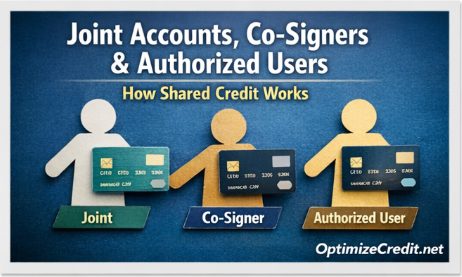
The short framework is simple:
- Joint account: shared ownership, shared access, shared liability
- Co-signed account: one primary borrower, but shared legal responsibility for repayment
- Authorized user: shared card access, but usually no legal obligation to repay
If you understand that one distinction, most of the credit consequences start to make sense.
For a deeper look at the score side of being added to someone else's card, see AU Tradeline Effect.
Quick comparison table
| Structure | Who owns the account? | Who is legally responsible? | Usually appears on both credit reports? | Typical use case | Relative risk |
|---|---|---|---|---|---|
| Joint account | Both people | Both people, fully | Yes | Couples with truly combined finances | Highest |
| Co-signed account | Primary borrower owns/uses it, cosigner backs it | Both people, fully | Yes | Parent helping child qualify for a loan | High |
| Authorized user | Primary cardholder owns it | Primary cardholder only, in most cases | Often yes, if issuer reports AUs | Credit building or convenience access | Lowest |
That ranking is about liability, not guaranteed score benefit. A well-managed authorized-user account can help. A joint account can also help if it is paid perfectly. But if your question is, "Who can get stuck with the debt?" joint is the riskiest, then co-signing, then authorized user.
Why shared credit gets people into trouble
Most consumers think shared credit is about convenience. In practice, it is also about data flow and legal exposure.
When an account is reported on your credit file, the lender or card issuer can transmit its balance, payment history, and status to the bureaus. If you are legally liable, the creditor can also pursue you for payment. That means two different issues are always in play:
- Reporting risk: can this account help or hurt my credit file?
- Contract risk: can the lender legally come after me for the debt?
Joint accounts create both kinds of risk at the highest level. Co-signing creates less day-to-day usage risk, but still creates major contract risk. Authorized-user status creates reporting risk without the same repayment obligation.
That is why people should stop asking only, "Will this help my score?" and start asking, "What exactly am I signing up for?"
Joint accounts: full sharing, full liability
A joint account is the purest form of shared credit. Both people are account holders. Both usually have equal access. Both are fully responsible for the debt.
That means if one person charges the balance up, both are still liable. If one person misses the payment, both can be affected. If the account is a revolving account such as a credit card, the balance can influence both files because the account is being reported to both.
This is why joint accounts can be powerful for some married couples or long-term partners with genuinely merged finances. A well-managed joint account can build shared history, shared payment performance, and shared credit depth. But it also means the downside is fully shared. There is no "that was really their purchase" defense with the creditor.
How joint accounts report
A joint account generally appears on both credit reports, with the same payment history and the same balance information attached to the account. That means:
- on-time payments can help both files
- late payments can hurt both files
- revolving balances can affect utilization calculations on both files
- installment history can contribute to both files while the account remains reported
The important point is that a joint account is not "half" an account on each report. It is the same debt relationship appearing on both reports.
When joint accounts make the most sense
Joint accounts usually make the most sense when two people:
- truly combine finances
- both want full access
- both trust each other's payment discipline
- both understand that the liability is fully shared
That usually points to spouses or long-term partners with one coordinated household system. It is rarely the safest structure for casual financial help.
Co-signers: not the main user, but still on the hook
Co-signing is most common when the primary borrower cannot qualify alone because of score, history, income, or file depth. The cosigner supports the application by adding their own credit strength to the file.
This is where people get fooled: the cosigner may not be the one driving the car, using the student-loan proceeds, or benefiting from the financed asset, but the lender still treats the cosigner as responsible for the debt.
In practical terms, a co-signed loan is often reported on both credit files. If the loan is paid perfectly, both files can reflect that positive history. If it goes late, both files can be damaged.
Why co-signing is different from joint credit
Co-signing is different from a joint account because the cosigner usually does not get equal operational access. They may not be the borrower using the money. They may not even control the account. But from the lender's perspective, they are still part of the repayment promise.
That creates a difficult structure:
- the cosigner gets much of the downside
- the cosigner gets much less practical control
- the account may still count against the cosigner when another lender evaluates debt obligations
This is why co-signing should be treated as a real financial commitment, not a favor in the abstract.
When co-signing can make sense
Co-signing can make sense in narrower scenarios, especially:
- a parent helping a young adult qualify for a first auto loan
- a parent or family member helping with a private student loan
- a spouse or partner helping one borrower qualify when the household intends to manage the debt together
But the right mindset is not "I'm just helping them qualify." It is "I am taking legal repayment risk on this account."
Authorized users: lowest legal risk, but still not harmless
Authorized-user status is the most misunderstood of the three because it looks similar to shared credit at the wallet level while being very different at the contract level.
The primary cardholder owns the account. The authorized user may receive a card and may be allowed to make purchases. But the authorized user is usually not contractually liable for the debt.
That makes authorized-user status the lowest-risk shared-credit structure from a legal perspective.
How authorized users help or hurt
If the issuer reports authorized users to the bureaus, the account may appear on the authorized user's credit report. When that happens, the account's history can influence the authorized user's profile.
That can be positive if the account is:
- old
- low utilization
- cleanly paid
- managed by a disciplined primary cardholder
It can be negative if the primary cardholder starts carrying high balances or missing payments.
That is the key idea: authorized-user status is low risk legally, but not necessarily low impact scoring-wise.
FICO has said authorized-user accounts can affect scores, but in newer versions they generally have less impact than primary accounts. So an AU account can help build or support a file, but it is not the same thing as proving you can manage your own primary credit successfully.
When authorized-user status makes the most sense
Authorized-user status is usually the best fit for:
- a parent helping a child or young adult build history
- a spouse helping the other spouse strengthen a thinner file
- early-stage credit building where the goal is to add positive reporting without adding shared legal debt
This is why authorized-user status is often the safest first shared-credit move in a credit-building context.
The risk ladder: joint, co-signer, authorized user
If you are ranking these purely by how much damage they can do if things go wrong, the order is straightforward.
1. Joint account — highest risk
You share ownership, access, and full liability. One person's mistake is fully the other person's problem with the creditor.
2. Co-signer — high risk
You may not control the account, but you are still legally responsible if the primary borrower fails to pay.
3. Authorized user — lowest risk
You may benefit from the reporting, and you may have a card, but you usually are not responsible for repayment.
That is why authorized-user status is usually preferred over joint or co-signed arrangements when the goal is simply to help someone build or support credit.
Divorce and separation: the contract does not disappear
This is where shared credit becomes emotionally expensive.
A divorce decree or separation agreement may say one person is supposed to pay a debt. But the creditor is not bound by that family-court arrangement unless the lender itself changes the contract.
So if two people have a joint credit card or joint loan and one spouse is ordered to pay it, the other spouse can still be exposed if the lender still has both names on the account.
That is the single biggest misconception around shared debt after divorce: family-court allocation is not the same thing as lender release.
The practical result is:
- joint accounts can still hurt both parties after divorce
- late payments can still report while both names remain on the contract
- closing or refinancing is often the only clean way to separate the risk
Authorized-user relationships are easier. If one spouse was only an authorized user, that person can usually be removed more simply than a true joint borrower or co-obligor.
Removal: how each structure is unwound
Removing an authorized user
This is usually the easiest. The primary cardholder can ask the issuer to remove the AU, and the authorized user may also be able to ask for removal directly. Once the lender updates its records, the account should stop reporting as an authorized-user account to that person's file.
This is one reason AU status is flexible: it is relatively easy to end compared with joint liability or co-signing.
Removing a co-signer
This is much harder. In most real-world cases, a cosigner is removed only through:
- payoff
- refinance into the primary borrower's sole name
- a lender's formal cosigner-release program
Until the lender agrees to that change, the cosigner typically remains exposed.
Getting out of a joint account
This is often the hardest of all because either:
- the account must be closed
- the debt must be paid off
- the lender must agree to alter the contract
- or one party must refinance into an individual obligation
The main point is that you usually cannot just "take your name off" a joint account the way people think.
Effects on both parties when the relationship changes
If an authorized user is removed
The primary cardholder usually keeps the account and responsibility. The authorized user may lose whatever benefit the account was contributing to their report. If the account had been helping the AU with age, available credit, or clean payment history, the AU's score may move down once the account is no longer reported.
If a co-signed loan is refinanced or released
The borrower keeps the debt in their own name if they qualify alone. The cosigner's exposure ends only once the lender formally releases it. Until then, the reporting and liability can remain tied to both people.
If a joint account is closed
Closing stops future use, but it does not make existing balances vanish. If a balance remains, both joint holders may still owe it. The account may continue to appear as a closed tradeline for some time, but the contractual issue is whether the balance and responsibility were fully resolved.
When each structure usually works best
Married couples or deeply merged households
Joint accounts can work when both people want true shared ownership and shared responsibility. But many couples still prefer one primary holder with the other as an authorized user for some accounts, because it isolates risk better.
Parents helping young adults
For a first car loan or certain student-loan situations, co-signing may be the structure that gets approval. But if the goal is general credit building rather than access to a specific loan, authorized-user status is usually safer.
Thin-file or early-stage credit building
Authorized-user status is usually the cleanest starting point because it can add positive history without legally tying the helper to new debt from the learner.
Verify what you actually are
A surprising number of people do not know whether they are a joint holder, a cosigner, or an authorized user. That is a dangerous ambiguity.
The fastest practical check is:
- pull all three reports from AnnualCreditReport.com
- review how the account is identified
- confirm directly with the lender or card issuer
Do not rely on household shorthand like "we're both on it." That phrase can describe three completely different legal structures.
Bottom line
Joint accounts, co-signers, and authorized users are all forms of shared credit, but they are not remotely the same thing.
A joint account means shared ownership and full shared liability. A co-signed loan means one person uses the credit, but both are still legally responsible. An authorized user arrangement means the account may report to the user's file, but the primary cardholder usually remains the one legally obligated to repay.
That is why the safest way to compare them is not by asking which one "helps credit the most." The safer first question is: Who owes the debt if something goes wrong?
Once you answer that, the reporting and removal issues become much easier to understand.
Get Your Personalized Credit Roadmap
Upload your credit report and our Credit Analyzer identifies what may be affecting your score and provides a step-by-step, report-based action plan.
Analyze My Credit Free →