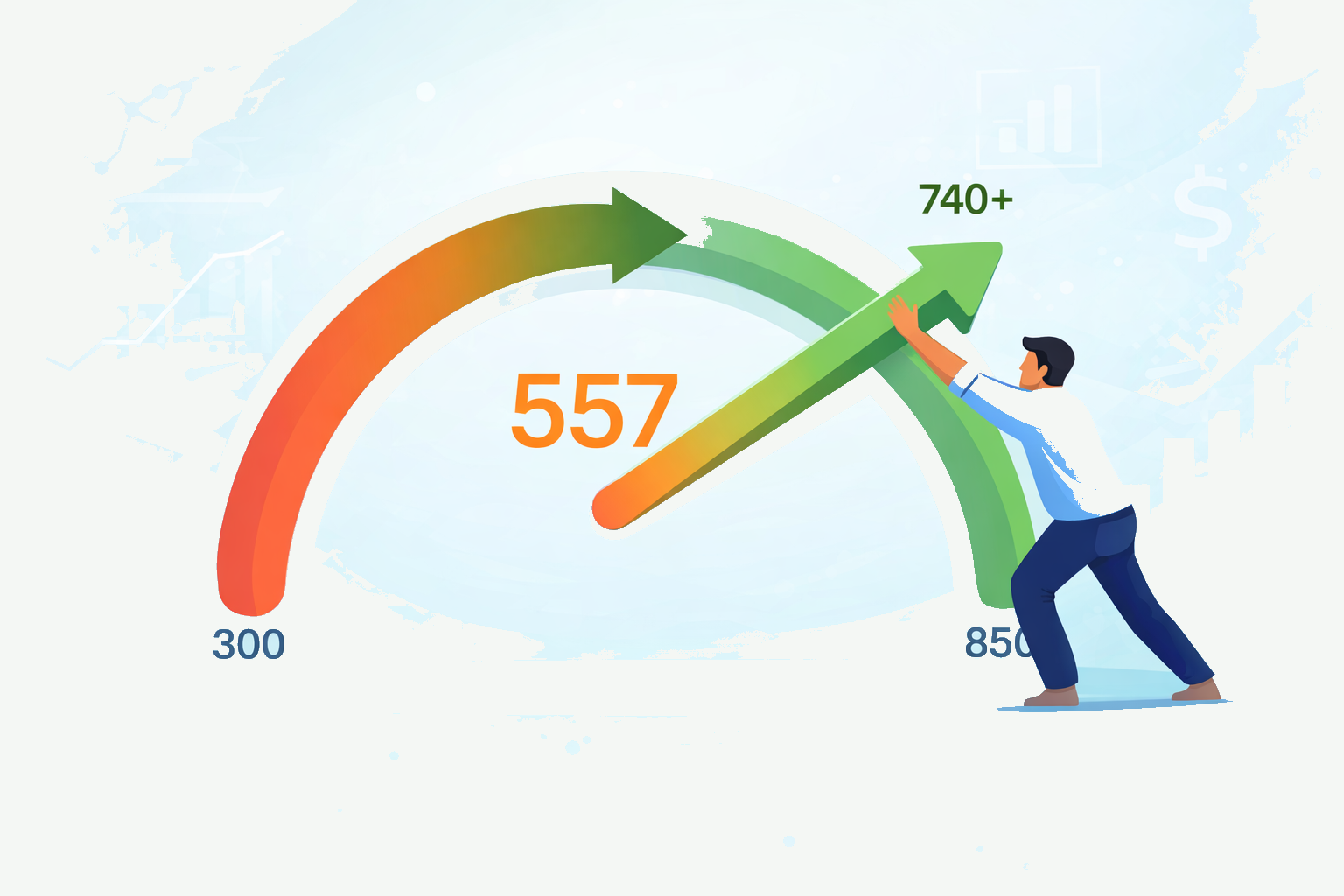
If you ask the average consumer what a "good" credit score is, you'll get a vague answer somewhere around 700. In the lending industry, vague answers cost money. Credit scoring is a mathematically precise system — your three-digit number is an algorithmic prediction of the likelihood you'll go 90+ days late on a debt within the next 24 months. Whether you're preparing for a mortgage, targeting a premium rewards card, or trying to pass an apartment screening, "good" is entirely relative to the specific product threshold you need to clear.
Here's the data-driven breakdown of every major scoring range, the exact thresholds where your borrowing costs change, and what lenders evaluate beyond the number itself.
FICO Score Ranges: The Industry Standard
FICO scores power over 90% of U.S. lending decisions. The base models — FICO 8 and FICO 9 — operate on a 300–850 scale. Here's how the algorithm categorizes consumer risk:
| Range | Category | What It Means |
|---|---|---|
| 800–850 | Exceptional | Lowest available rates on every product. About 21% of consumers fall here. Mathematically identical to 780 for pricing purposes. |
| 740–799 | Very Good | Best-tier pricing on most loans. This is where the rate curve flattens — lenders consider you low-risk. |
| 670–739 | Good | Prime borrowing territory. Competitive approvals, but not optimal pricing. You're above the national median. |
| 580–669 | Fair | Subprime to near-prime. FHA mortgages open at 580, but conventional products carry significant rate premiums. |
| 300–579 | Poor | Severe risk tier. Limited to secured products, credit-builder loans, or FHA with 10% down (500–579). |
The average American FICO score currently sits around 715, placing the typical consumer in the upper half of the "Good" range. That's functional for everyday credit needs but leaves real money on the table for major financing — especially mortgages, where the gap between 715 and 740 can translate to tens of thousands of dollars over a 30-year term.
VantageScore Ranges: Similar Scale, Different Math
VantageScore — developed jointly by Equifax, Experian, and TransUnion — uses the same 300–850 scale but draws the category lines differently and weights factors with a distinct algorithm.
| Range | VantageScore 3.0 Category |
|---|---|
| 750–850 | Excellent |
| 700–749 | Good |
| 650–699 | Fair |
| 550–649 | Poor |
| 300–549 | Very Poor |
The critical difference: VantageScore can generate a score with as little as one month of history and one account, while FICO typically requires six months and at least one account reporting in the last six months. VantageScore also treats paid collections more leniently and penalizes recent credit-seeking behavior more aggressively.
This matters because Credit Karma, Credit Sesame, and most free monitoring tools display a VantageScore. Your mortgage lender, auto lender, and most credit card issuers pull a FICO score. Discrepancies of 20–40+ points are common, and the gap tends to be larger for consumers with thinner files or recent negative items. If you're using a free VantageScore to gauge mortgage readiness, you could be in for a costly surprise at the loan officer's desk.
For a deeper technical breakdown of how these models diverge, see our guide on FICO vs. VantageScore.
Why "Good" Depends Entirely on Your Goal
A 680 might be a massive win for someone rebuilding after a bankruptcy, but it's an expensive score for someone funding a $500,000 mortgage. "Good" is subjective; approval thresholds are absolute.
FHA Mortgages: 580+
The hard systemic threshold for an FHA loan with maximum financing (3.5% down) is a 580 FICO. Drop to 579 and the required down payment jumps to 10%. Below 500, FHA is off the table entirely.
Conventional Mortgages: 620+
Fannie Mae and Freddie Mac's automated underwriting systems require a minimum 620 FICO. At 619, conventional lending is effectively unavailable until you execute a rapid rescore to cross that line.
Best Mortgage Rates: 740+
This is where the pricing curve flattens. On a $400,000 30-year fixed mortgage, the rate difference between a 680 and a 740 can run 0.50%–0.75%, translating to $120–$180/month — or $43,000–$65,000 over the life of the loan.
Auto Loans (Best Rates): 740+
Auto lending uses specialized FICO Auto Scores that weight installment loan history more heavily. You can get financed at 580, but expect APRs 8–12 points higher than a 740+ borrower. Captive lenders (Toyota Financial, Ford Motor Credit) reserve their 0%–1.9% promotional rates for 740+.
Premium Credit Cards: 720+
Heavy-hitting rewards cards with $400+ annual fees and large sign-up bonuses typically require 720+ to consistently clear automated approval logic. Solid cashback cards are accessible at 670+. Secured cards are available at virtually any score.
Apartment Rentals: 650+
Most property management companies screen at 650, though competitive urban markets (San Francisco, New York, Seattle) effectively require 700+ when landlords can choose among many qualified applicants. Some screening services use proprietary models rather than standard FICO, adding another layer of unpredictability.
The Pricing Thresholds That Actually Matter
If you take one technical concept from this article, let it be this: lending pricing is not a smooth curve — it's a staircase.
When you apply for a conventional mortgage, your interest rate and fees are dictated by Loan-Level Price Adjustments (LLPAs). This is a grid matrix used by Fannie Mae and Freddie Mac that intersects your FICO score with your loan-to-value ratio to determine how much additional risk-based pricing you'll pay.
These LLPA thresholds occur in strict 20-point increments:
- 620 — The conventional loan floor. Below this, you're limited to FHA, VA, USDA, or non-QM products. Crossing 620 opens the entire conventional market.
- 640 — The first meaningful LLPA reduction. Pricing adjustments begin to ease, particularly for borrowers with larger down payments.
- 660 — Jumbo loan programs often set their floor here. Many lenders apply a significant pricing improvement above 660.
- 680 — The threshold where the most aggressive risk-based pricing adjustments drop off. PMI rates improve meaningfully. Several major auto lenders use 680 as their "prime" cutoff.
- 700 — A psychological and practical benchmark. Many landlords and credit card issuers use 700 as an informal floor for their better products.
- 720 — Premium credit card territory. Auto lenders offer their best or near-best rates. Some mortgage lenders hit optimal PMI pricing here.
- 740 — The gold standard for mortgage pricing. LLPA adjustments at this level are minimal or zero for most loan-to-value ratios. The push from 739 to 740 can eliminate thousands in fees over the life of a mortgage — a single-point jump worth more than the leap from 770 to 800.
- 760 — Some lenders offer one final incremental rate improvement. The benefit above 740 is modest but measurable.
- 780+ — The pricing ceiling. An 820 gets the same rate as a 780 in virtually every lending scenario. The marginal return on score improvement above 780 is functionally zero.
Understanding this staircase structure is the key to strategic score optimization. If you're at 735, the push to 740 is worth far more than going from 770 to 810.
Beyond the Number: What Lenders See in Your Full Report
Your score gets you through the automated filter. The underwriter reads the report. Here's what they evaluate beyond the three-digit number:
Thick files vs. thin files. A 720 generated from a single secured card open for 14 months is mathematically identical to a 720 built on 12 years of auto loans, a mortgage, and multiple revolving accounts. The score is the same, but the underwriting risk assessment is not. Thin-file borrowers face more scrutiny and may be asked for compensating factors.
Derogatory context. A 680 caused by high revolving utilization is a completely different risk profile than a 680 caused by a recent 90-day late on an installment loan. The score is identical, but FICO reason codes tell the underwriter which factors are driving the number — and utilization-driven suppression is considered far more fixable (and less risky) than recent payment failures.
Utilization snapshots. Aggregate utilization matters, but per-card utilization matters too. A single card reporting above 50% can suppress your score even when your overall ratio looks reasonable. The real optimization math favors keeping individual card utilization under 9% and total revolving utilization under 30%. For the full mechanics behind these thresholds, see our utilization math guide.
Debt-to-income ratio (DTI). Your credit score measures your willingness to repay. DTI measures your ability to repay. You can carry an 800 FICO, but if your monthly debt obligations consume 50%+ of gross income, a mortgage underwriter will deny the application. These are independent systems that lenders evaluate in parallel.
Account age and depth. FICO weighs average age of accounts, age of oldest account, and age of newest account. A 690 built on eight years of diversified history is more robust — and more underwriter-friendly — than a 690 from two cards opened 14 months ago.
The Consumer Financial Protection Bureau (CFPB) provides a comprehensive guide to understanding what creditors report and how bureaus compile your file. You can also pull your full reports for free weekly at AnnualCreditReport.com.
Score Versions: You Don't Have One FICO Score
There isn't a single FICO score. There are dozens of FICO scoring models, each calibrated for a specific lending vertical:
Mortgage lenders almost universally use older FICO versions — FICO Score 2 (Experian), FICO Score 5 (Equifax), and FICO Score 4 (TransUnion). These models can be 15–20 years old. The score on your bank's dashboard is likely a FICO 8, which can differ meaningfully from your mortgage-specific scores.
Auto lenders typically pull FICO Auto Score 8 or Auto Score 9, which weight installment loan history more heavily than generic models.
Credit card issuers mostly use FICO Bankcard Score 8 or FICO Score 8.
It's not unusual for your FICO 8 to read 730 while your mortgage FICO 2 comes back at 705. Planning around the wrong score version leads to expensive surprises at the application stage. If you're within 3–6 months of applying for a mortgage, ask a loan officer for a tri-merge pull with mortgage-specific scores. It's a hard inquiry, but it gives you the actual numbers your underwriter will use.
Get Your Personalized Credit Roadmap
Upload your credit report and our Credit Analyzer identifies exactly what is holding your score back and gives you a step-by-step 90-day plan to reach 740+.
Trusted by 500+ successful placements and excellent reviews on TrustPilot ★★★★★
Analyze My Credit Free →