What Is Credit Mix in the FICO Score?
Most consumers rebuilding credit focus on the two biggest FICO variables first: Payment History (35%) and Amounts Owed (30%). That's logical — master those two and you've optimized 65% of the scoring model. But when you're stuck in the 550–680 range fighting for a mortgage pre-approval or a Tier 1 auto rate, mastering the basics isn't enough. You have to optimize the margins.
The most misunderstood of those marginal factors is Credit Mix.
Credit mix evaluates the diversity of account types on your credit report. The underlying logic is straightforward: a borrower who can successfully manage both fluctuating credit card balances and fixed-term loan payments is statistically less likely to default than a borrower who has only ever handled one type of debt.
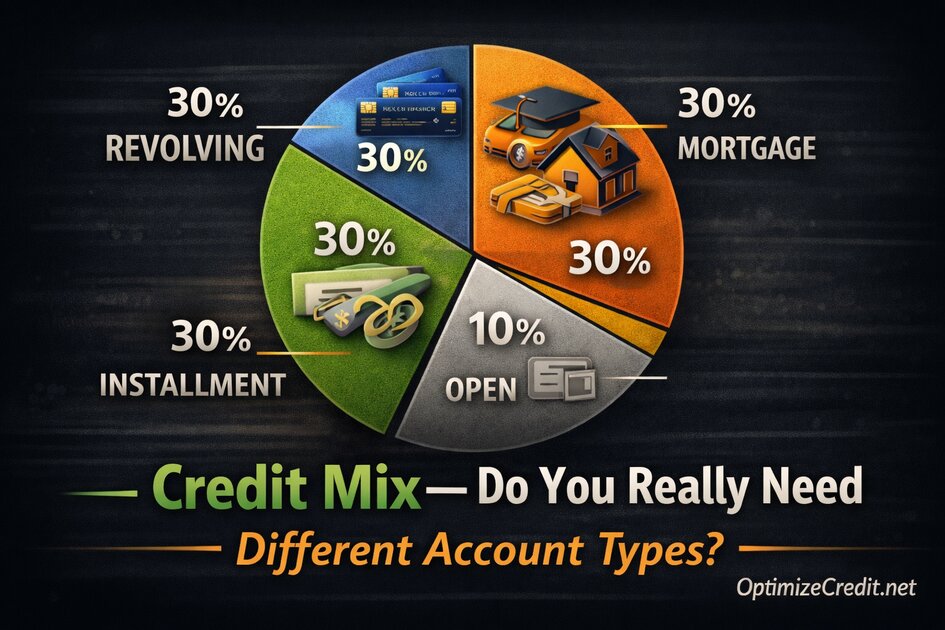
According to myFICO, credit mix accounts for approximately 10% of your FICO 8 and FICO 9 scores. The older mortgage-specific models (FICO 2, 4, and 5) assign a functionally similar weight.
The FICO algorithm categorizes your accounts into four primary types:
- Revolving credit — Credit cards, store cards, HELOCs. No fixed end date, no fixed monthly payment. Your minimum fluctuates with your balance. This is the account type most heavily weighted in utilization calculations, which means revolving accounts do double duty: they affect both your credit mix and your amounts owed (30% of FICO).
- Installment credit — Auto loans, personal loans, student loans, credit-builder loans. You borrow a fixed amount and repay it in equal monthly payments over a set term. The balance decreases predictably over time.
- Mortgage accounts — Technically installment debt, but FICO parses mortgages into their own sub-category. A mortgage tradeline signals you've passed a significant underwriting bar — it's the strongest single indicator of creditworthiness the algorithm recognizes.
- Retail and open accounts — Store-branded cards (Macy's, Home Depot) and charge cards that require full monthly payment (certain American Express products). These carry less algorithmic weight than general-purpose bank-issued revolving cards.
Why 10% Can Make or Break a Borderline File
Ten percent of an 850-point scale sounds small. But FICO doesn't distribute its weight evenly across all consumers. For thin files — people with fewer than five tradelines or limited history — credit mix carries disproportionate influence. And for borderline files in the 600–680 range, 10–20 points from a stronger mix can be the exact difference between approval and denial.
Here's a scenario that plays out constantly in mortgage lending: a borrower has three credit cards, all current, no late payments, 12% aggregate utilization. Score: 648. They need 660 for conventional loan pricing with reasonable PMI. Their file has zero installment history. The algorithm sees a consumer who has only proven they can manage one type of credit obligation. That gap in mix is costing them.
To understand how credit mix fits within the full FICO scoring architecture, see our breakdown of the 5 Factors That Make Up Your FICO Score.
The Monolithic File Problem
A "monolithic" credit file contains multiple accounts — but all of the same type. This is the most common credit mix failure pattern, and it shows up in two flavors.
Revolving-only files. Five credit cards, all paid on time, balances at zero. Looks great on the surface. But when this consumer applies for a $40,000 auto loan, FICO's model views them as untested. They've proven they can manage small, flexible credit lines — but there's zero data showing they can commit to a $600 fixed payment every month for five years.
Based on scoring patterns reported across myFICO community data and lender observations, a revolving-only file with otherwise identical metrics (same age, same payment history, same utilization) typically scores 10–25 points lower than a mixed file.
Installment-only files. Less common but equally problematic. A borrower whose only history is $50,000 in student loans and a $20,000 auto loan has never demonstrated the restraint required to hold a credit card with a $10,000 limit and not max it out. And without revolving accounts, there's a second problem: there's no revolving utilization to optimize. Since amounts owed (30% of FICO) relies heavily on revolving utilization ratios, having zero revolving tradelines means leaving the single largest score-optimization lever completely untouched.
The Minimum Viable Mix
The most efficient path to neutralizing the credit mix penalty is simple:
One revolving account + one installment account.
Once the FICO algorithm detects at least one active account in both primary categories, the "lack of mix" penalty is largely neutralized. You don't need five credit cards, an auto loan, a mortgage, and a personal loan. Going from zero installment accounts to one has a meaningful impact. Going from one to three installment accounts has almost no additional mix benefit.
For the revolving side, a single general-purpose credit card (Visa, Mastercard) counts. Store cards technically add revolving history but often come with low limits ($500–$2,000) that create utilization problems if you actually use them.
For the installment side, a credit-builder loan ($500–$1,000, held in a locked savings account) satisfies the same mix criteria as a $30,000 auto loan. The amount doesn't matter for mix purposes — only the account type classification.
For consumers in the 550–620 range, the minimum viable mix is most commonly achieved by pairing a secured credit card with a credit-builder loan.
The Mathematical Trap: Opening Accounts Just for Mix
Here's where generic credit advice goes wrong. Yes, credit mix matters. But when you open a new account solely to improve your mix, you actively damage two other FICO factors that carry more weight:
Hard inquiries (part of the 10% new credit factor). Every new credit application generates a hard inquiry, which typically costs 3–8 points for 12 months. You're spending points from one 10% factor to gain points in another 10% factor — at best, a lateral trade with delayed upside.
Length of credit history (15% of FICO). A new account drops your average age of accounts immediately. If you have three accounts averaging 6 years and open a fourth at 0 months, your average falls to 4.5 years. That 15% factor outweighs mix by 50%.
The timing mismatch. The inquiry and age-of-accounts hits are instantaneous. The mix benefit takes at least one billing cycle to appear — sometimes two, depending on when the new account reports to the bureaus. If you need your score optimized for a specific application date, opening a new account is a gamble.
The rule: Do not open a new primary account within 6 months of applying for a major loan just to improve credit mix. If you're 6+ months out and have a monolithic file, adding the missing account type is worth the short-term cost. If you're inside that window, optimize what you already have — utilization positioning, payment timing, and dispute resolution for inaccurate items.
How Authorized User Tradelines Add Mix Without the Penalty
There's one way to add revolving account diversity to your credit report without a hard inquiry and without resetting your average account age: authorized user (AU) tradelines.
When you're added as an authorized user on someone else's credit card, that account's full history — including its age, credit limit, and payment record — typically appears on your credit report. FICO 8 and FICO 9 both score AU tradelines. FICO 8, still the dominant model for most lending decisions, gives them meaningful weight.
For credit mix purposes, an AU tradeline adds a revolving account to your file. If your report is installment-only, this directly addresses the mix gap. If you already have revolving accounts, an additional AU tradeline still helps by injecting account age depth and reducing your aggregate utilization ratio (the higher total limit lowers your overall utilization percentage). For a deeper look at how shared credit relationships interact with scoring models, see our guide on joint and AU account structures.
The limitation: AU tradelines are revolving by nature. They won't add installment diversity. If your file is revolving-only and needs an installment account, an AU tradeline doesn't solve the mix problem — though it may still improve your score through age and utilization effects.
Credit Mix Across Different Scoring Models
Credit mix isn't treated identically across every model:
- FICO 8 — the most widely used model for credit cards and auto lending — weights mix at roughly 10%.
- FICO 2, 4, and 5 — the older models still used in mortgage underwriting — recognize mix with functionally similar weight.
- VantageScore 3.0 and 4.0 — fold account type into a broader "depth of credit" category rather than treating it as a standalone factor. The exact weight differs, and VantageScore generally treats mix as less of a differentiator.
For consumers in the 550–680 range preparing for a mortgage, auto, or rental application, FICO 8 or the FICO mortgage suite is what matters. Don't spend energy optimizing for VantageScore mix mechanics unless you know your lender uses it (most don't for major lending decisions).
When Credit Mix Stops Mattering
Above roughly 750, credit mix becomes nearly irrelevant in practice. At that score level, you have enough positive signals — long history, perfect payments, low utilization — that the marginal contribution of mix is negligible. No lender is going to reject a 760-score borrower because they've never had a car loan.
Mix matters most in two zones: thin files (fewer than 5 tradelines, under 3 years of history) and borderline files (610–680 where every point affects approval thresholds and rate tiers). If you're in one of those zones, pay attention to it. If you're above 720 with established history, focus on utilization and payment timing instead.
For more credit fundamentals, explore the full Credit Basics library.
Get Your Personalized Credit Roadmap
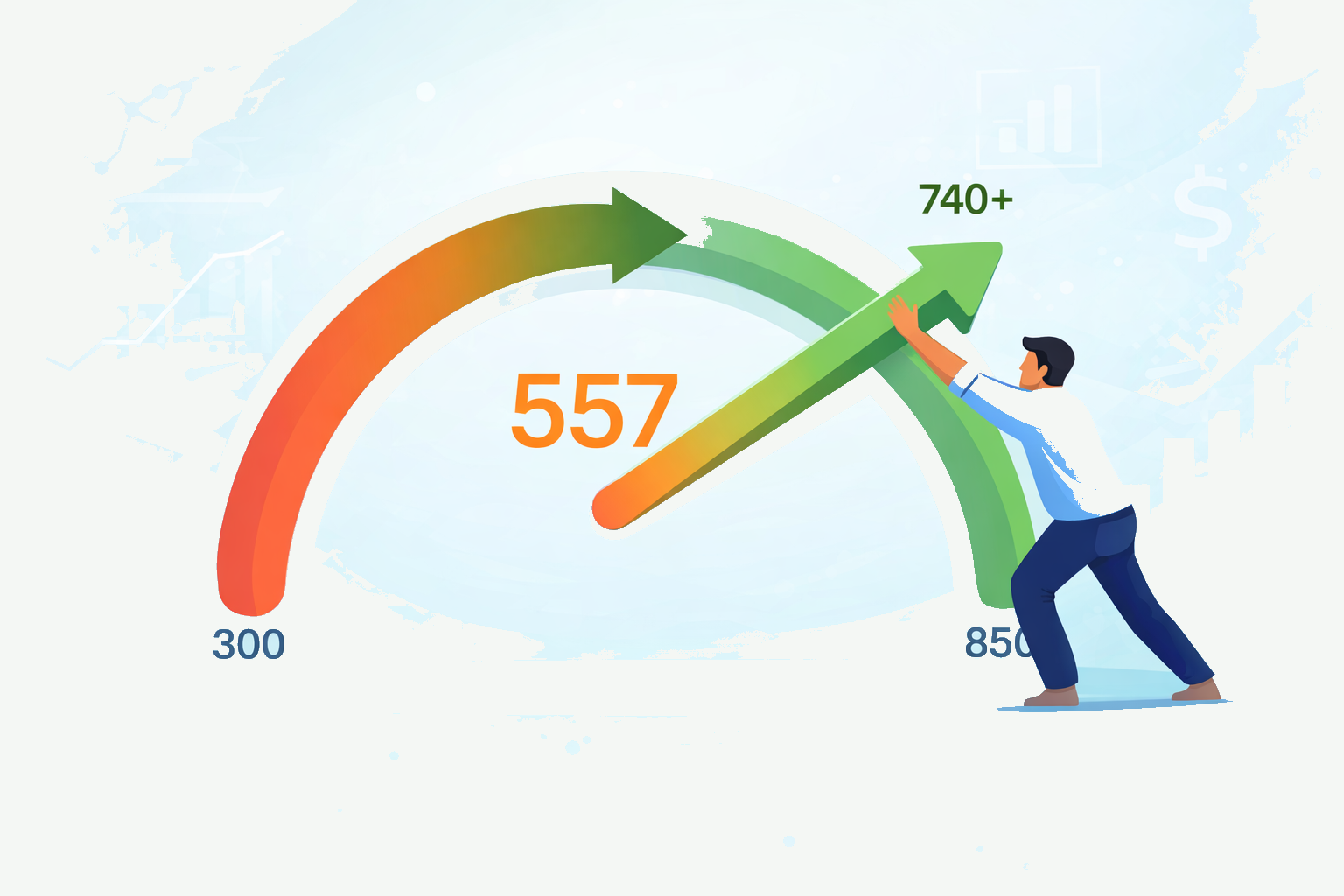
Upload your credit report and our Credit Analyzer identifies exactly what is holding your score back and gives you a step-by-step 90-day plan to reach 740+.
Trusted by 500+ successful placements and excellent reviews on TrustPilot ★★★★★
Analyze My Credit Free →