Master Recovery Roadmap: The TL;DR
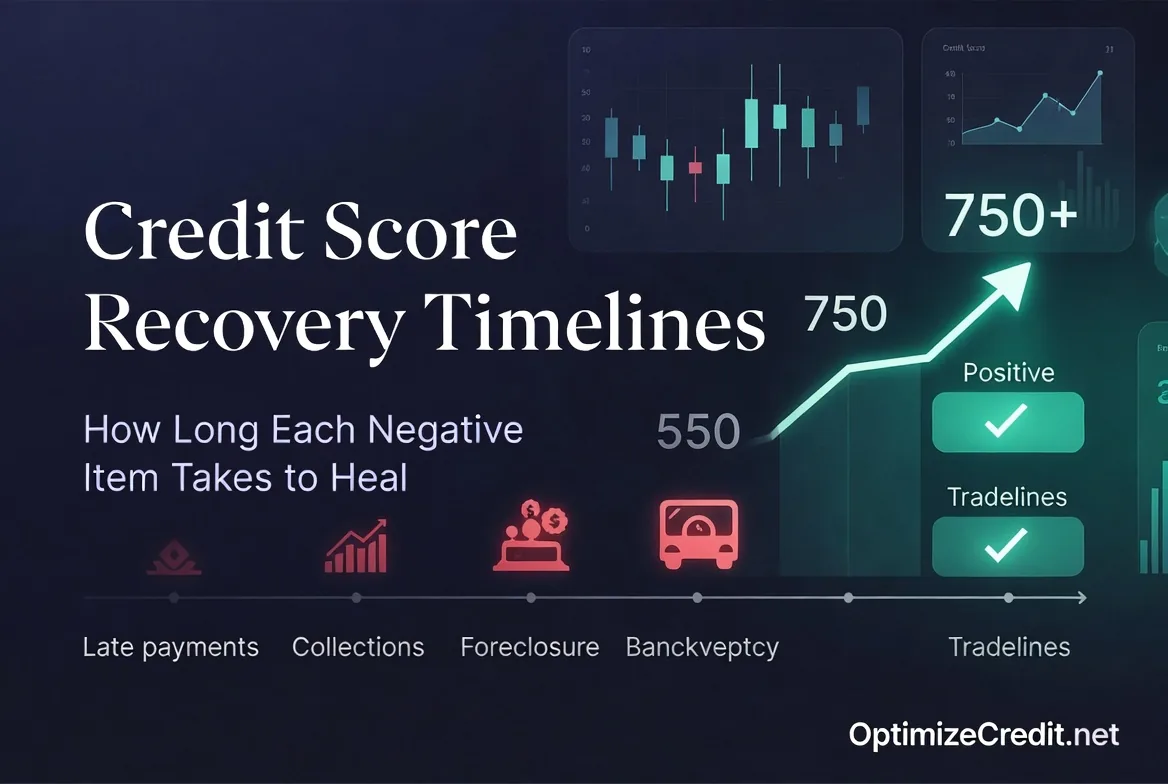
- ›Most negative items stay on reports for 7 years (BK is 7-10).
- ›Scoring impact decays significantly after the first 12-24 months.
- ›Recovery strategy: Stack positive data while negative items age.
- ›Hard inquiries only impact FICO scores for the first 12 months.
When your credit gets hit, the worst advice is also the most common: "Just wait." Time does matter. But if you are sitting at a 580 trying to get mortgage-ready, qualify for an auto loan, or stop rental denials, "wait" is not a strategy. What actually matters is understanding two separate clocks:
- How long a negative item can stay on your credit report
- How long it tends to meaningfully hurt your score
Those are not the same thing.
Most negative items stay on a credit report for about seven years. Hard inquiries usually stop affecting FICO scores after 12 months even though they remain visible for two years. Chapter 7 bankruptcy can stay for 10 years. But scoring impact is more front-loaded than reporting life. In plain English: a fresh negative usually hurts much more than an old one.
That is why recovery is not just about letting bad data age. It is about stacking positive data while the negative ages. The consumers who recover fastest are usually the ones who stop new damage, build clean payment history, keep revolving utilization low, and let the math re-weight their files month by month.
For a tactical rebuild sequence after reading this master timeline, see Credit Score Optimization: The 90-Day Plan. For an external authority summary of how long major negatives generally remain, CFPB's credit-rebuild guide is the cleanest consumer reference: How to rebuild your credit.
The master timeline table
| Negative item / Lifecycle Event | Typical report life | What recovery usually feels like |
|---|---|---|
| 30/60/90-day late payment | 7 years | Usually heaviest in the first 12–18 months, then softens if everything else stays clean |
| Collection account | Usually 7 years | Stronger early, less dominant as it gets older and new positives stack |
| Charge-off | 7 years from the delinquency that led to it | Severe at first, then gradually less influential if no new negatives appear |
| Foreclosure | 7 years | One of the heavier mortgage-related negatives, especially in the early years |
| Chapter 13 bankruptcy | 7 years | Linear recovery; scores often stabilize during the 3–5 year repayment plan before the final discharge jump. |
| Chapter 7 bankruptcy | Up to 10 years | Hard reset; often sees the most significant score rebound 12–24 months post-discharge if new lines are added. |
| Hard inquiry | 2 years visible, usually 12 months of FICO impact | Short-lived unless you stack many in a short window |
| Thin File (Students) | 6 months to be scorable | High sensitivity to "first mistakes"; recovery is fast (6–12 months) with disciplined stacking. |
| Joint Debt (Divorce) | 7 years for shared lates | Recovery is "locked" until legal liability is untangled, refinanced, or removed. |
| Military Deployment | 7 years (unless corrected) | Potential for 30-day administrative recovery via SCRA if protections were triggered. |
| 1099 Utilization Spike | 30-day cycles | Zero "memory"; recovery is immediate once debt is paid down—the fastest lever in the system. |
| Retirement Inactivity | Indefinite | Slow "thinning" of file depth; recovery requires reopening lines, which resets the age clock. |
The table above combines CFPB's consumer reporting windows with myFICO's inquiry guidance. The "what recovery usually feels like" column is a practical rebuild pattern, not a formal scoring schedule.
First principle: report life and score life are different
This is the mistake most people make. A late payment can stay on your report for seven years. That does not mean it hurts equally for all seven years. Credit scoring models care about recency. CFPB says recent negative information generally has more effect on your credit score than older information. That one line explains most real-world recovery behavior.
A fresh 60-day late, a fresh collection, and a five-year-old version of the same item are not treated the same way in practice, even if both are still visible on the report. The older item is still negative, but it is less predictive than a newer one. That is why score recovery usually starts long before the item drops off completely.
Late payments: common, painful, but usually the fastest to visibly fade
Late payments are the most common negative item and often the one consumers notice first. They matter because payment history is the largest part of a FICO score. A single 30-day late can hurt sharply if the rest of the file was clean. A deeper delinquency—60 or 90 days late—usually hurts more because it signals a more serious breakdown in payment behavior. But the big practical point is this: the damage is usually most intense while the late is fresh.
Late payments can remain on your report for seven years. If you missed several payments in a row and never brought the account current, the recovery clock ties back to the original delinquency sequence, not to the day the account finally charged off or went to collections. From a recovery standpoint, many consumers start to feel meaningful relief in roughly the 12- to 18-month window as new clean payment history accumulates.
Collections: still serious, but less dominant as they age
Collection accounts are generally tied to the original delinquency date of the underlying debt, and collection reporting typically remains for about seven years. Paying a collection may matter for underwriting optics, but it does not usually make the reporting timeline disappear. Where collections become easier to manage is recency. A six-year-old collection on a file with two years of perfect payments and low utilization is much less powerful than a fresh one.
Charge-offs: severe because they bundle delinquency plus loss
Charge-offs are heavier than ordinary lates because they signal that the creditor wrote the account off as a loss. The reporting timeline is generally seven years from the delinquency that led to the charge-off, not seven years from the day you later settled it. For a deeper breakdown, see charge-offs explained.
Foreclosure: long tail, front-loaded pain
Foreclosure information generally remains on a credit report for seven years. Like charge-offs, foreclosure pain is front-loaded. As time passes, the foreclosure remains part of the history, but the score impact typically weakens if the borrower keeps the rest of the file clean. In reality, the scoring question is: what has happened since the foreclosure?
Bankruptcy: Chapter 7 vs. Chapter 13 recovery curves
Bankruptcy reporting involves two distinct curves governed by both reporting maximums and practical rebuild latency:
- Chapter 7 (Liquidation): Stays for up to 10 years. It represents a "hard reset." While the initial score hit is severe, filers often see a significant score "bounce" 12–24 months post-discharge if they immediately layer 2–3 new, clean tradelines.
- Chapter 13 (Reorganization): Stays for 7 years. Because it involves a 3-to-5-year repayment plan, the recovery is more linear. Scores often stabilize during the plan, with the final "rehab" occurring once the discharge is recorded.
In both cases, you do not need to wait 7 to 10 years for the public record to age off. The strongest rebuilds start by adding positive data while the negative ages. For a fuller walkthrough, see build credit from bankruptcy.
Hard inquiries: the shortest problem on this list
Hard inquiries remain visible for two years, but FICO generally only counts them for 12 months. If you have too many recent applications, inquiry drag is real, but it is relatively temporary. This is one reason some rebuilds feel noticeably easier after the one-year mark.
Lifecycle recovery: Timelines for specific transitions
Recovery is not just about negative items; it is about the structural context of the file. Major life transitions create unique algorithmic constraints.
Teenagers & College Students: The First-Mistake Recovery
For those starting from zero, the timeline is governed by generation latency. It takes roughly 180 days of reporting to move from "invisible" to a scorable FICO output. The risk for students is the "impact-to-depth ratio": a single late payment on a file with only one card is catastrophic. However, recovery is also accelerated; adding two additional clean lines (positive stacking) can re-weight the file's risk profile in 6 to 12 months.
Divorce & Separation: The Untangling Timeline
Divorce recovery is gated by **liability untangling**. While divorce itself is not a scoring factor, the timeline is gated by the speed of account separation. Score recovery frequently remains flat as long as a delinquent joint account or co-signed loan remains on the report, then jumps significantly once the legal liability is severed through refinancing or removal. The rebuild phase is about **purgation**—clearing shared risk so individual behavior can drive the score.
Veterans & Military: Deployment and SCRA Timelines
Service members navigate a **protected recovery timeline**. Deployment-related delinquency often stems from logistical friction rather than financial incapacity. Under the Servicemembers Civil Relief Act (SCRA), veterans have administrative paths to recovery that civilians do not. If a negative was reported while the member was on active duty and protections were violated, the timeline can be bypassed entirely through administrative correction—potentially restoring a score in 30 to 60 days.
Self-Employed & 1099: The Utilization Volatility Curve
For the self-employed, the primary variable is **utilization oscillation**. Unlike derogatory items which carry a 7-year decay constant, revolving utilization has no "memory." A 1099 professional who spikes a personal card for business inventory will see immediate suppression, but recovery is a 30-day binary event: as soon as the balance is paid and the new statement reports, the score resets. This makes utilization management the highest-leverage tool for volatile income.
Seniors (60+) & Retirement: The Inactivity Risk
In retirement, the threat is **credit decay** through inactivity. Closing "unused" 30-year-old accounts can trigger a sudden drop in available credit and account seasoning. Recovery from a "thinned" file is slower because age cannot be manufactured. Rebuilding in this stage is about **preservation and estate-readiness**: maintaining the reporting clock on older tradelines to ensure access to liquidity (like a HELOC) remains open for health costs or estate needs.
The recovery curve: why the first 24 months usually matter most
The recovery curve is front-loaded but not linear. A recent negative typically hurts much more than an older one, and the relief usually comes gradually. The 18- to 24-month window is often the tipping point where new clean history and the aging of the negative item align to produce meaningful score movement.
Why waiting is not the best strategy
Waiting helps, but it is rarely enough. The strongest recoveries come from positive stacking: on-time payments, low revolving utilization, maintaining a healthy mix, and stopping the self-inflicted damage of fresh inquiries while older ones fade.
The tipping point: when positives start to outweigh the old damage
Consumers often describe a point—usually around month 18 to 24—when the file finally starts behaving more like a "recovering" profile than a "damaged" one. This is not a formal bureau milestone, but a practical tipping point that occurs when the negative is no longer fresh, inquiries have aged out of the FICO window, and clean history has accumulated.
How to read your own recovery clock correctly
If you are rebuilding, track the report, not just the score. Use your reports to separate "still visible" from "still hurting heavily." For more recovery and repair walkthroughs, browse the full troubleshooting hub.
Choose your transition playbook
Every life event above has a deep-dive playbook. Pick the one that matches your situation, or run your full file through the Credit Optimizer for a personalized plan.
Complex mortgage approvals
- How to qualify for a mortgage as a self-employed borrower.
- How to buy a home with five-figure student debt.
- How a military PCS move affects your VA loan and credit.
Family, relationships, and shared finances
- How marriage and a joint mortgage change your credit profile.
- How joint accounts, co-signers, and authorized users actually work.
- Who is liable when a joint or co-signed account goes late.
- How to manage an aging parent's finances without wrecking yours.
Crisis recovery and legal exposure
- How to prevent credit damage during unemployment.
- How to rebuild credit after Chapter 7 or Chapter 13 bankruptcy.
- How to rebuild credit after divorce and untangle joint liability.
- How to manage debt and the estate after the loss of a spouse.
Identity and life-stage transitions
- How to prevent split credit files during a legal name change.
- How to establish US credit history as a new immigrant.
- How to keep your credit stable through retirement and downsizing.
- How to separate personal and business credit as an entrepreneur.
Bottom line
Credit score recovery is not magic—it is time plus clean new data. Most negatives remain visible for years, but their scoring power fades as they age, especially if you stop adding new damage and start stacking positives.
Get Your Personalized Credit Roadmap
Upload your credit report and our Credit Analyzer identifies what may be holding your score back and provides a step-by-step report-based improvement plan.
Analyze My Credit Free →