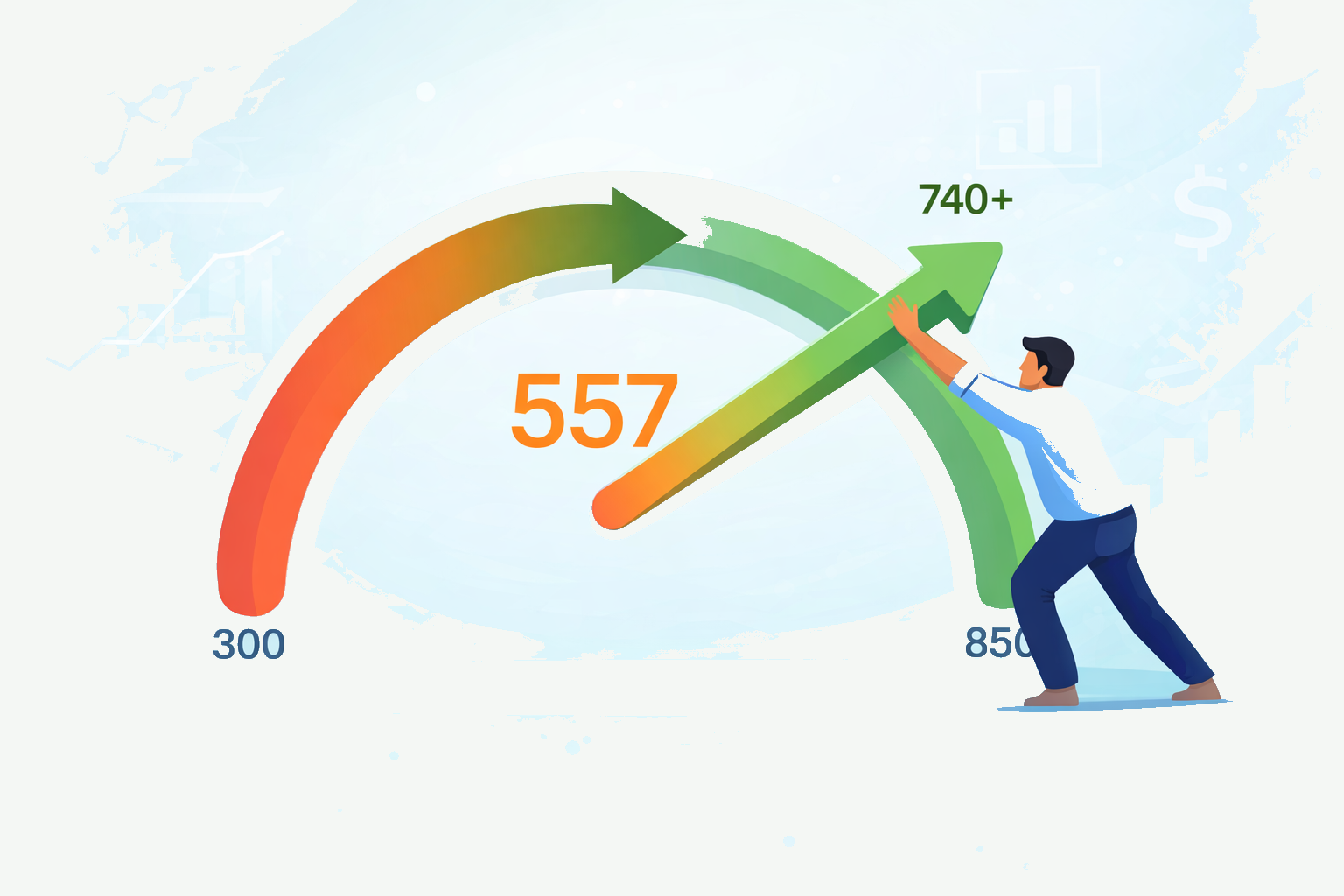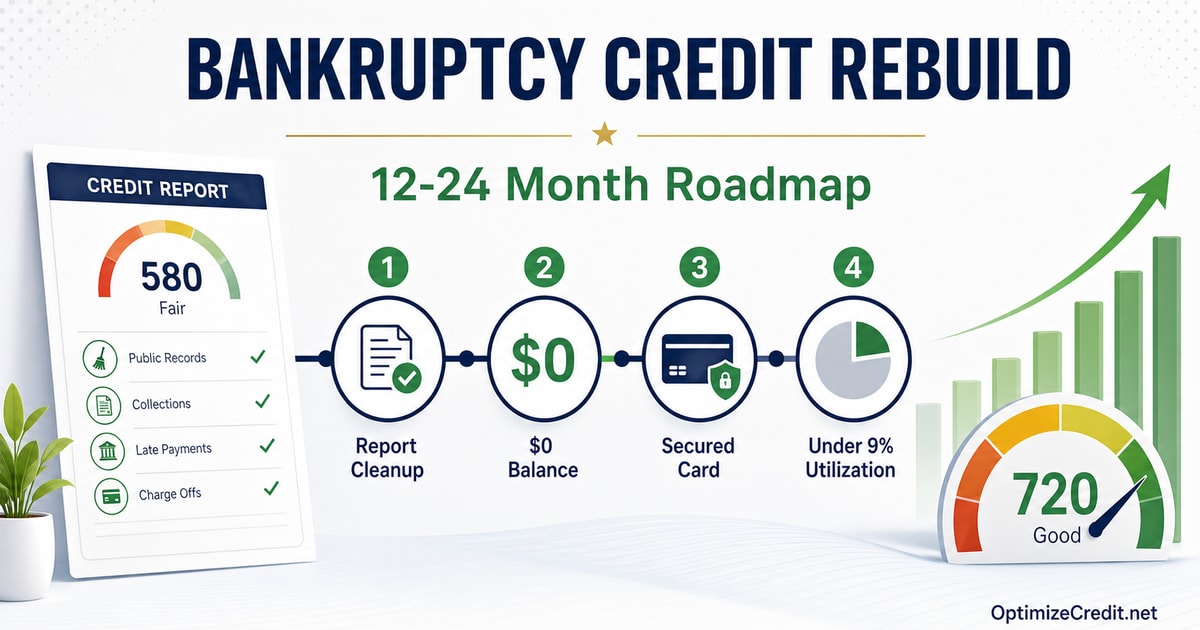
Yes, you can build credit from bankruptcy before the bankruptcy falls off your report. The first move is not opening five new accounts or chasing a deletion promise. The first move is debugging the post-discharge credit file so discharged debts stop reporting like active damage. For a complete understanding of how long various negative items suppress your score, refer to the Master Credit Recovery Roadmap.
Rebuilding from Bankruptcy: The TL;DR
- ›Verify all discharged accounts show a $0 balance.
- ›Wait 30-60 days post-discharge before opening new accounts.
- ›Start with one secured card and maintain < 9% utilization.
- ›FHA eligibility typically opens at 2 years post-discharge.
Build Credit from Bankruptcy by Separating Two Clocks
Bankruptcy has a reporting clock and a rebuilding clock. Those are not the same thing. According to Experian's bankruptcy reporting guidance, Chapter 7 can remain on a credit report for up to 10 years from the filing date, while Chapter 13 can remain for up to 7 years from the filing date.
That does not mean you must wait 7 to 10 years to rebuild. The public record may remain visible while newer positive data starts changing how the file behaves. This is a core principle of the Master Credit Recovery Roadmap: score recovery and reporting life operate on different curves. Lenders and scoring models look at the whole file: whether discharged accounts are coded correctly, whether new accounts are paid on time, whether revolving balances are low, and whether the file shows stability after the event.
The practical goal is not to pretend bankruptcy never happened. The goal is to make the rest of the file increasingly clean, current, and low risk.
Post-discharge credit report debugging comes first
After discharge, pull all three credit reports and read them account by account. A bankruptcy discharge changes the legal obligation, but the credit reporting system still has to update correctly. If the reporting is wrong, your rebuild starts with a false baseline.
Post-bankruptcy report debugging checklist
- Accounts included in bankruptcy should generally show a $0 balance.
- The account status should say included in bankruptcy, discharged in bankruptcy, or similar bankruptcy language.
- Included accounts should not keep updating every month as active 30, 60, 90, or 120-day late payments after the filing or discharge.
- A discharged debt should not reappear as a new collection with a collectible balance.
- The same discharged debt should not report twice with two active balances through both the original creditor and a collector.
- Dates should be accurate, especially filing date, discharge date, and date of first delinquency where relevant.
- Accounts that were never yours should be investigated separately as identity, mixed-file, or reporting errors.
If an item fails this checklist, dispute the inaccurate detail with precision. Do not dispute everything blindly. A focused dispute says what field is wrong, why it is wrong, and what documentation supports the correction. The broader credit score debugging workflow is useful here because the problem is often a specific suppressor, not a mystery.
The safest account stack after bankruptcy
Once the file is accurate enough to rebuild, add new positive data in a controlled order. The goal is to prove recent stability without creating a new cluster of hard inquiries, fees, and low-limit utilization problems.
Start with one secured card
A secured credit card is usually the foundation because it creates revolving payment history. The deposit reduces the issuer's risk, but the card can still report like a normal revolving account. Choose a card that reports to Experian, Equifax, and TransUnion, has low fees, and offers a path to graduate to unsecured credit.
Do not confuse approval ease with value. Some post-bankruptcy cards are expensive because they charge setup fees, annual fees, monthly maintenance fees, and high APRs. A low-fee secured card often creates the same scoring signal with less cost and less risk.
Add installment depth only when the file is stable
A credit-builder loan or small installment account can help add account mix after the secured card has started reporting cleanly. This is usually a months 6 to 12 move, not a day-one scramble. The file should first show that the new revolving account is paid on time and reporting low utilization.
If you are choosing between the first two rebuilding tools, the comparison in secured cards vs. credit-builder loans explains why revolving control and installment depth solve different problems.
Use authorized user tradelines only when they fit
An authorized user tradeline can add age, available credit, and clean payment history to a thin post-bankruptcy file. That can help when the file is already accurate and the missing ingredient is revolving depth. It is not the first repair step when discharged debts are still miscoded.
Tradeline outcomes vary by individual circumstances; tradelines are only one lever. They do not delete a legitimate bankruptcy, they do not fix wrong discharged balances, and they should not replace your own primary rebuilding accounts.
Utilization is the fastest post-bankruptcy scoring lever
Utilization can suppress a rebuilding score quickly because early post-bankruptcy limits are usually small. A $90 balance on a $300 secured card is 30% utilization. A $270 balance is 90%. The dollar amount is small, but the reported percentage can look risky.
Use these rules:
- Pay before the statement closes. The due date protects payment history, but the statement closing date often controls the balance that gets reported.
- Keep reported balances low. Single-digit reported utilization is usually the cleaner target when optimizing.
- Do not carry interest to build credit. Scoring models reward on-time reporting, not interest paid.
- Avoid maxing out small limits. A small secured card can still report very high utilization.
- Keep one small account active. A small recurring charge paid down before statement close can show activity without debt stress.
This is why many people see faster progress from controlling reported balances than from opening more accounts. A clean $300 secured card at 3% utilization is a better rebuilding signal than three new cards all reporting high balances.
Rebuilding your credit file: The year-by-year roadmap
Bankruptcy recovery is not a single event; it is a multi-year sequence. While the public record has a long shelf life, the scoring impact fades as newer positive data accumulates.
Year 0 to 1: Post-discharge debugging
This is the most critical operational phase. As discussed above, your primary task is ensuring the credit bureaus reflect the legal reality of your discharge. The U.S. Courts explain that a discharge bars creditors from trying to collect discharged debts. If your report shows an active balance, it is a reporting error suppressing your score.
Year 1 to 2: Adding boring, positive accounts
Once the foundation is clean, start adding fresh data. This is when most people open their first post-bankruptcy secured card or credit-builder loan. The goal is 12 to 24 months of perfect payment history with single-digit utilization.
Year 2 to 4: Re-entering the lending market
This is the 'bridge' phase. Many borrowers graduate to unsecured credit and become eligible for major loans. FHA mortgage eligibility typically opens 2 years after a Chapter 7 discharge, or after 12 months of on-time payments in a Chapter 13 plan with court permission.
Year 4 to 7: Conventional mortgage readiness
By year 4, you are often back inside conventional mortgage windows. Fannie Mae standard waiting periods are generally 4 years from discharge for Chapter 7 and 2 years from discharge for Chapter 13. At this stage, a well-managed file may look surprisingly normal even with the bankruptcy record still visible.
Mistakes that delay bankruptcy credit rebuilding
Most post-bankruptcy setbacks come from overreacting. The file is fragile, so small mistakes can have outsized effects.
- Applying for too many cards right after discharge. Multiple hard inquiries plus a recent bankruptcy can make the file look desperate and reduce approval odds.
- Using predatory fee-heavy cards. High setup and maintenance fees do not create better credit reporting than a simple secured card.
- Disputing accurate bankruptcy data. Correct wrong balances and statuses, but do not waste time trying to dispute a legitimate public record as if it were an error.
- Ignoring reporting errors because the bankruptcy is real. A legitimate bankruptcy can still be surrounded by inaccurate account reporting.
- Maxing out a small secured card. The scoring system reads the percentage, not your intention to pay it off later.
- Closing the first positive account too early. Your first clean post-bankruptcy account can become an anchor for age and stability.
- Opening accounts before checking reports. New positive data is less useful if old discharged debts are still updating as active delinquencies.
When authorized user tradelines make sense after bankruptcy
Authorized user tradelines can help when they solve the right problem. They are most useful when a file is clean but thin, short on revolving age, or close to a threshold where additional clean history may help. The host account must have perfect payment history, low utilization, and reliable bureau reporting.
They usually do not make sense when the real problem is unresolved discharged-account reporting, active collections that should have been included, or new late payments after discharge. In that situation, adding age does not fix the underlying suppressor. It can make the file look more complicated without addressing the error.
The practical rule is simple: clean first, build primary accounts second, optimize third. A tradeline belongs in the third category.
How the Credit Optimizer fits the rebuild
The Credit Optimizer is the diagnostic step, not a promise to remove legitimate bankruptcy records. It helps identify which items are still suppressing the file and which actions should happen first.
For a post-bankruptcy file, that means prioritizing:
- discharged accounts that still show balances or active delinquency,
- collection entries that may duplicate included debts,
- reported utilization on new or remaining revolving accounts,
- thin-file structure and account mix,
- and whether a secured card, credit-builder loan, or authorized user tradeline fits the actual file.
That order matters. If the issue is wrong reporting, opening another account is not the cleanest first move. If the issue is thin-file structure, endless disputes will not solve it. The value is knowing which lever is actually connected to the score problem.
Bottom line: rebuild the file in the right order
Bankruptcy is not the end of credit building. It is a major negative event with a long reporting life, but the rebuild can start much earlier than the falloff date.
Start by debugging the reports. Make sure discharged accounts show the correct balance and status. Then add one safe secured card, control the reported balance before the statement closes, and build account depth slowly. When the file is clean and stable, additional tools such as credit-builder loans or authorized user tradelines may help. The recovery is not instant, but it is mechanical: accurate reporting, low utilization, clean payments, and time.
Related life-transition guides
Get Your Personalized Credit Roadmap
Upload your credit report and our Credit Analyzer identifies what may be holding your score back and provides a step-by-step report-based improvement plan.
Analyze My Credit Free →