Your credit report is a structured database record
Your credit report is the single data file that determines whether you get approved or denied. When a mortgage underwriter evaluates your application, they aren't assessing your character — they're reading raw data housed at Equifax, Experian, and TransUnion, then feeding it into a FICO scoring engine.
For consumers in the 550–680 range working toward mortgage, auto, or rental approvals, understanding how to parse this data is the mandatory first step. FICO algorithms are entirely blind to anything outside of this file. If you want to engineer a higher score, you need to understand the structural mechanics of every field the algorithm reads.
This guide breaks down your credit report line by line — every section, every code, every red flag — exactly as the data appears on real bureau reports.
Where to get your credit reports
You need the actual statutory reports, not simplified summaries from monitoring apps. Under the Fair Credit Reporting Act (FCRA), you're entitled to see exactly what the bureaus have on file.
AnnualCreditReport.com is the only federally authorized source for free reports from all three bureaus. Since the pandemic-era policy became permanent, you can pull free weekly reports — that's up to 156 free reports per year if you rotate bureaus. Go directly to the site and skip any lookalike domains pushing paid monitoring products.
Pull all three bureaus. Creditors report asynchronously, and data variances across the three databases are common. An account showing perfect payment history on Experian may show a 60-day late on TransUnion because of different batch-reporting dates.
If you're preparing for a mortgage, ask your loan officer for a tri-merge report. That's the version underwriters actually use, pulling FICO scores specific to mortgage lending — not the VantageScore 3.0 you see on Credit Karma.
What is NOT on your credit report
Before diving into what's on the report, it's important to clear up what isn't. The bureaus receive data in Metro 2 format — the standardized reporting language creditors use — and that format does not include:
Income or salary. Lenders verify income separately through pay stubs, tax returns, or VOE requests. Your report has no earnings data.
Bank account balances. Checking and savings accounts don't appear on credit reports and cannot affect your score.
Debit card usage. Only credit accounts are reported. Your debit card spending has zero impact.
Rent payments. Unless your landlord reports through a service like Experian RentBureau, rent payments won't appear. Most landlords don't report.
Utility and phone bills. Gas, electric, and cell phone bills don't appear unless they go to collections.
Investment accounts. Brokerage accounts, 401(k)s, and IRAs are invisible to the bureaus.
Medical debt under $500. As of 2023, the bureaus exclude medical collections under $500 and remove paid medical collections entirely.
If it isn't an explicit extension of credit, a bankruptcy record, or an inquiry for credit, it's not on this report and it cannot impact your FICO score.
The four sections of every credit report
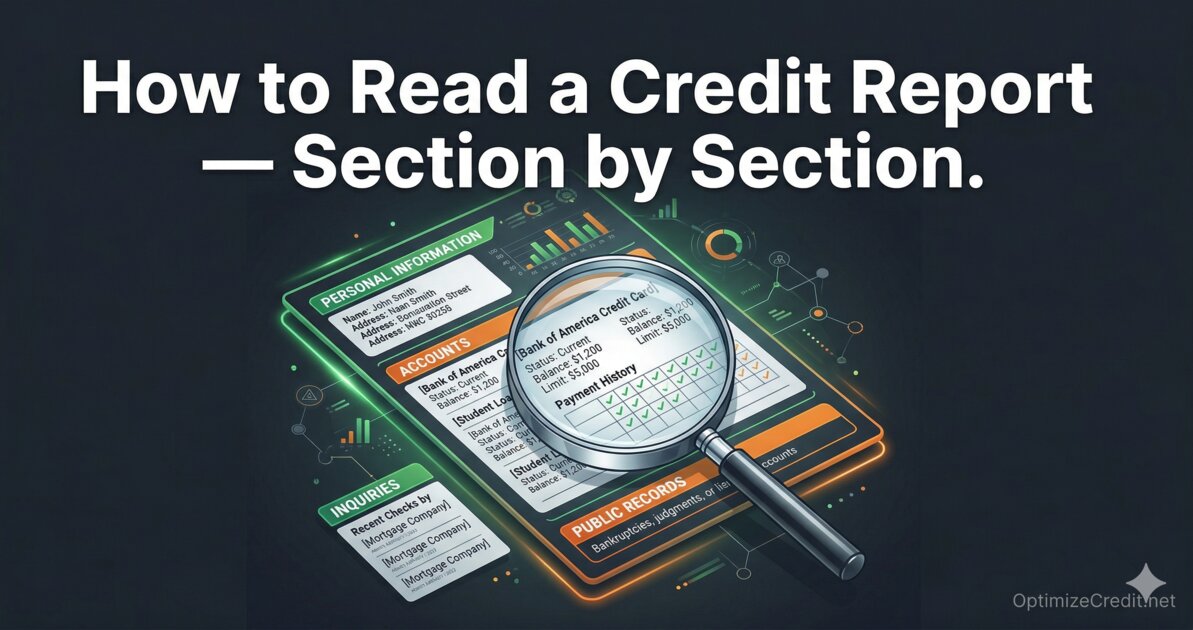
Every credit report — regardless of bureau — is organized into four core sections. Labels vary slightly between Equifax, Experian, and TransUnion, but the structure is consistent.
1. Personal identifying information
This section contains your identifying data. It does not affect your score, but errors here can cause serious problems.
What you'll see: full legal name and any variations (maiden names, misspellings, nicknames creditors have reported), current and previous addresses (typically 7–10 years), Social Security number (partially masked), date of birth, and employer name(s) — self-reported by creditors and often outdated.
What to check: Look for names you don't recognize, addresses you've never lived at, or employers you've never worked for. These are signs of a mixed file — your data merged with another consumer's — or potential identity theft. A wrong middle initial might seem minor, but it can mean someone else's accounts are attached to your file.
Expert note: Outdated addresses tied to charged-off accounts or old collections can make it easier for third-party debt buyers to verify old debts during a dispute. Cleaning up stale address data is a legitimate first step.
2. Account information (trade lines)
This is the core of the report. A "trade line" is industry terminology for any credit account — credit cards, auto loans, mortgages, student loans, personal loans, and authorized user accounts. FICO algorithms derive roughly 90% of your score from this section, spanning payment history (35%), amounts owed (30%), length of credit history (15%), and credit mix (10%).
Each trade line contains a dense block of fields. Here's what each one means:
Creditor name — The original lender or card issuer. If the account was sold or transferred, you may see both the original creditor and the current servicer.
Account number — Partially masked for security (last 4–8 digits). Useful for matching the same account across bureaus or identifying duplicates.
Account type — Reported using standardized codes: R (revolving — credit cards, HELOCs), I (installment — auto loans, mortgages, student loans), M (mortgage), O (open/charge card). FICO treats revolving and installment accounts differently in its scoring model.
Responsibility — Individual, joint, or authorized user. Joint holders share full legal liability. Authorized users inherit the account's payment history but carry no legal debt obligation.
Date opened — When the account was first established. This feeds into your average age of accounts. Older accounts help your score; new accounts temporarily lower it.
Credit limit / high balance — For revolving accounts, this is your credit limit. For installment loans, this is the original loan amount (sometimes labeled "high balance" or "high credit"). This field is critical: if a creditor fails to report your credit limit, FICO may substitute the high balance as the limit, which can severely distort your utilization calculation. A card with a $10,000 limit that only reports a $3,000 high balance would make a $2,500 balance look like 83% utilization instead of 25%.
Current balance — The amount owed as of the last reporting date. This is not a real-time number. Most issuers report once per billing cycle, typically on the statement closing date. A $3,000 balance on a $10,000 limit shows 30% utilization even if you pay it off the next day.
Monthly payment — The minimum or scheduled payment amount.
Payment status / account rating — Whether the account is current, delinquent, or derogatory. This is the most consequential field for your score.
Payment history grid — A month-by-month matrix (typically 24–84 months) showing your payment status for each reporting period. This grid is the raw data behind FICO's 35% payment history factor.
Date of first delinquency (DOFD) — This field only appears on accounts with negative history. It marks the exact date you first went delinquent on an account that was never brought current again. By federal law, the negative mark must be deleted seven years from this specific date — not from when the account was closed, charged off, or sold to collections. This is the most important date on any derogatory trade line.
Decoding payment history codes
The payment grid uses standardized codes:
OK / Current — Paid on time. This is what you want for every month in the grid.
30 — Payment was 30–59 days past due. A creditor cannot legally report a late payment until you are a full 30 days past the due date. A single 30-day late on an otherwise clean file can drop a 750 score by 60–100 points. The impact diminishes over time but remains on your report for seven years.
60 — Payment was 60–89 days past due. Materially worse than a 30-day late.
90 — Payment was 90–119 days past due. At this stage, most creditors have escalated to internal collections.
120 / 150 / 180 — Progressively worse delinquency stages. Most creditors charge off accounts at 180 days.
CO (Charge-Off) — The creditor wrote off the debt as a loss, typically at the 180-day mark. This is an accounting classification by the original lender — it does not mean you no longer owe the money.
FC (Foreclosure) — The lender repossessed real property. Remains on your report for seven years from the filing date.
CA (Collection) — The debt was sold or assigned to a third-party collection agency. This is distinct from a charge-off: the charge-off is the original creditor's accounting action, while the collection is what happens after, when the debt changes hands. Both can appear on your report simultaneously for the same underlying debt.
Account status codes
| Status | Meaning | How Long It Stays |
|---|---|---|
| Open / Current | Active, no issues | N/A |
| 30/60/90 Days Past Due | Late by that many days | 7 years from DOFD |
| Charged Off (CO) | Creditor wrote it off | 7 years from DOFD |
| In Collections | Debt sold/assigned | 7 years from DOFD |
| Closed | Closed, still reporting | 10 years (positive) |
| Closed by Consumer | You initiated closure | 10 years |
| Paid / Settled | Balance resolved | 7 years if negative |
3. Public records
Following the National Consumer Assistance Plan (NCAP) overhaul in 2017–2018, the bureaus removed civil judgments and tax liens from credit reports. Today, this section contains only bankruptcies:
- Chapter 7 bankruptcy (liquidation) — Remains for 10 years from the filing date
- Chapter 13 bankruptcy (reorganization) — Remains for 7 years from the filing date
If you see a tax lien or civil judgment still on your report, it shouldn't be there and is grounds for a dispute.
4. Inquiries
Inquiries are divided into two types:
Hard inquiries — Triggered when you apply for credit. Each hard inquiry can lower your score by 3–5 points and remains on your report for two years, though FICO only factors them for 12 months. Rate-shopping within a 14–45 day window (depending on the FICO version) for mortgages, auto loans, or student loans counts as a single inquiry.
Soft inquiries — Triggered by pre-approval checks, employer screenings, account reviews, or your own report pulls. These are visible only to you and have zero score impact.
Review hard inquiries carefully. An inquiry you don't recognize could mean someone applied for credit in your name.
Red flags that demand immediate action
When reviewing your report, these specific problems require attention:
Unrecognized accounts. A trade line from a creditor you've never used could be identity theft, a mixed file, or a data furnishing error.
Incorrect credit limits or missing limits. A credit card reporting a $0 limit while showing a $2,000 balance creates the appearance of extreme utilization. This can suppress your score by 40–80 points.
Duplicate collection entries. When a debt is sold from one collection agency to another, the previous collection sometimes doesn't get removed. You end up with two or three collection entries for the same underlying debt, each one damaging your score independently.
Re-aged accounts. If a debt buyer has altered the Date of First Delinquency (DOFD), they may be attempting to restart the seven-year reporting clock. This is a violation of the FCRA.
Authorized-user trade lines showing as joint liability. If an AU account is reporting you as a joint account holder, you're being held responsible for debt that isn't legally yours.
Outdated negative items. Most derogatory marks must be removed seven years from the date of first delinquency. If a 2018 charge-off is still on your 2026 report, it has likely exceeded its reporting window.
If any of these issues appear on your report, the credit score debugging guide walks through how to isolate the suppressor and determine whether a dispute, timing adjustment, or structural fix is the right next step.
For a complete step-by-step walkthrough of the FCRA dispute process, including what documentation to attach and how long the bureau has to investigate, see our credit disputes step by step guide. You can also return to the credit basics hub for more foundational guides.
Get Your Personalized Credit Roadmap
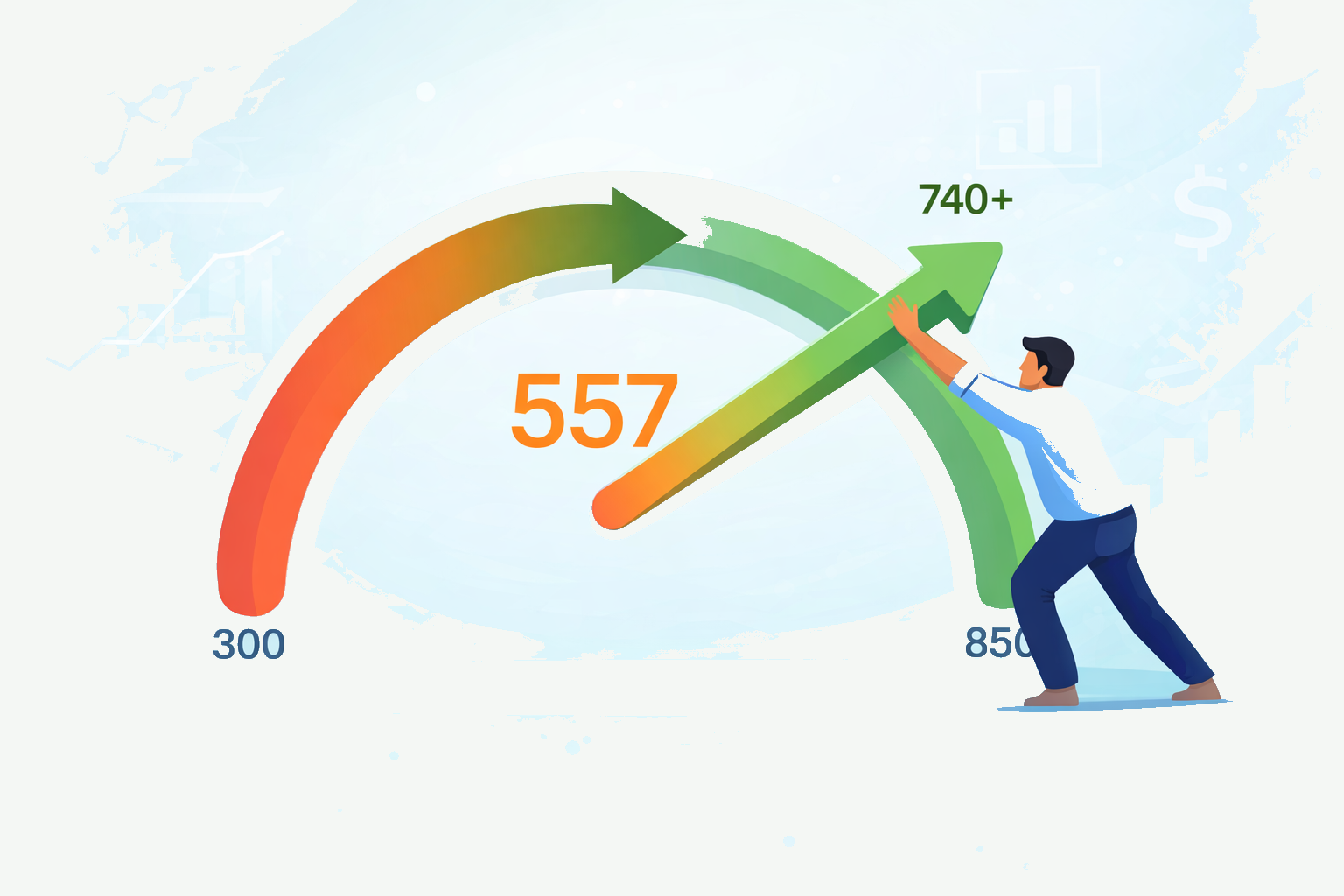
Upload your credit report and our Credit Analyzer identifies exactly what is holding your score back and gives you a step-by-step 90-day plan to reach 740+.
Trusted by 500+ successful placements and excellent reviews on TrustPilot ★★★★★
Analyze My Credit Free →