Disclaimer: I am not a CPA. This article covers credit scoring mechanics for educational purposes only. Consult a qualified financial professional for advice specific to your situation.
No credit score doesn't mean bad credit. It means you're invisible to the system — and that's a fixable problem with the right sequence of moves.
The Consumer Financial Protection Bureau (CFPB) calls these consumers "credit invisibles." Roughly 26 million Americans have zero records at any of the three major bureaus — Equifax, Experian, and TransUnion. Another 19 million have files too thin or too stale to produce a score. That's 45 million adults locked out of mainstream lending because the algorithm has nothing to calculate.
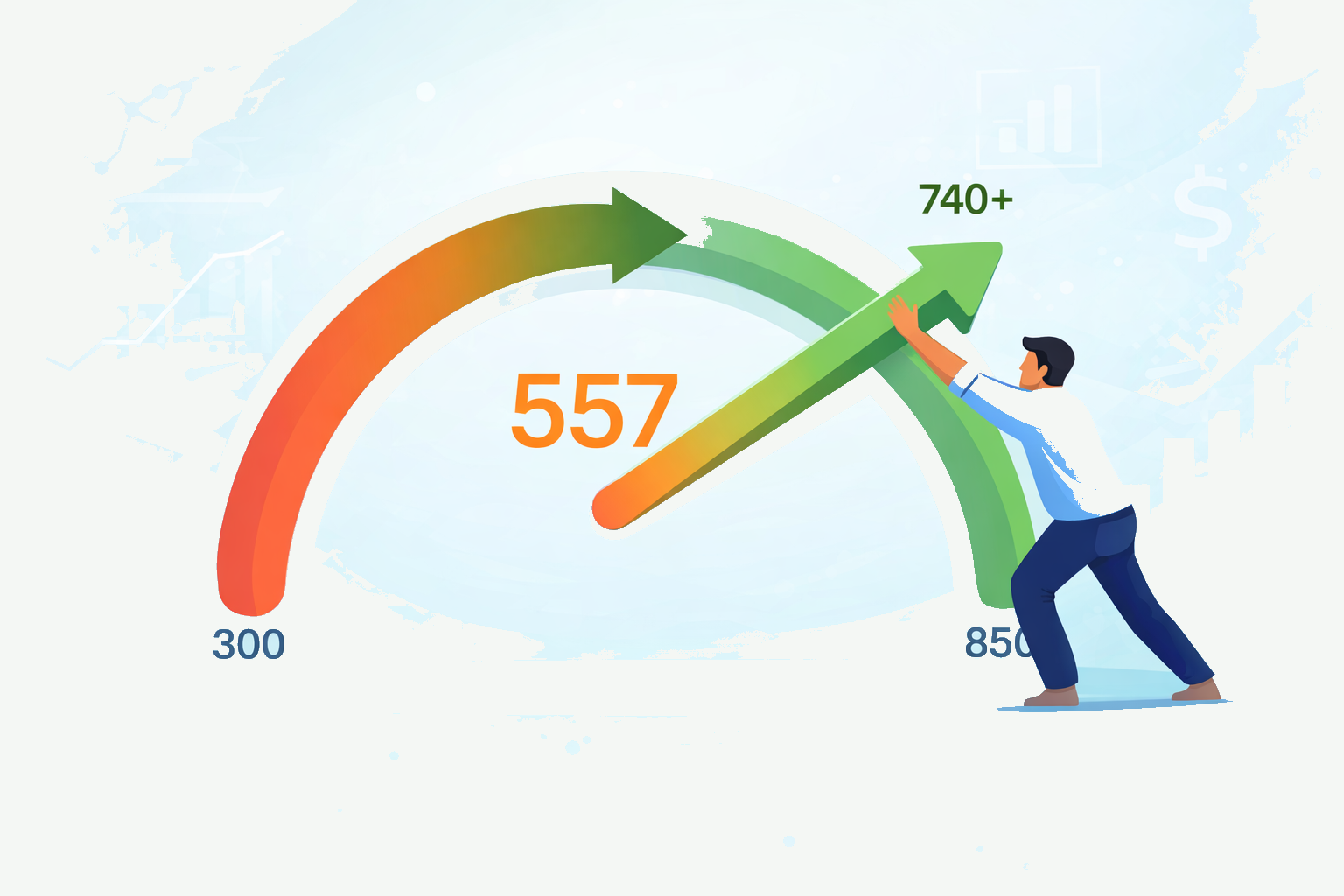
This roadmap covers the exact mechanics of moving from an unscorable file to a prime FICO score (700+) — no generic advice, just how the scoring algorithm interprets new data.
Who Has No Credit — and Why
Having no credit isn't financial irresponsibility. It's a lack of algorithmic data. The "credit invisible" population breaks into distinct groups:
Young adults (18–24): After the CARD Act of 2009 made it significantly harder for consumers under 21 to obtain unsecured credit without a co-signer or proof of independent income, many young adults simply never enter the credit system. If your parents paid for everything or you've only used a debit card, the bureaus don't know you exist.
Recent immigrants: Credit scoring is strictly localized. A perfect 800-equivalent score in Canada, the UK, or India doesn't cross the border. Once you receive a Social Security Number or ITIN, your U.S. credit file starts at absolute zero.
Cash-and-debit-only adults: Many consumers operate purely on cash, sometimes deliberately after watching family members struggle with debt. Financially responsible — but debit card transactions, bank balances, and cash purchases are never reported to the bureaus. The system penalizes non-participation.
Divorced individuals who were removed from joint accounts may discover their ex held all the credit history. They're effectively starting over.
The Chicken-and-Egg Problem — and FICO's Minimum Requirements
Here's the structural paradox: you need credit history to get credit, but you can't build history without being approved for credit first.
If you have no file at the bureaus, lenders see you as an unknown risk. In underwriting terms, "no score" often gets treated as worse than a 580, because at least a 580 tells the lender something about your default risk.
To even generate a classic FICO score, your credit file must meet strict minimums. According to myFICO, you need at least one undisputed account open for six months or longer, at least one undisputed account reported to a bureau within the past six months, and no deceased indicator on the file.
If you don't meet that six-month threshold, you have a "thin file" — the bureaus simply lack enough historical data to predict your default risk. The goal for a zero-credit consumer is to inject positive, verifiable data into the bureaus as quickly and strategically as possible.
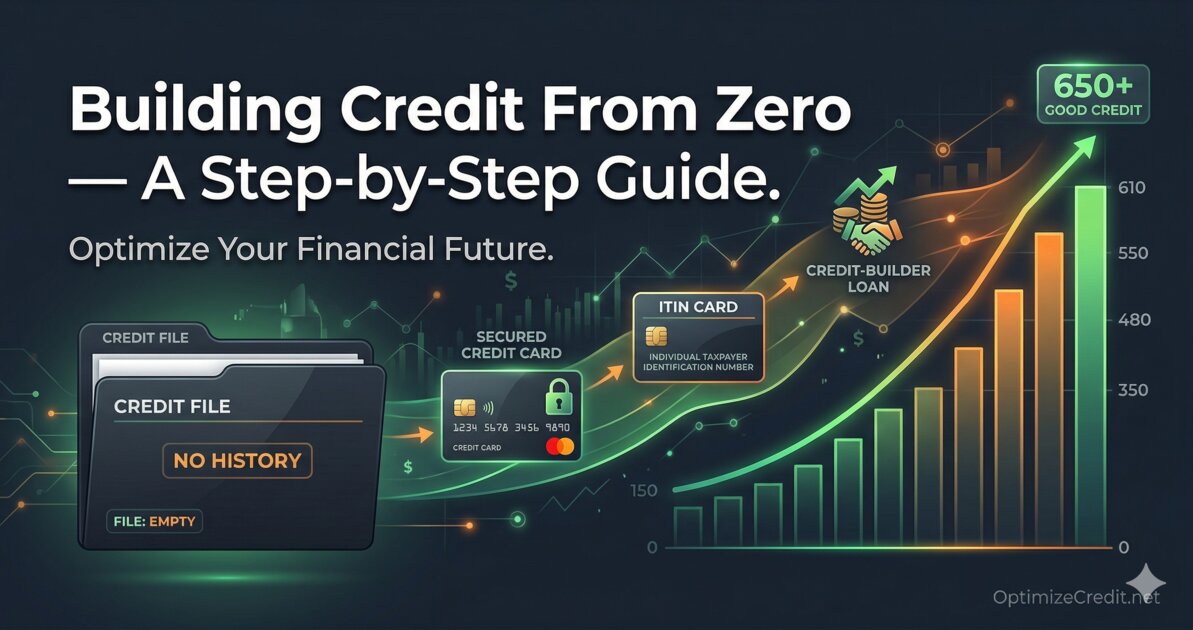
The way out is a three-tier strategy. Here's how each tier works and the order that matters.
Tier 1: Secured Credit Cards — The Foundation
A secured credit card is the single most reliable entry point into the credit system.
How They Work
You provide a refundable cash deposit — typically $200 to $500 — and the issuer gives you a credit card with a limit equal to your deposit. The deposit collateralizes the credit line, which is why issuers approve applicants with no history at all.
Here's the critical detail: to the FICO algorithm, a secured card is treated identically to an unsecured card. It's categorized as a revolving account (Type "R") and evaluated on the same metrics — payment history, utilization ratio, and age.
Bureau Reporting Is Non-Negotiable
Not all secured cards report to all three bureaus. If a card only reports to Experian and TransUnion but not Equifax, and a lender pulls your Equifax report, you're invisible on that bureau. Mortgage lenders pull all three and use the middle score — a gap in reporting can cost you. Cards from major issuers like Discover, Capital One, and Bank of America reliably report to all three. Verify before you apply.
The Statement Closing Date Mechanic
This is where most beginners get tripped up. Credit card issuers do not report your balance on the day your payment is due. They report your balance on your statement closing date — an earlier date when your billing cycle ends and the statement is generated.
To optimize your score, pay down your balance before the statement closing date so that a low balance is what gets reported to the bureaus. Then pay the remaining statement balance by the due date to avoid interest.
FICO's "Amounts Owed" category makes up 30% of your total score, and utilization — your reported balance divided by your credit limit — is the primary driver within that category. For a secured card with a $300 limit, here's the math:
| Statement Balance | Utilization | Score Impact |
|---|---|---|
| $3 | 1% | Optimal |
| $12 | 4% | Excellent |
| $27 | 9% | Very good |
| $90 | 30% | Neutral to slightly negative |
| $210 | 70% | Significant drag |
| $300 | 100% | Score killer |
The sweet spot is keeping your reported statement balance between 1% and 9% of your limit. For a deeper breakdown of how these percentages affect each scoring bucket, see our guide on utilization math.
You do not need to carry a balance or pay interest to build credit. FICO algorithms don't track interest paid — they only see the balance reported on the statement closing date and whether the minimum payment was met by the due date. Paying in full every cycle results in a "Pays as Agreed" status code (the best possible) and costs $0 in interest.
Tier 2: Credit-Builder Loans — Adding Installment Mix
While revolving credit (credit cards) is heavily weighted, the FICO algorithm also rewards consumers for managing different types of debt. "Credit Mix" accounts for 10% of a FICO score.
How They Work
A credit-builder loan is an installment account (Type "I"). Instead of receiving money upfront, the lender places the loan amount (typically $500–$1,000) into a locked savings account. You make fixed monthly payments over 12 to 24 months. Each payment reports to the bureaus as an on-time installment payment. Once the term ends, the locked funds are released to you.
This accomplishes two things beyond adding payment history. First, it thickens your file with a second, distinct tradeline. Second — and this is a detail most guides miss — FICO uses different internal "scorecards" (segmentation algorithms) based on consumer profiles. Moving from "only revolving debt" to "revolving + installment debt" places you on a more favorable scorecard, often yielding a slightly higher baseline score independent of other factors.
Companies like Self and many credit unions offer credit-builder loans with monthly payments as low as $25–$35. The total interest cost is usually $15–$50 over the life of a small loan.
When to Add It
Don't open a credit-builder loan simultaneously with your secured card. Wait until your secured card has reported for 2–3 months. Opening too many accounts at once when you have a thin file generates multiple hard inquiries and drops your average account age. Stagger your applications.
Tier 3: Authorized User Tradelines — The Timeline Accelerator
Building credit organically takes a minimum of six months before a FICO score even generates. For consumers who can't wait that long — a lease approval, a vehicle purchase, a time-sensitive need — authorized user (AU) tradelines offer a strategic shortcut. If you need results on an even faster timeline, our guide on how to boost your credit score fast covers additional tactics.
The Piggybacking Mechanism
When you're added as an authorized user on someone's credit card, the issuing bank reports that account to your credit file. The full history follows — including the account's original open date, its age, payment record, credit limit, and current balance. If you're added to a card opened five years ago with a $15,000 limit, perfect payment history, and a low balance, that data string gets added to your previously blank report.
Bypassing the Six-Month Wait
Because the AU tradeline data includes the account's original opening date, it can bypass FICO's six-month minimum age requirement. A zero-credit consumer added to a seasoned AU tradeline can often generate a FICO score within one billing cycle — typically 30 to 45 days — rather than waiting six months.
FICO 8 and FICO 9 algorithms contain anti-abuse logic designed to filter illegitimate AU tradelines. However, high-quality tradelines from primary bank issuers with low utilization and perfect payment history consistently pass these filters and influence the "Length of Credit History" (15%) and "Payment History" (35%) categories. The impact on thin files is significant — 30 to 80+ point increases are common.
But experienced underwriters, particularly in mortgage lending, can and do distinguish AU accounts from primary accounts during manual review. AU tradelines work best as an accelerator alongside your own primary accounts, not as a substitute for them.
Choosing the Right Tradeline
The account's characteristics determine impact. Older accounts contribute more to average account age. Payment history must be 100% on-time — a single 30-day late on the AU account appears on your report. Low utilization on the account (a $15,000 limit reporting a $300 balance) helps your overall utilization. And the account should report to the bureau(s) you need within one billing cycle.
The Realistic Timeline: Zero to 700+
Credit building is an exercise in data aging. Here's what the path looks like with disciplined execution:
Months 0–1: Open a secured credit card. Use it for a small recurring charge. Set up autopay for the full balance.
Month 6 (organic path): FICO's six-month minimum is met. For a consumer with one secured card and one credit-builder loan, ultra-low utilization, and zero missed payments, initial scores typically debut in the 680–720 range. With only a single secured card and no credit-builder loan, expect a lower debut — closer to 630–670.
With an AU tradeline (accelerated path): If an AU tradeline is added in months 1–3, a score can generate as early as 30–45 days after the tradeline reports. Initial scores vary widely based on the tradeline's age and limit, but thin files commonly see 650–700+ at this stage.
Months 6–12: Payment history depth builds. Average account age increases. Scores typically reach 680–720 regardless of path.
Months 12–18: With consistent behavior — on-time payments, low utilization, no negative marks — scores of 700–740 are realistic. This is where the "Length of Credit History" factor (15% of FICO) rewards time that cannot be shortcut. The file becomes robust enough to absorb hard inquiries from auto loan or rewards card applications without major score degradation.
At the 12-month mark, many secured cards will "graduate" — the issuer refunds your deposit and converts the account to an unsecured line, preserving the original account age.
Critical Mistakes That Stall Your Progress
Shotgunning Applications
Each credit card application triggers a hard inquiry, costing roughly 5–10 points. On a thin file, three inquiries in a month can suppress your score by 15–30 points — and since you likely won't get approved for unsecured cards anyway, those inquiries are wasted damage. Limit yourself to one secured card to start.
Carrying a Balance "to Build Credit"
This is the most expensive myth in personal finance. FICO does not track interest paid. It only sees the balance reported on the statement closing date and whether the minimum payment was met. Paying in full every cycle produces the same "Pays as Agreed" code as making minimum payments — except it costs you $0 in interest. Carrying a balance just costs you money and risks spiking your utilization.
Closing Your Secured Card Too Early
Your secured card is your oldest account. Closing it removes that card's credit limit from your utilization calculation and eventually shortens your credit history. Keep it open — even after you get unsecured cards. Many issuers will graduate it to an unsecured product and return your deposit without closing the account.
Skipping Report Monitoring
Errors on credit reports are surprisingly common. Check your reports regularly through AnnualCreditReport.com — the only federally authorized source for free reports. Catching an incorrect late payment or fraudulent account early prevents compounding score damage.
Start with the credit basics hub to explore the full series, or run the optimizer to see exactly where your file stands today.
Get Your Personalized Credit Roadmap
Upload your credit report and our Credit Analyzer identifies exactly what is holding your score back and gives you a step-by-step 90-day plan to reach 740+.
Trusted by 500+ successful placements and excellent reviews on TrustPilot ★★★★★
Analyze My Credit Free →