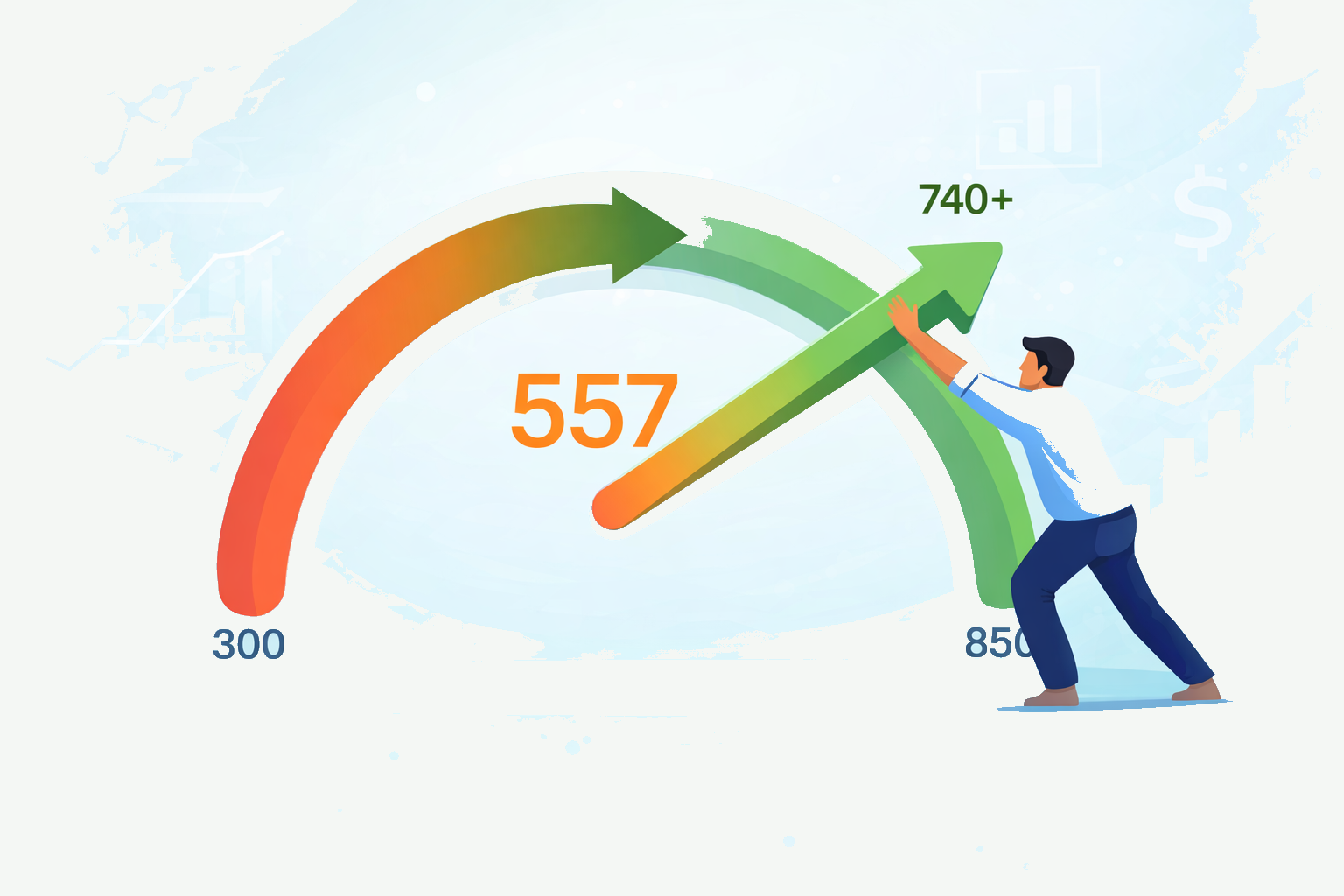
If you are trying to go from the 500s to the 700s, collections can feel like an anchor that never stops dragging.
That is why this topic is so confusing. Some people say "never pay a collection." Others say "pay everything immediately." Both are incomplete. The right move depends on:
- whether the collection is accurate
- whether it is medical or non-medical
- whether your target lender uses FICO 8 or a newer model
- whether the debt is owned by the original creditor or a collection company
- whether you can negotiate deletion or only a zero balance
A single collection can be brutal. On an otherwise cleaner file, a new collection can easily function like a 75–100+ point hit. And once it lands, the collection can stay on your report for 7 years from the date of first delinquency, not from the date the collector bought it. That detail matters because consumers often think the 7-year clock restarts when the debt is sold. It does not.
The good news is that improving your credit score with collections is not impossible. It just requires the right order of operations. For more context on how collections interact with other credit issues, visit the Troubleshooting hub.
The scoring-model shift: why your lender matters more than your feelings
If you want the single most important fact in this article, it is this:
Paying a collection helps some score models a lot more than others.
That is why two consumers can both pay a collection and get totally different results.
How FICO 8 vs FICO 9 Models Treat Paid Collections
| Model | Paid Collections | Unpaid Collections | Medical Debt |
|---|---|---|---|
| FICO 8 | Usually still hurts if original balance was over $100 | Hurts | No special model-level forgiveness beyond bureau reporting changes |
| FICO 9 | Ignored when paid | Hurts | Paid medical collections do not report; medical treated more leniently |
| FICO 10 / 10 Suite | Ignored when paid | Hurts | Similar logic to FICO 9 for paid collections |
| VantageScore 3.0 / 4.0 | Ignored when paid | Hurts if unpaid | Paid collections ignored; medical debt treated more favorably |
This is the key practical meaning:
- If your lender uses FICO 8, paying a collection may do little for your score unless it is deleted.
- If your lender uses FICO 9, FICO 10, or VantageScore 3.0+, paying can help more because paid collections are ignored.
That is also why the phrase "paying collections helps credit" is only half true. It helps on the right model.
One six-profile test often cited in the industry found an average improvement of about 31.2 points under FICO 9 and about 38 points under VantageScore after paying collections. That is useful directional evidence, not an official lender guarantee, but it aligns with how those models are designed to treat paid collections.
2026 medical debt rules: this part changed a lot
Medical debt needs its own playbook.
What still matters in 2026:
- The three major bureaus removed medical collections under $500 in April 2023
- Paid medical collections are not reported by the big three bureaus
- A broader CFPB medical-debt rule was overturned in 2025
- Maryland and Oregon now have strong state-level protections against medical debt appearing on credit reports
That means many people should not start by negotiating medical collections the same way they would negotiate a phone bill or utility collection.
If the medical collection is:
- Under $500 — it should not be there
- Already paid — it should not be there
- In a state with stronger protections — check state law first
- Over $500 and unpaid — negotiate, settle, or pay strategically
For medical debt, the first question is often not "should I pay?" It is "should this even be reporting?"
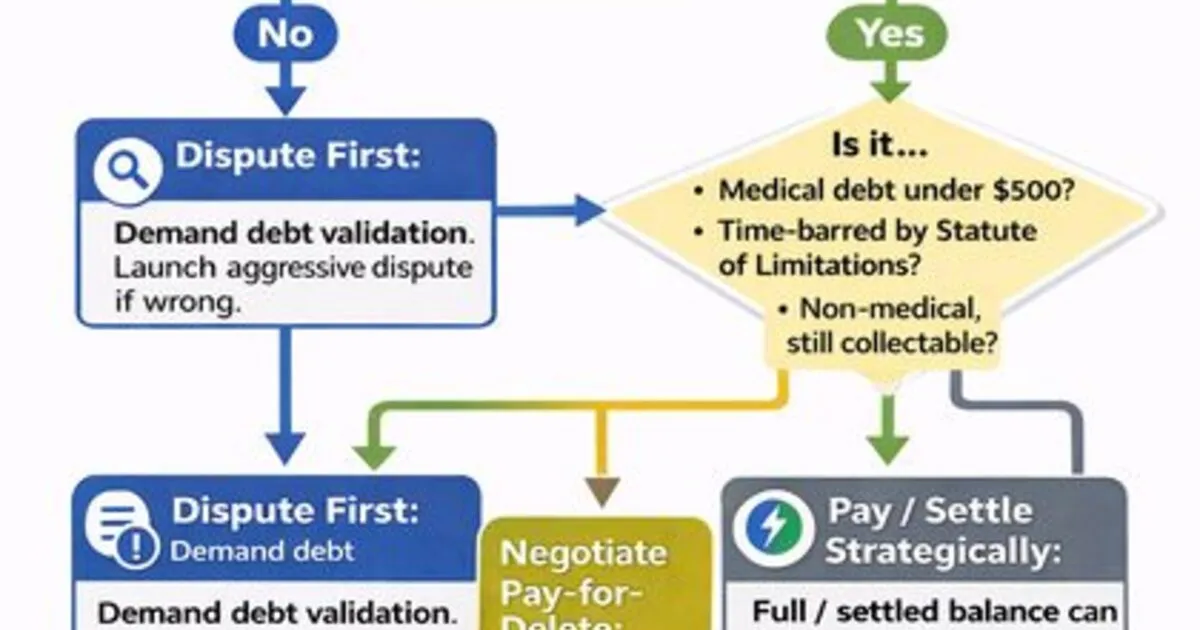
Pay vs dispute vs negotiate vs wait: the decision flowchart
This is the missing practical framework most collection articles do not give.
Step 1: Is the collection accurate?
No — Dispute it first. See our credit dispute guide.
Yes — Go to Step 2.
Step 2: Is it medical debt under $500?
Yes — It should not be there; dispute the reporting.
No — Go to Step 3.
Step 3: Is it already paid?
Yes — If the lender uses a newer model, the score impact may already be reduced. Decide whether you care more about underwriting optics or full deletion.
No — Go to Step 4.
Step 4: Is it a third-party collection or an original-creditor charge-off?
Third-party collection — Pay-for-delete or settlement may be worth trying.
Original creditor charge-off — Deletion is much harder; payment may still be necessary, but the negative history often remains.
Step 5: Which score model matters?
FICO 8 lender — Deletion matters more than simple payment.
FICO 9 / 10 / VantageScore — Payment can help more even without deletion.
Step 6: Is the debt old and relatively small?
Yes — Negotiation odds improve.
No — Still possible, but the collector may be less flexible.
Step 7: Do you need the score improvement within 3–6 months?
Yes — Resolve, delete if possible, then immediately rebuild.
No — You may have more options, including waiting and focusing on utilization and tradelines first.
How to raise your score from the 500s to the 700s
If your score is in the 500s, the collection is usually not the only problem. Most 500-range files also have one or more of the following:
- high utilization
- thin or weak revolving history
- recent late payments
- charge-offs
- too many derogatories relative to positive accounts
That means paying or settling the collection may be necessary, but it is only the first phase.
The path from the 500s to the 700s usually looks like this:
- Dispute anything wrong
- Resolve valid collections strategically
- Lower utilization hard
- Add clean positive revolving history
- Let time work for you
That last step is where many people fail. They pay the collection, then wait, hoping the score will magically jump to 720. It usually will not. Once the collection is handled, the next move is rebuilding. For a realistic look at how long this takes, see credit recovery timelines.
Does paying off collections improve a score?
Sometimes, yes. Sometimes, barely. It depends on the model.
On FICO 8
Paid and unpaid collections are treated very similarly if the original amount was over $100. That means paying may help your underwriting story and reduce collection pressure, but the score change may be small.
On FICO 9, FICO 10, and VantageScore
Paid collections are generally ignored. That means paying can remove the score suppression once the account updates.
So the right answer is: paying off collections improves a score if the model rewards paid collections or if the account gets deleted.
How long after paying off collections does credit improve?
For ordinary reporting, a realistic expectation is 30–45 days for the new paid or settled status to update. Some updates happen faster, some slower.
But real rebuilding takes longer than one update cycle.
A useful framework is:
- Initial improvement: often 3–6 months
- Meaningful rebuilding: often 12–24 months
- Final fall-off of the collection: by 7 years from original delinquency
Score recovery is not just about whether the account changes to paid. It is about what happens after that: lower balances, zero new late payments, new clean tradelines, and aging of the derogatory mark.
Timeline projection: what recovery can look like
This table is a planning guide, not a promise.
| Starting Score | 6 Months | 12 Months | 18 Months | 24 Months |
|---|---|---|---|---|
| 500–550 | 560–620 | 610–670 | 650–710 | 680–740 |
| 550–600 | 600–650 | 650–700 | 680–730 | 700–750 |
| 600–650 | 630–680 | 670–720 | 700–740 | 720–760 |
These ranges assume the collection issue is handled correctly, utilization is brought under control, no new major derogatories appear, and the consumer adds positive history and lets time pass.
Paying collections alone rarely gets you to 700+. It helps create the conditions for rebuilding, but positive data still has to be added afterward.
How collection agencies affect your score and for how long
Collections are one of the heaviest negative items that can appear on a credit report.
A single collection can:
- Drop a healthier file by 75–100+ points
- Stay on the report for 7 years
- Hurt most in the first 12–24 months
- Gradually lose sting over time if no new negatives appear
This is why consumers feel stuck. The mark lasts a long time, and paying it does not always instantly remove the damage. But the severity is front-loaded. A recent collection hurts more than an older one. That means time is part of the repair plan whether you like it or not. Understanding how charge-offs work can also clarify how these negative marks interact.
Should you dispute or pay a collection?
Use the simplest rule possible:
- Dispute first if it is inaccurate, duplicated, outdated, already paid, or nonreportable medical debt.
- Pay or settle first if it is accurate, collectible, and you need to stop collection risk or qualify for lending.
- Negotiate deletion if it is a third-party collection and the collector is flexible.
- Wait cautiously only if the debt is very old, likely time-barred, and you fully understand the legal and credit tradeoffs.
If you are not sure who owns the debt, do not guess. Ask. It matters whether the original creditor still owns it or whether the debt has been sold.
Should you pay a debt in collections?
Usually yes, but for the right reason.
Good reasons to pay:
- The lender you care about uses a model that rewards paid collections
- You need to stop collection activity
- You need underwriting stability
- You can negotiate deletion
- You want a zero balance on the report even if the item remains
Bad reason to pay: you assume every paid collection automatically boosts every score. That assumption is wrong. Payment is sometimes a scoring move, sometimes a legal-risk move, and sometimes just a cleanup move.
Is it better to pay the original creditor or the collection company?
If the original creditor still owns the debt, paying them can be cleaner.
But once the debt has been sold, you generally need to deal with the new owner or collection agency. That is why your first question should be: who actually owns this debt right now?
The answer changes who can settle it, who can delete it, who can update the report, and who can be negotiated with.
If a collection is disputed and removed, can it show back up?
Yes, it can. If the furnisher later verifies the debt properly, the collection may be reinserted. That does not mean disputes are useless. It means removal is strongest when the account was genuinely inaccurate or nonreportable in the first place.
So if a collection disappears after a dispute, do not assume it is dead forever unless you know why it was removed.
Collections action plan: step by step
- Pull all three reports. Identify every collection, who owns it, and whether it is medical or non-medical.
- Classify each item. Accurate or inaccurate, paid or unpaid, original creditor or third-party collection, under $500 medical or not.
- Match the score model to your goal. Mortgage, auto, credit card, rental — which model is likely to matter?
- Dispute what is wrong. Especially duplicates, nonreportable medical debt, wrong balances, and identity errors.
- Negotiate what is accurate. Settle, pay, or pursue pay-for-delete where appropriate.
- Lower utilization aggressively. Collection cleanup alone is not enough.
- Rebuild with positive tradelines. Once the collection situation is stabilized, adding clean history accelerates recovery instead of waiting passively.
- Track progress over 24 months, not just 24 days. Initial recovery often starts in 3–6 months, meaningful rebuilding in 12–24 months.
The bottom line
Whether paying collections helps credit depends on which scoring model your lender uses.
- If the collection is wrong, dispute it.
- If it is medical under $500, it should not be there.
- If it is accurate, paying may help under FICO 9, FICO 10, and VantageScore 3.0+, but may do little under FICO 8 unless you get deletion.
- If you want to go from the 500s to the 700s, paying collections is often necessary — but rarely sufficient by itself.
The CFPB explains what debt collectors can and cannot do, which is essential reading if you are navigating active collections.
Get Your Personalized Credit Roadmap
Upload your credit report and our Credit Analyzer identifies exactly what is holding your score back and gives you a step-by-step 90-day plan to reach 740+.
Trusted by 500+ successful placements and excellent reviews on TrustPilot ★★★★★
Analyze My Credit Free →