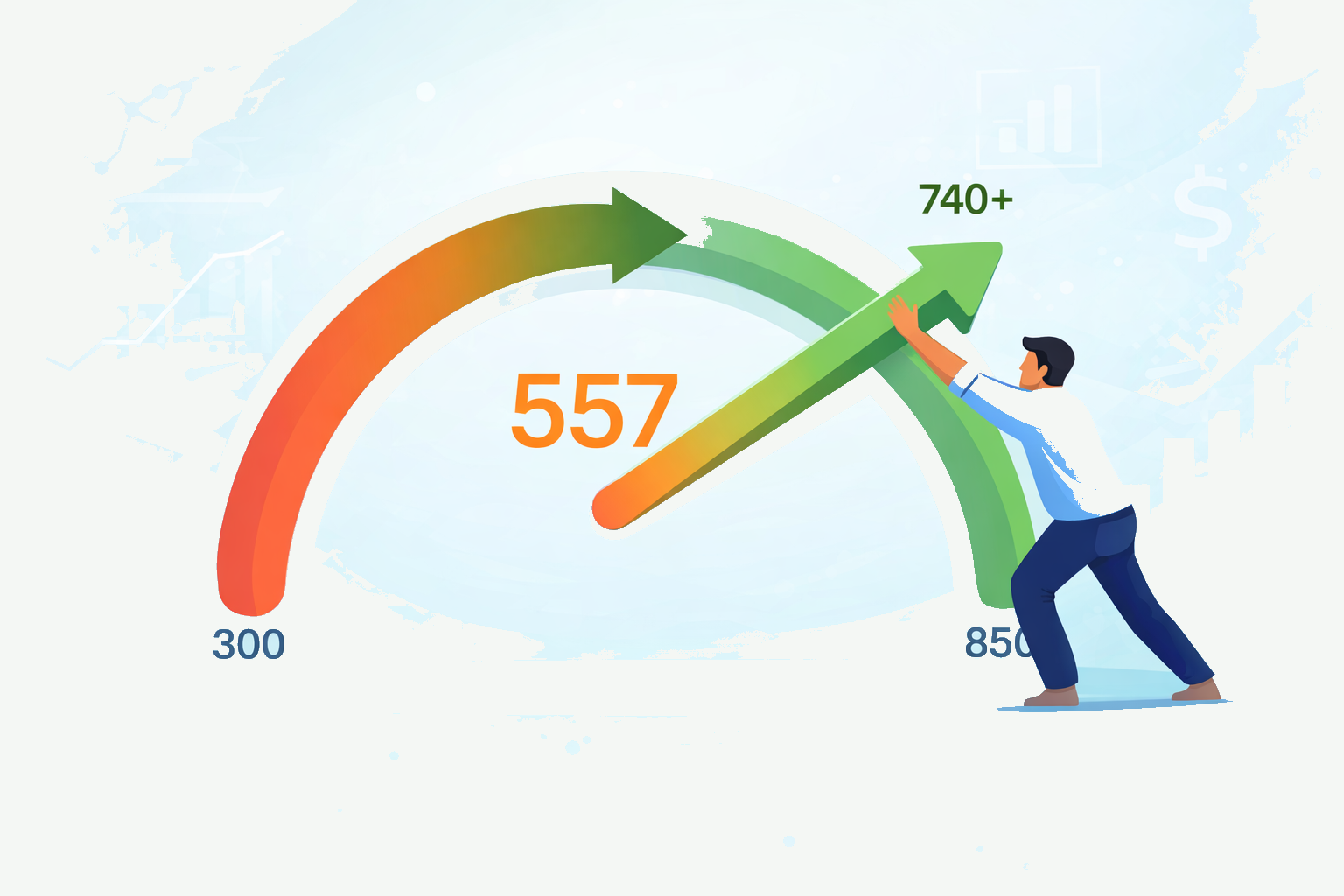
Yes, you can improve your credit score in 30 days. A 100-point jump is possible. But it only happens under the right conditions.
A 30-day credit push works best when your score is being held down by something that can actually move in one billing cycle — especially:
- maxed-out or near-maxed-out credit cards
- meaningful credit-report errors
- a thin or very young file that can benefit from authorized-user help
- a mortgage file where a lender can run a rapid rescore
It works much less well when the score problem is:
- recent severe late payments
- collections that are accurate and still unpaid
- charge-offs
- bankruptcy damage
- a mature file that is already fairly optimized
That is why the best answer is not just "use every hack." The best answer is: know which lever actually drives your score down, then hit that lever first.
Realistic expectations: what can you really gain in 30 days?
This is the part most articles either oversell or ignore.
| Starting profile | Main problem | Realistic 30-day gain |
|---|---|---|
| 500–580 | Maxed cards / 90%+ utilization | 60–100+ points |
| 550–620 | Major report errors or duplicate collections | 40–80+ points |
| 600–650 | Thin or short file | 20–60 points |
| 650–720 | Good file but balances too high | 20–50 points |
| Any range | Recent severe delinquencies or charge-offs | Usually much less |
A 100-point jump in 30 days is possible if your score is being artificially suppressed by utilization or a major error. It is much less realistic if the file is damaged by legitimate recent derogatories.
A 160-point jump can happen, but it is an outlier. Those cases usually involve a perfect storm: maxed cards paid down aggressively, errors removed, or multiple score suppressors fixed at once. Treat those stories as exceptions, not planning assumptions.
Ranked: the fastest ways to improve your score in 30 days
1. Pay down revolving utilization below 10%
Expected points: 60–100+ on highly utilized files
Timeline: 1 billing cycle
Cost: Whatever it takes to pay down balances
This is usually the single fastest legitimate move.
A lot of advice still says "keep utilization under 30%." That may be enough to avoid looking risky, but it is not how you maximize score in a short window. The most practical scoring target is to get overall utilization into the low single digits or at least under 10%, with many optimization plans aiming around 1%–7% rather than 30%.
Why this works so fast:
- utilization is about 30% of a FICO Score
- utilization has no long memory in classic FICO 8
- when the new lower balance reports, the score can move quickly
If you take cards reporting 90%+ usage and bring them under 10%, the score swing can be dramatic in one cycle. For a deeper look at the math, see the utilization sweet spot.
2. Dispute meaningful report errors
Expected points: 25–100+ if the error is real and important
Timeline: often 10–30+ days
Cost: Free
This is where "fix credit fast" becomes real. If your report is wrong, you do not need a trick. You need a correction.
Examples of fast-moving errors:
- duplicate collections
- wrong late payments
- wrong balances
- mixed-file accounts
- collection accounts that should not still be reporting
This is also one of the few strategies where the point gain can be large and legitimate. But it only works if the item is actually wrong. Disputing accurate information does not create points just because you want them. For a full walkthrough, read our credit dispute guide.
3. Use rapid rescore if you are in a mortgage file
Expected points: depends on what changed
Timeline: 2–5 business days
Cost: usually lender-handled, often roughly $25–$50 per account per bureau in industry practice
Rapid rescore is one of the most misunderstood fast-score tools. It is not something you order directly. It is usually a mortgage-lender tool used after you paid down cards, paid off debt, or corrected a report issue and need the new data reflected quickly for mortgage underwriting.
Rapid rescore does not create extra points by itself. It speeds up the reporting of real positive changes. That makes it one of the best last-mile tools if you are close to approval or to a better pricing tier.
4. Add an authorized-user tradeline
Expected points: 20–100 on the right file
Timeline: typically 15–45 days in market practice
Cost: free through family, or paid if commercial
Authorized-user strategy is usually either oversold or dismissed. Both are wrong.
AU tradelines can help most when:
- your file is thin
- your oldest account is young
- the AU account is old, clean, and low-utilization
- you move early enough in the 30-day cycle
They help much less when the file is already thick, derogatories dominate the profile, or you expect a tradeline to override serious risk signals. The timing is the catch — if you need results in 30 days, this is only worth considering if you move immediately and the file is a strong fit.
5. Use Experian Boost
Expected points: about 13 on average
Timeline: often instant or near-instant
Cost: free
Experian Boost is real, but it is not magic. It can help some users by adding utility, telecom, and streaming payment history to Experian-based scoring. The average lift is modest. It is worth doing because it is free, but it should be treated as a side tactic, not the centerpiece of a 30-day improvement plan.
Its biggest limitations:
- it affects only Experian
- it mainly affects FICO 8 from Experian
- many mortgage lenders will not care
6. Optimize statement timing
Expected points: small to moderate depending on current balances
Timeline: same billing cycle
Cost: free
A lot of people pay before the due date and assume they are optimized. But what matters for score is often the statement balance, not just whether you paid before the due date.
If you want fast results:
- ask every issuer for the statement closing date
- pay down balances before that date
- do not assume paying after statement close will help this month
This is not a separate trick from utilization paydown. It is how you make utilization paydown show up on time. For a deeper explanation, see statement date vs. bureau update.
Can I raise my credit score 100 points in 30 days?
Yes, but only under the right conditions.
A 100-point jump is most realistic when:
- utilization is very high
- the file is thin and young
- a meaningful error gets removed
- you combine multiple high-impact moves
It is much less realistic when the report is accurate but heavily damaged, recent late payments are the main problem, collections and charge-offs remain unresolved, or the file is already fairly optimized.
So the best way to think about this question is not "Can anyone do it?" It is "What exact thing is suppressing my score right now?"
How much will paying off my credit card raise my score?
This depends mostly on how high the utilization was before you paid it down.
- If a card goes from 95% usage to 5%, the score impact can be huge.
- If a card goes from 45% to 5%, the improvement can still be meaningful.
- If a card goes from 8% to 0%, the change may be much smaller and not always better than letting one small balance report.
A good working rule: the more maxed-out the card was, the more cards were highly utilized, and the cleaner the rest of the file is — the bigger the score jump tends to be. That is why utilization fixes often outperform almost everything else in 30-day plans.
Is it possible to fix credit in 30 days before applying for a mortgage?
Yes, sometimes. This is actually one of the most realistic 30-day use cases.
Mortgage applicants often have a known target score, a lender helping them, a short window, and a reason to optimize fast. That is where a combination of utilization paydown, rapid rescore, error correction, and sometimes AU optimization can be very effective.
But mortgage timing also makes mistakes more expensive. If you are applying soon, avoid:
- random new accounts
- unnecessary hard inquiries
- letting cards report high balances
- assuming Boost or AU strategy will solve a deeply damaged file
Day-by-day 30-day action plan
Day 1–7: Audit and triage
- Pull all three reports
- List every revolving balance, limit, due date, and statement date
- Identify real errors
- Turn on Experian Boost if useful
- Decide whether your biggest problem is utilization, errors, or both
Day 8–14: Execute the biggest moves
- Pay all revolving balances down before statement close
- Submit disputes for real errors only
- If you are in a mortgage file, tell your lender what changed
- If AU strategy makes sense, this is the latest point you should act fast
Day 15–21: Watch reporting and timing
- Confirm new statement balances reported
- Track disputes and document responses
- Keep all utilization low
- If needed, line up rapid rescore with your mortgage lender
Day 22–30: Lock in the gains
- Recheck your reports and scores
- Avoid new hard inquiries unless it is the actual target application
- Keep balances low through the lender pull
- Prepare your application once the improved data is visible
Bottom line
If your goal is to improve your credit score in 30 days, here is the priority order:
- Pay down utilization first — this is the fastest major lever
- Fix real errors second — free and potentially high-impact
- Use rapid rescore only if you are in a mortgage file
- Use AU tradelines only if your file is thin and timing still works
- Use Experian Boost only as a small extra
A 100-point increase is possible, but usually only when you are correcting something big and fixable — especially maxed-out cards or meaningful report errors. That is the realistic version of "fix credit fast." It is not magic. It is math, timing, and picking the right lever.
For more fast-score strategies, see how to boost your credit score fast. For a broader view of all troubleshooting strategies, return to the Troubleshooting hub.
Get Your Personalized Credit Roadmap
Upload your credit report and our Credit Analyzer identifies exactly what is holding your score back and gives you a step-by-step 90-day plan to reach 740+.
Trusted by 500+ successful placements and excellent reviews on TrustPilot ★★★★★
Analyze My Credit Free →