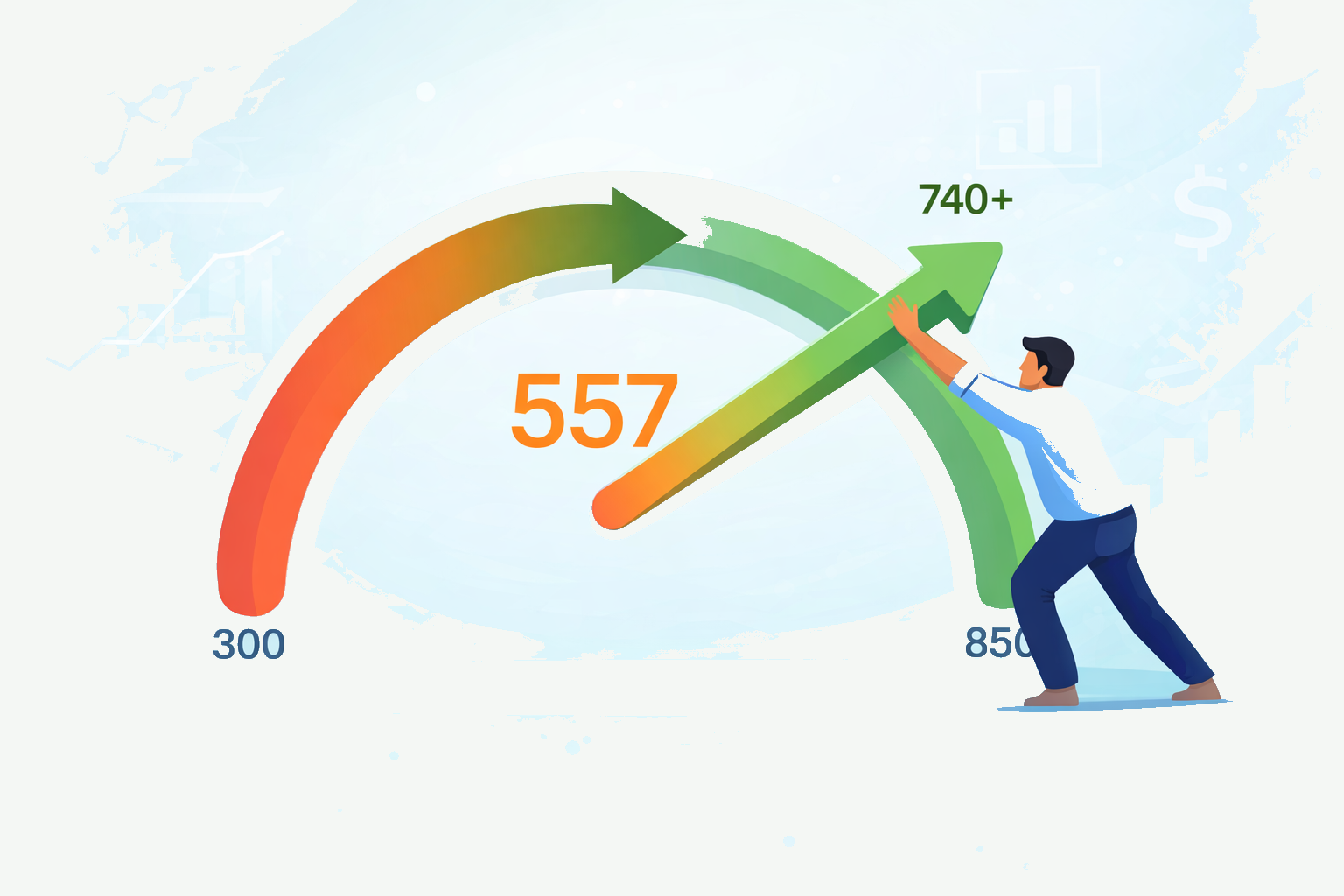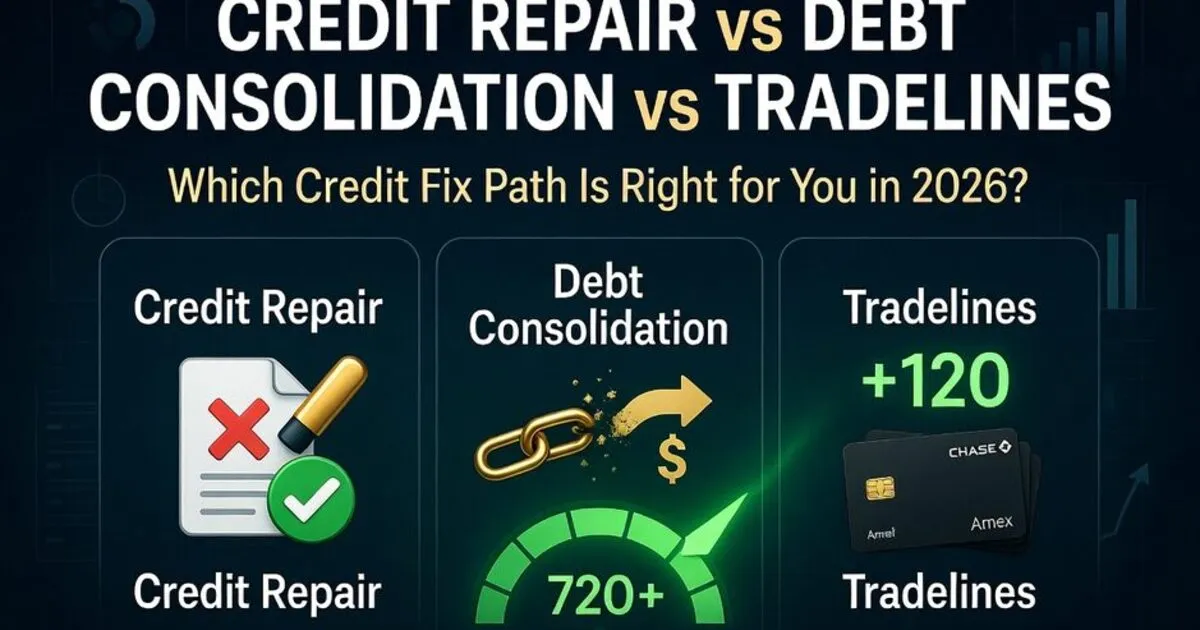
When you are trying to improve your credit score, the sheer volume of conflicting advice can be paralyzing. One company pitches credit repair as the answer. Another forum swears by tradelines. A third says debt consolidation is the only real fix. The truth is that none of these paths are inherently "better" — they are different tools that solve entirely different problems. Choosing the wrong one for your situation wastes money. Choosing the right combination, in the right order, is what separates consumers who spend years stuck in the 500s from those who reach 700+ in under a year.
Most guides compare only two of these options at a time, leaving you to guess how the third fits in. This article compares all three side by side — with real costs, timelines, limitations, and a decision framework — so you can map out a plan based on what is actually on your credit reports right now. For a broader view of troubleshooting strategies, visit the Troubleshooting hub.
The correct order of operations
This is the most important section of this article. Getting the sequence wrong is the number one reason consumers waste thousands of dollars with minimal score improvement.
Step 1 — Dispute and remove errors (Credit Repair). You must stop the bleeding first. If your score is suppressed by inaccurate data — a duplicate collection, an on-time payment marked late, an account that is not yours — no other strategy will deliver full results until those items are addressed. Review our complete credit dispute guide to start this process yourself for free.
Step 2 — Pay down balances and manage existing debt (Debt Consolidation). Once your report is clean, address the roughly 30% of your FICO score driven by credit utilization. If you are carrying high balances across multiple high-interest cards, you need a strategy to reduce that debt load. This is where consolidation — whether a personal loan, balance transfer, or debt management plan — becomes the right tool.
Step 3 — Strategically add positive history (Tradelines). Only after Steps 1 and 2 are complete should you add new data to your credit file. If your score is still held back by a thin file, short average account age, or limited credit mix, an authorized user tradeline delivers massive leverage on an already-clean foundation. To understand the math behind this, read our guide on how AU tradelines affect your score.
Skipping steps or starting out of order is like adding a fresh coat of paint to a house with a cracked foundation. The paint looks good for a week, then the cracks show through.
Side-by-side comparison
| Feature | Credit Repair | Debt Consolidation | Tradelines (AU) |
|---|---|---|---|
| What it fixes | Inaccurate negatives (errors, collections, late payments) | High debt load, multiple payments, high interest rates | Thin file, short history, low credit mix |
| How it works | Disputes inaccurate items under FCRA with the three bureaus | New loan or nonprofit DMP combines debts into one payment | You are added as an authorized user on a seasoned credit card |
| Cost | $50–$150/month with a company, or DIY for free | Loan interest (7–36% APR); DMP fees $25–$50/month | $150–$4,000+ per tradeline |
| Timeline | 1–6+ months | 3–5 years (DMP); 2–5 years (loan payoff) | 15–45 days to post |
| Score impact | Variable — removes score penalties (30–120 points if errors exist) | Moderate — gradual improvement as utilization drops | Fast — 20–100+ points on a clean profile |
| Limitations | Can only remove inaccurate information — not legitimate negatives | Consolidation loans typically require 670+ FICO to qualify | Boost is temporary (30–90 days for purchased AUs); some lenders discount AU accounts |
| DIY possible? | Yes — free dispute letters | Partially — you can negotiate directly with creditors | No — requires a tradeline provider |
| Best for | Profiles with collection errors, duplicate debts, or misreported late payments | Consumers with unmanageable debt, high utilization, and a score above 670 | Thin files, short histories, or consumers needing a fast boost for an imminent approval |
Credit repair is surgical (removes damage). Debt consolidation is organizational (manages debt). Tradelines are additive (builds positive history). The consumers who get the best results use all three in sequence.
Cost breakdown: what you will actually pay
| Option | Low End | High End | Total Typical Spend |
|---|---|---|---|
| DIY Credit Repair | $0 (online disputes) | ~$8/letter (certified mail) | $0–$50 |
| Hired Credit Repair | $50/month + $50 setup | $150/month + $300 setup | $200–$1,500 over 3–6 months |
| Debt Consolidation Loan | 7% APR (good credit) | 36% APR (subprime) | Interest over loan term |
| Balance Transfer Card | 3% transfer fee | 5% transfer fee | $300–$500 on $10K balance |
| Debt Management Plan | $25/month + $0 setup | $50/month + $75 setup | $1,200–$2,400 over 3–5 years |
| Debt Settlement | 15% of enrolled debt | 25% of enrolled debt | $4,500–$7,500 on $30K debt + severe credit damage |
| Tradelines (AU) | $150 (young account) | $4,000+ (15+ year premium) | $500–$2,500 for 1–3 lines |
Tradelines carry the highest upfront cost but deliver the fastest visible results — weeks instead of months or years. DIY credit repair is free but requires your time. Debt settlement is the costliest when you factor in the credit damage.
Which path is right for you? Decision framework
Answer these five questions in order to find your starting point.
1. Are there inaccurate items, duplicate collections, or misreported payments on your credit reports?
If yes: Start with credit repair. Nothing else will deliver full results until errors are removed. Even one erroneous collection can suppress your score by 50 to 100 points.
If no: Move to Question 2.
2. Is your credit card utilization above 30%, or do you have high-interest debt spread across multiple accounts?
If yes: Prioritize debt consolidation — a personal loan, balance transfer, or DMP to reduce balances and lower your utilization ratio.
If no: Move to Question 3.
3. Is your credit file thin (fewer than 3 open accounts) or young (average age under 2 years)?
If yes: Add tradelines strategically. Your profile needs the weight of seasoned account history to generate a stronger score.
If no: Move to Question 4.
4. Do you have a specific approval deadline within 30 to 90 days (mortgage, auto loan, lease)?
If yes: Tradelines provide the fastest boost (15–45 days), but only on a reasonably clean profile. Pair with a rapid rescore through your lender if available.
If no: Move to Question 5.
5. Is your debt-to-income ratio too high to qualify for new credit?
If yes: Debt consolidation or a DMP must come first. No amount of credit repair or tradeline boosting overcomes a DTI that exceeds lender thresholds (most mortgage lenders cap at 43–50%).
If you answered yes to multiple questions, the winning path is almost always a hybrid: repair → consolidation → tradelines, executed in that order.
Credit repair vs credit counseling: know the difference
This is one of the most common mix-ups in credit education, and confusing the two can send you down the wrong path entirely.
Credit repair companies are for-profit businesses that dispute inaccurate items on your credit reports. Under the Credit Repair Organizations Act (CROA), they cannot charge fees before performing services, must provide a written contract, and must give you three days to cancel. Credit repair addresses what is reported about you — not what you owe.
Credit counseling agencies are typically nonprofits certified by the NFCC or FCAA. They review your full financial picture and may enroll you in a debt management plan that consolidates payments and negotiates lower interest rates with your creditors. Initial consultations are usually free; DMP fees run $25 to $50 per month.
The distinction matters: if your problem is errors on your report, you need repair (or DIY disputes). If your problem is unmanageable debt, you need counseling. Many consumers need both — just in the right order.
Credit repair or tradelines — which comes first?
Always credit repair first. Disputing and removing inaccurate negatives creates a clean foundation so that positive tradeline data has maximum scoring impact. Adding tradelines to a report full of errors and collections is like planting flowers in a yard full of weeds — the weeds choke out the benefit.
The correct sequence: dispute errors → pay down utilization → then add tradelines.
Can you do credit repair and tradelines at the same time?
Yes — and for consumers on a tight timeline, it is often the optimal strategy. You can dispute errors while simultaneously adding an authorized user tradeline. The tradeline begins reporting while disputes are processing through the bureau's 30-day investigation window. In this scenario, you may see two separate score bumps: one when the tradeline posts and another when disputed items are removed.
The only caveat: running both in parallel slightly reduces the tradeline's initial impact because the negative items are still present during the first scoring cycle. If time allows, sequential execution (repair first, tradelines second) delivers the cleanest results.
Is debt settlement worth it?
Debt settlement — negotiating with creditors to accept less than the full balance, typically 40 to 60 cents on the dollar — almost always damages your credit. The settled account gets reported as "settled for less than full balance," a notation that stays on your reports for seven years and can drop your score by 50 to 100+ points. Settlement companies typically charge 15 to 25% of the enrolled debt on top of the credit damage.
Debt settlement should be considered only as a last resort when you cannot afford full payments and the alternative is bankruptcy. If you have any other viable option — consolidation loan, DMP, even a payment plan negotiated directly with the creditor — pursue that first.
Practical tips most guides skip
DIY disputes are free and often just as effective as paid services for straightforward errors. The bureaus do not care whether a dispute comes from you or a company — they follow the same FCRA investigation process either way.
Tradelines are a bridge, not a destination. Purchased AU tradelines provide a temporary boost (30–90 days). Use that window to apply for your own accounts — a secured card, a credit-builder loan — that will build permanent history under your name.
Debt consolidation loans require a 670+ score to get competitive rates. If you are below that threshold, you may need credit repair or tradelines first to qualify for a consolidation loan with rates that actually improve your situation.
Never pay for "guaranteed" removal of accurate negatives. No one can legally guarantee removal of information that is correctly reported. Any company making that promise is violating CROA and is likely a scam.
FICO 10 and newer scoring models reduce the weight of AU tradelines. Tradelines still work, but their impact is strongest on FICO 8 and earlier models, which most lenders still use for mortgage, auto, and credit card decisions in 2026. For more on fast score strategies, see how to boost your credit score fast.
The bottom line
Credit repair vs debt consolidation vs tradelines is not an either/or decision — it is a strategic sequence. The consumers who see the fastest, most durable results follow the correct order: clean the report, reduce the debt, then add positive history. Skipping steps wastes money. Starting in the wrong place delays your goals. For a realistic timeline of what recovery looks like, see credit recovery timelines.
If you are unsure which combination is right for your score range and timeline, upload your credit report to our credit optimizer for a personalized action plan. You will get a prioritized roadmap showing exactly which steps to take, in what order, based on what is actually on your reports — not generic advice.
Get Your Personalized Credit Roadmap
Upload your credit report and our Credit Analyzer identifies exactly what is holding your score back and gives you a step-by-step 90-day plan to reach 740+.
Trusted by 500+ successful placements and excellent reviews on TrustPilot ★★★★★
Analyze My Credit Free →