If you recently formed an LLC and your personal credit is not perfect, you have probably asked: can I use tradelines to get business credit fast? The short answer is yes — but not in the way most people think.
The internet is full of misinformation blurring the lines between personal and business credit. You will find companies selling "business tradelines" that do not actually exist, forums claiming an LLC completely separates you from your personal credit history, and guides that skip the most critical piece: how personal and business credit actually connect in the eyes of a lender.
This guide debunks the myths, explains the exact distinction between personal and business tradelines, lays out a complete 12-month building timeline, and shows you how to use personal tradelines as a bridge to real business financing.
The "separate entity" myth — debunked
Many new business owners believe that because an LLC is a separate legal entity, their personal credit history becomes irrelevant. This is one of the most dangerous myths in business credit education.
While an LLC does protect your personal assets from business liabilities in a legal sense, it does not erase your personal financial history in the eyes of a lender. When a business is new — typically under two years old — it has no established financial track record. Banks and lenders mitigate their risk by evaluating the business owner directly. Your personal FICO score, debt-to-income ratio, and payment history are all part of the underwriting decision.
The hard truth: almost all small business funding requires a personal guarantee (PG). SBA loans mandate personal guarantees from anyone owning 20% or more of the business. Business credit cards from Chase, American Express, and Capital One all pull your personal credit during the application. Business lines of credit from banks and online lenders follow the same pattern, especially for businesses under two years old or with limited revenue history.
If you are asking "can I get business credit with bad personal credit," the answer is: you can get starter vendor credit, but securing actual bank loans, SBA financing, or high-limit business credit cards will be extremely difficult without a strong personal score. Your personal credit is the gatekeeper to your business credit journey.
The goal of business credit building is to eventually reach standalone funding with no personal guarantee — but that typically requires two or more years of strong payment history, $250K+ in annual revenue, and multiple primary business tradelines.
Personal vs business tradelines: the critical distinction
This is where most articles fail their readers. The terms "tradelines for business credit" and "business credit tradelines" get used interchangeably, but they refer to two completely different things.
Personal AU tradelines are authorized user accounts on someone else's personal credit card. When you purchase an AU tradeline, that account reports to your personal credit file — the one tied to your Social Security number — through the consumer bureaus. You cannot add an AU tradeline to an EIN. There is no mechanism for it. Any company claiming they can add tradelines directly to your business credit file is either confused or running a scam.
Business tradelines are vendor accounts, supplier credit lines, and business credit cards opened in your company's name using its EIN. These accounts report payment history to the business credit bureaus and build your company's credit profile over time. Business tradelines are not something you "buy" from a tradeline provider — you earn them by opening vendor accounts, using net terms, paying on time, and ensuring those vendors actually report to the bureaus.
| Feature | Personal AU Tradelines | Business Tradelines |
|---|---|---|
| Attached to | SSN (personal credit report) | EIN / DUNS (business credit report) |
| Reports to | Experian, Equifax, TransUnion | D&B, Experian Business, Equifax Business |
| How you get them | Added as authorized user on someone else's card | Open vendor accounts (Net 30) in company name |
| Effect on LLC | Indirect only (boosts personal score for PG loans) | Direct — builds PAYDEX, Intelliscore |
| Can you buy them? | Yes — pay to be added as AU | No — must be earned through trade relationships |
| Speed | 15 to 45 days to post | 30 to 90 days per tradeline to appear and age |
| Primary accounts required? | No (AU is secondary) | Yes — lenders want primary tradelines in business name |
| Cost | $150 to $4,000+ per line | Free to open (pay for products, not the credit line) |
Will buying personal AU tradelines help my LLC get a loan?
Yes — but indirectly. Because most business loans and credit cards require a personal guarantee, a poor personal credit score results in a denial regardless of how strong your business plan is. Adding high-quality personal AU tradelines can rapidly reduce your overall personal credit utilization and increase your average age of accounts, potentially boosting your personal score into the fundable range.
Most business lenders look for minimum personal credit scores in these ranges:
- Online alternative lenders: 580 to 620 minimum (higher interest rates)
- Credit unions and bank lines of credit: 650+
- SBA 7(a) loans: 640 to 680+ depending on the lender
- Equipment financing: sometimes as low as 550 to 580 if business tradelines are strong
By utilizing personal tradelines, LLC founders elevate their personal profile to a level where the lender feels comfortable issuing business credit.
Important caveat: Can you get funding with just authorized user tradelines? Almost never. Lenders have sophisticated underwriting processes. Most require one to three primary personal accounts (accounts you own, not AU accounts) open for at least 12 months. AU tradelines supplement your profile — they do not replace the need for your own credit history. Lenders will also evaluate your personal debt obligations, making understanding DTI critical before applying.
The bridge strategy: from personal to business credit
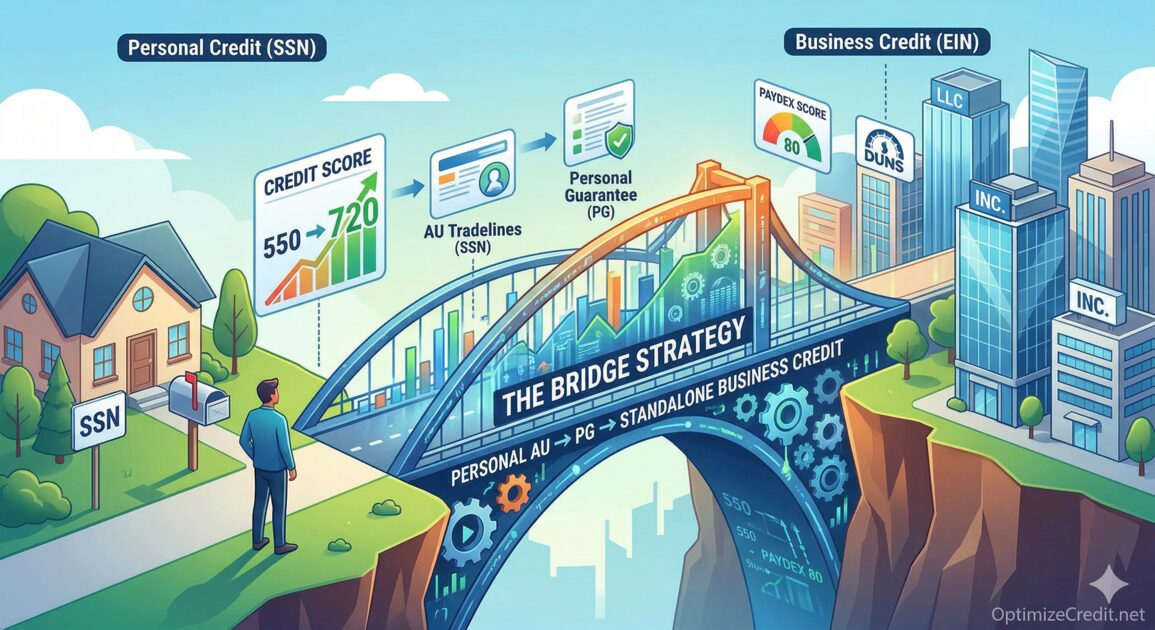
Because of the personal guarantee requirement, the smartest way to use tradelines is as a bridge — not a destination. Here is how the bridge works:
Stage 1 — Optimize personal credit. Add personal AU tradelines to boost your personal score above the lender's threshold. If your score is below 580, start with credit repair (dispute inaccurate items) before adding tradelines. If your score is 580 to 650, a well-chosen AU tradeline can push you into the qualifying range. If you are already above 650, you may not need this step at all. To understand how AU accounts affect different scoring models, read the AU tradeline effect guide.
Stage 2 — Leverage your personal score for business financing. Use your newly optimized personal credit to apply for entry-level business credit cards or lines of credit, signing a personal guarantee. This gets capital into your LLC and starts building your business credit profile — provided the issuer reports to business bureaus (not all do). American Express, Chase, and Capital One generally report business card activity to D&B and Experian Business.
Stage 3 — Build standalone business credit. Simultaneously open vendor accounts that report to business bureaus. Use them consistently, pay every invoice on time or early. Your PAYDEX score should begin populating after three to four reported payments.
Stage 4 — Graduate to no-PG financing. After 12 to 24 months of perfect business payment history, your business will have its own robust credit profile. At this point, some lenders will offer financing with reduced or no personal guarantee — typically requiring $250K+ in annual revenue, a PAYDEX of 80+, and multiple established business tradelines.
Step-by-step business credit building timeline
Month 1: Foundation
- Form or verify your entity. Ensure your LLC or corporation is legally registered and in good standing with your state.
- Get your EIN. Apply for free at irs.gov — takes five minutes online, instant approval.
- Get a DUNS number. Apply free at dnb.com — takes about 10 minutes to request. Standard processing can take up to 30 days; expedited processing is available for a fee.
- Open a business bank account. You must separate business and personal finances. Use your EIN, not your SSN, on the account.
- Set up a business phone number listed under your company name and ensure your business address is consistent across all registrations.
Months 1 to 2: Starter vendor accounts
Open two to three "Tier 1" vendor accounts that extend Net 30 terms and report to business credit bureaus. Make small, necessary purchases for your business and pay every invoice five to ten days early for maximum score impact.
Months 3 to 6: Scores appear
Your first business credit scores should populate in this window: D&B PAYDEX, Experian Intelliscore, and Equifax Business scores. Verify that your vendor accounts are actually reporting — not all vendors report consistently. If an account is not showing on your D&B file after 60 days, contact the vendor directly or submit them as a trade reference to D&B.
Once you have a PAYDEX score generated (usually requires at least three reporting tradelines), apply for an entry-level business credit card using your bridge strategy.
Months 6 to 12: Scale and finance
Add two to three more business tradelines, increase limits where possible, and keep utilization low. With six or more months of on-time payments, a PAYDEX of 75+, and a solid personal credit profile backing your guarantee, you can apply for business lines of credit, term loans, and SBA products.
Month 12+: Reduce personal reliance
Your business now has a foundation of five or more tradelines. Larger funding with better terms becomes available. The path to no-PG financing opens for businesses with strong revenue and payment history.
Vendor tradeline list: companies that actually report
Finding the right initial vendors is critical. Not all vendors report to business bureaus — using ones that do not is wasted effort. Here is a curated list of reliable Tier 1 vendors known to report payment history:
| Vendor | Reports To | Net Terms | Notes |
|---|---|---|---|
| Uline | D&B, Experian, Equifax | Net 30 | Shipping, packaging, janitorial supplies; easy for new businesses |
| Quill (Staples) | D&B, Experian, Equifax | Net 30 | Office supplies, electronics; often approves new businesses |
| Grainger | D&B, Experian, Equifax | Net 30 | Industrial and MRO supplies; may require trade references |
| Crown Office Supplies | D&B, Experian, Equifax | Net 30 | Office supplies, decor; $30 to $99 annual fee |
| Strategic Network Solutions | D&B, Experian | Net 30 | Technology products; reports to multiple bureaus |
| Summa Office Supplies | Equifax Business | Net 30 | $75+ minimum purchase |
| Staples Business Advantage | D&B | Net 30 | Office and tech; separate from consumer Staples account |
Start with two to three from this list. Diversify across bureaus so you build profiles at D&B, Experian Business, and Equifax Business simultaneously. Always verify current terms on their websites before applying — reporting policies can change.
Does a business loan affect your personal credit?
It depends on the loan structure. If you signed a personal guarantee — which you almost certainly did for any business loan under $350K — the lender can report the account to your personal credit bureaus. If the business defaults, it will appear on your personal credit report and damage your personal score.
Business credit cards add another layer of complexity. Most major issuers report the account to business bureaus routinely but only report to personal bureaus if the account becomes delinquent. However, some issuers — notably Capital One and Discover — report business card utilization to your personal credit report even when payments are current, which can affect your personal utilization ratio. Always check the issuer's reporting policy before applying.
Loans with no personal guarantee are reported only to business credit bureaus and do not affect your personal credit in either direction.
Risks, costs, and realistic expectations
Costs: Vendor accounts may have small annual fees ($0 to $99). Personal AU tradeline services have their own pricing ($150 to $4,000+ per line). Business credit cards and loans carry interest if you carry a balance.
Time: You can lay the foundation in 30 days, but generating a meaningful business credit score takes three to six months. Real financing eligibility — especially for larger amounts or favorable terms — takes 6 to 12+ months.
Personal liability: Early-stage financing almost always carries a personal guarantee. Plan for this reality rather than trying to avoid it.
Scams to avoid: Anyone promising "instant business credit," "add tradelines to your EIN," or "guaranteed approval regardless of credit" is selling fiction. Business credit is built through consistent payment history on legitimate trade accounts — there are no shortcuts.
The bottom line
Business tradelines — vendor accounts that report payment history — absolutely work. They are the proven, legitimate way to build PAYDEX, Intelliscore, and lender confidence in your company.
Personal authorized user tradelines do not work directly on business credit reports. But they are a smart bridge strategy when your personal score is the bottleneck preventing you from accessing personally-guaranteed business financing.
If you are an LLC owner with imperfect personal credit, the fastest path is usually: strengthen personal credit with AU tradelines, lock in two to three reporting vendor accounts immediately, use the resulting profile to access initial funding, then scale to standalone business credit over 12 to 24 months.
The businesses that get funded fastest are the ones that build on both tracks — personal and business — from day one, rather than waiting for one to mature before starting the other.
For credit professionals advising business clients on these strategies, see the credit strategy professionals guide. For a broader view of professional credit topics, return to the For Pros hub.
Tradelines That Actually Report
We focus on what actually moves credit scores: utilization, account age, and clean reporting. With 500+ successful placements and excellent reviews on TrustPilot ★★★★★, every tradeline is screened for reporting consistency before it is listed.